Figurative language in stories worksheet for Years 5–6: Word pictures in stories
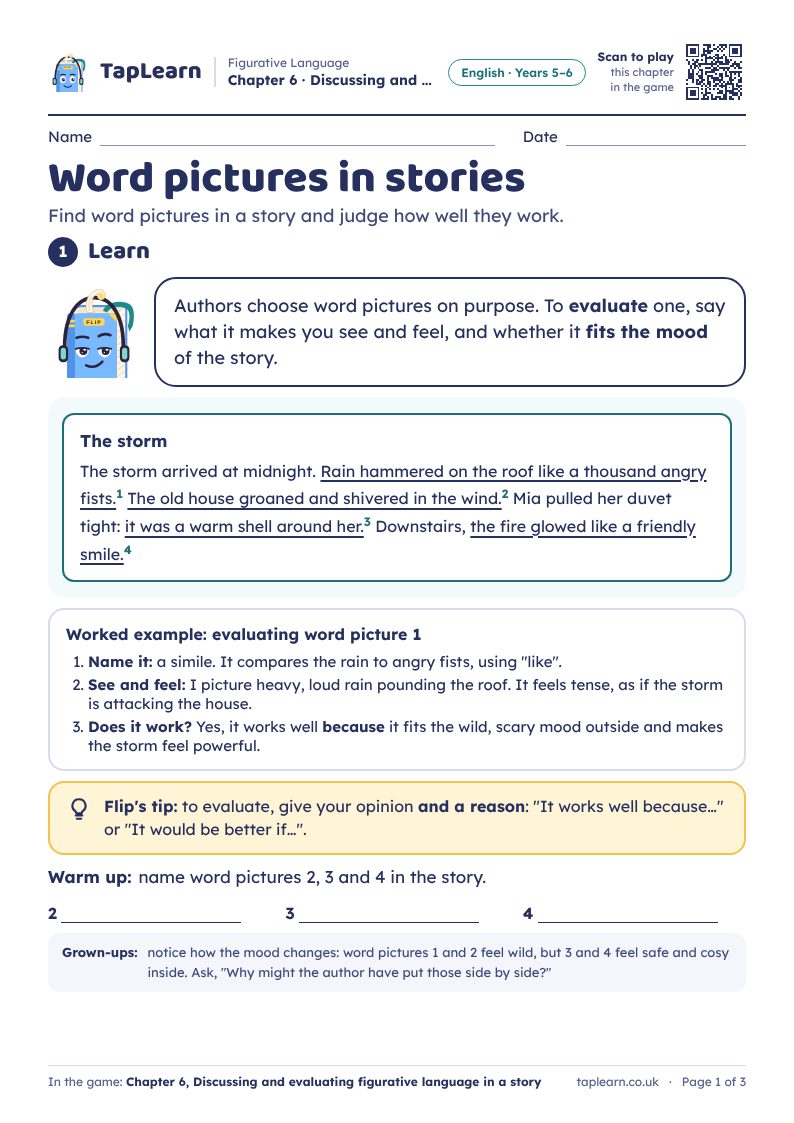
Word Pictures in Stories is a printable worksheet on figurative language in stories for Years 5 and 6 (ages 9 to 11) that teaches children to find similes, metaphors and personification in a story and judge how well they work. It covers the Years 5 and 6 English statement to discuss and evaluate how authors use language, including figurative language, considering the impact on the reader.
Free to print, no account needed.
Print it on A4, in colour or black and white. Do it after the chapter, or before it to see what your child already knows.
What's on the worksheet
Your child finds similes, metaphors and personification in short stories, explains their effect and judges which word pictures work for the mood. Includes a word picture award hunt in books from home and an answers sheet.
- Page 1 · Learn
- A short storm story with four word pictures, a worked example evaluating rain hammered like a thousand angry fists, Flip's tip on giving an opinion with a reason, and a warm-up.
- Page 2 · Try it together
- Word picture award: each hunt a book from home for a favourite word picture, say its kind and what it makes you see and feel, give it 1 to 3 stars and choose a winner together.
- Page 3 · Practise
- Find a simile, metaphor and personification in a beach story, explain one, fix a word picture that doesn't fit a scary mood, choose one for a bedtime story, and a challenge.
- Answers sheet
- Every answer, mix-ups like naming without evaluating, and an author's choice question for reading time.
3 A4 pages and an answers sheet · about 30 minutes
Using it at home
- In the word picture award, it's fine to disagree on the stars as long as each of you gives a reason from the words.
- Ask "Why might the author have put the storm outside and the cosy duvet inside side by side?"
- When reading, pick a word picture and ask "Why do you think the author chose that one?"
Watch out for
- Naming without evaluating, like 'it's a simile'.
- Ask "What does it make you see and feel? Does it work well here? Why?"
- Mixing up the three kinds.
- Like or as: simile. Says it is something: metaphor. A thing doing something human: personification.
- Missing the mood, like a giggling bulb in a scary cellar.
- Ask "How does the character feel? Does this match?"
Questions from the worksheet
- Read the story. Find one of each kind of word picture: simile, metaphor and personification.
- One word picture doesn't fit the mood. Ring it, then rewrite it to fit.
- Which works better in a calm bedtime story? The baby slept as peacefully as a still pond. / The baby snored like a roaring engine.
- Ava says, "More word pictures always make writing better. I'll put one in every sentence!" Do you agree? Why?
The answers are on the answers sheet, for grown-ups.
National curriculum in England
This worksheet practises this statement from the Years 5–6 english programme of study:
- Discuss and evaluate how authors use language, including figurative language, considering the impact on the reader
In the classroom
- Hold a class word picture award, with each group nominating one from their reading book and justifying it.
- Use Ava's challenge for a debate about how many word pictures a story needs.
Questions and answers
How do you evaluate figurative language in a story?
Name the word picture, say what it makes you see and feel, then judge whether it fits the mood and why: "It works well because…"
Do more similes and metaphors make writing better?
Not always. Too many can crowd a story. Writers choose a few that fit the mood and show something important.
Why do authors use figurative language?
Authors use word pictures on purpose to help readers see and feel what is happening and to build the mood of a story.
More worksheets from Similes and Metaphors: Paint Word Pictures with Quill
- Chapter 1: Literal and figurative language worksheet: Literal or word picture? Free
- Chapter 2: Similes worksheet: Spotting similes Free
- Chapter 3: Metaphors worksheet: Mighty metaphors Free
- Chapter 4: Personification worksheet: Things come alive Free
- Chapter 5: Effect on the reader worksheet: See it, feel it Free
 TapLearn