Effect on the reader worksheet for Years 5–6: See it, feel it
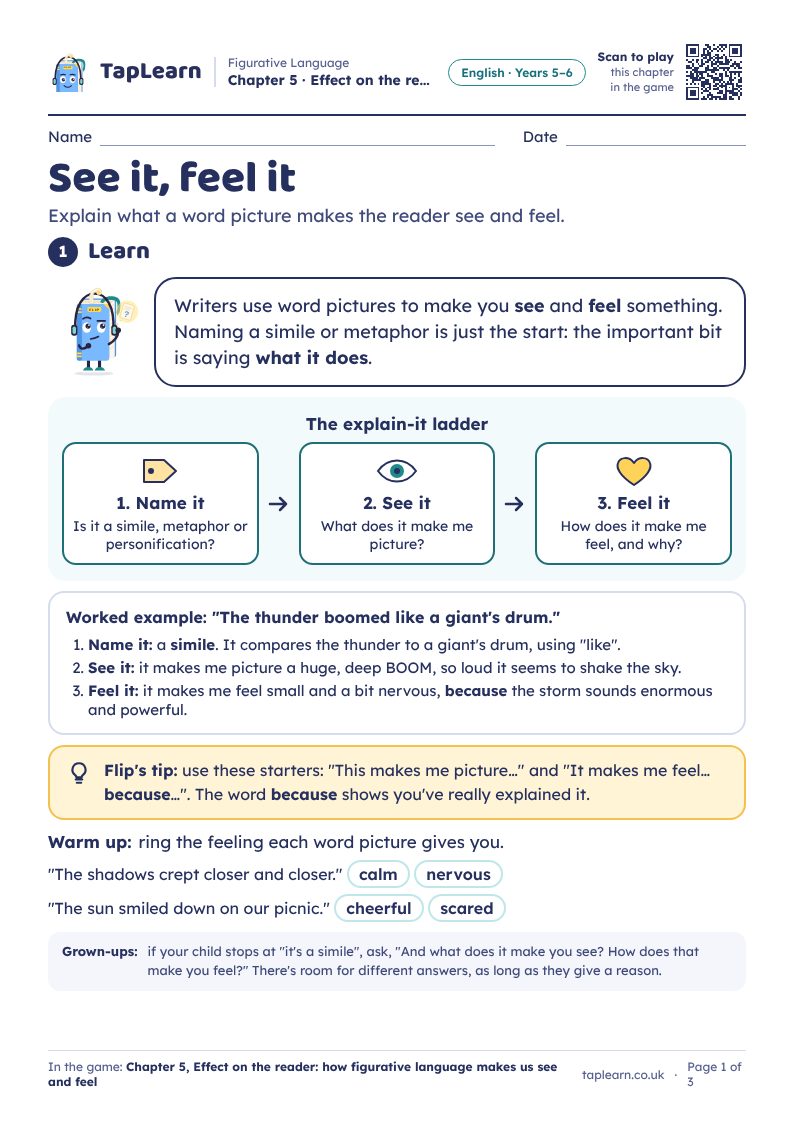
See It, Feel It is a printable effect on the reader worksheet for Years 5 and 6 (ages 9 to 11) that teaches children to explain what a word picture makes the reader picture and feel, and why. It covers the Years 5 and 6 English statement to discuss and evaluate how authors use language, including figurative language, considering the impact on the reader.
Free to print, no account needed.
Print it on A4, in colour or black and white. Do it after the chapter, or before it to see what your child already knows.
What's on the worksheet
Your child explains what similes, metaphors and personification make the reader picture and feel, and chooses word pictures that match the mood. Includes a feelings detectives hunt in a book from home and an answers sheet.
- Page 1 · Learn
- The explain-it ladder: name it, see it, feel it, worked through for the thunder boomed like a giant's drum, with sentence starters and a feelings warm-up.
- Page 2 · Try it together
- Feelings detectives: find three word pictures in a book from home, read each aloud with eyes closed, and say what you each see and feel and why. Then name word pictures S, M or P.
- Page 3 · Practise
- Explain the effect of two word pictures, ring the word picture that fits a spooky or sunny mood, choose which sentence paints the stronger picture, and a challenge about Leo's explanation.
- Answers sheet
- Every answer with model explanations, mix-ups like naming the technique only, and a mood switch activity.
3 A4 pages and an answers sheet · about 25 minutes
Using it at home
- There's room for different answers about how a word picture feels, as long as your child gives a reason from the words.
- Use the starters "This makes me picture…" and "It makes me feel… because…" when talking about books together.
- Describe the same room twice, once as cosy and once as creepy, using word pictures.
Watch out for
- Naming the technique only, like 'it's a metaphor'.
- Ask "What does it make you see? How does it make you feel, and why?"
- Explaining it as if it really happened.
- Ask what the two things have in common.
- Missing the mood, like a smiling sun in a scary scene.
- Ask "How is the character feeling here? Does the word picture match?"
Questions from the worksheet
- Name it: write S, M or P. The angry wind slammed the door. / Her smile was a ray of sunshine.
- Explain the effect: "The fog was a grey blanket." This makes me picture… It makes me feel… because…
- Ring the word picture that fits the mood best. A spooky wood at night: The trees stretched out bony fingers. / The trees waved a cheerful hello.
- Leo wrote: "'The wind howled like a wolf' is a simile." Has he explained the effect on the reader? Write a better explanation.
The answers are on the answers sheet, for grown-ups.
National curriculum in England
This worksheet practises this statement from the Years 5–6 english programme of study:
- Discuss and evaluate how authors use language, including figurative language, considering the impact on the reader
In the classroom
- Model the explain-it ladder with a word picture from a class reader, then have pairs climb it with another.
- Use the mood switch as a paired writing task: one cosy and one creepy description of the classroom.
Questions and answers
What does 'effect on the reader' mean?
It means what a word picture makes the reader picture and feel. Explaining the effect goes further than just naming a simile or metaphor.
How do you explain the effect of a simile?
Say what it makes you picture, then how it makes you feel and why. "It makes me feel small and nervous because the storm sounds enormous."
Why should figurative language match the mood?
A word picture that matches the mood strengthens it. A cheerful image in a scary scene would confuse the reader.
More worksheets from Similes and Metaphors: Paint Word Pictures with Quill
- Chapter 1: Literal and figurative language worksheet: Literal or word picture? Free
- Chapter 2: Similes worksheet: Spotting similes Free
- Chapter 3: Metaphors worksheet: Mighty metaphors Free
- Chapter 4: Personification worksheet: Things come alive Free
- Chapter 6: Figurative language in stories worksheet: Word pictures in stories Free
 TapLearn