Literal and figurative language worksheet for Years 5–6: Literal or word picture?
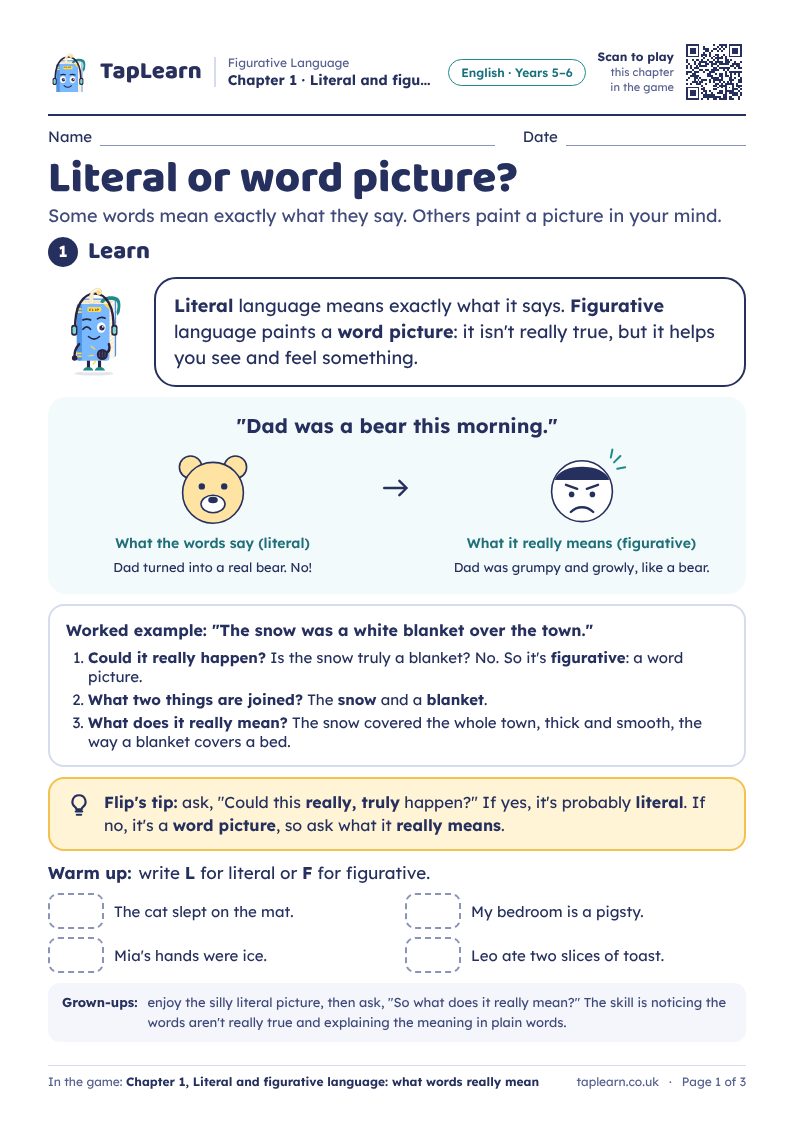
Literal or Word Picture? is a printable literal and figurative language worksheet for Years 5 and 6 (ages 9 to 11) that teaches children to tell words that mean exactly what they say from word pictures, and explain what a word picture really means. It covers the Years 5 and 6 English statement to discuss and evaluate how authors use language, including figurative language, considering the impact on the reader.
Free to print, no account needed.
Print it on A4, in colour or black and white. Do it after the chapter, or before it to see what your child already knows.
What's on the worksheet
Your child tells literal language from figurative language and explains what a word picture really means in plain words. Includes a silly-picture, real-meaning drawing game and an answers sheet.
- Page 1 · Learn
- Dad was a bear shown literally and figuratively, a worked example explaining the snow was a white blanket, Flip's could-it-really-happen tip, and an L-or-F warm-up.
- Page 2 · Try it together
- Silly picture, real meaning: the grown-up reads a word picture like time flew by, the child draws the silly literal version, then together you write what it really means.
- Page 3 · Practise
- Ring the figurative sentences, match word pictures to their meanings, explain and write word pictures, and a challenge about the sun smiled down on the beach.
- Answers sheet
- Every answer with model word pictures, mix-ups like taking word pictures literally, and spot-them and act-it-out ideas.
3 A4 pages and an answers sheet · about 25 minutes
Using it at home
- Ask "Could this really, truly happen?" for each sentence: if not, it's a word picture.
- When explaining a word picture, encourage your child to start "It means…" and use everyday words.
- Listen for word pictures in everyday chat, like "I'm starving" or "it's boiling", and say what they really mean.
Watch out for
- Taking word pictures literally, like thinking Dad grew fur.
- Ask "Could that really happen? So what is the writer telling us?"
- Calling plain sentences word pictures, like the cat slept on the mat.
- Ask "Is anything here not really true?" If it could all happen, it's literal.
- Explaining with the same words, like 'it means it was a zoo'.
- Encourage "It means…" in everyday words: it was noisy and wild.
Questions from the worksheet
- Draw a ring round each sentence that is figurative: The wind was a wolf, howling at the door. / Sam put his coat on the hook.
- Explain what this word picture really means: "Mum's patience was a thin thread."
- Turn this literal sentence into a word picture: The night was very dark.
- Sam says, "'The sun smiled down on the beach' is literal, because the sun really was shining." Is he right? Explain.
The answers are on the answers sheet, for grown-ups.
National curriculum in England
This worksheet practises this statement from the Years 5–6 english programme of study:
- Discuss and evaluate how authors use language, including figurative language, considering the impact on the reader
In the classroom
- Play act it out: one child says a word picture and a partner acts it out as if it were literally true.
- Use the warm-up as a quick sort on mini-whiteboards, writing L or F for each sentence.
Questions and answers
What is the difference between literal and figurative language?
Literal language means exactly what it says. Figurative language paints a word picture that isn't really true but helps the reader see or feel something.
What is a word picture?
A word picture is figurative language, such as a simile, metaphor or personification, that helps you imagine something by linking it to something else.
Can one sentence be both literal and figurative?
Yes. In "The sun smiled down on the beach", the sun really shone, but "smiled" is a word picture.
More worksheets from Similes and Metaphors: Paint Word Pictures with Quill
- Chapter 2: Similes worksheet: Spotting similes Free
- Chapter 3: Metaphors worksheet: Mighty metaphors Free
- Chapter 4: Personification worksheet: Things come alive Free
- Chapter 5: Effect on the reader worksheet: See it, feel it Free
- Chapter 6: Figurative language in stories worksheet: Word pictures in stories Free
 TapLearn