Personification worksheet for Years 5–6: Things come alive
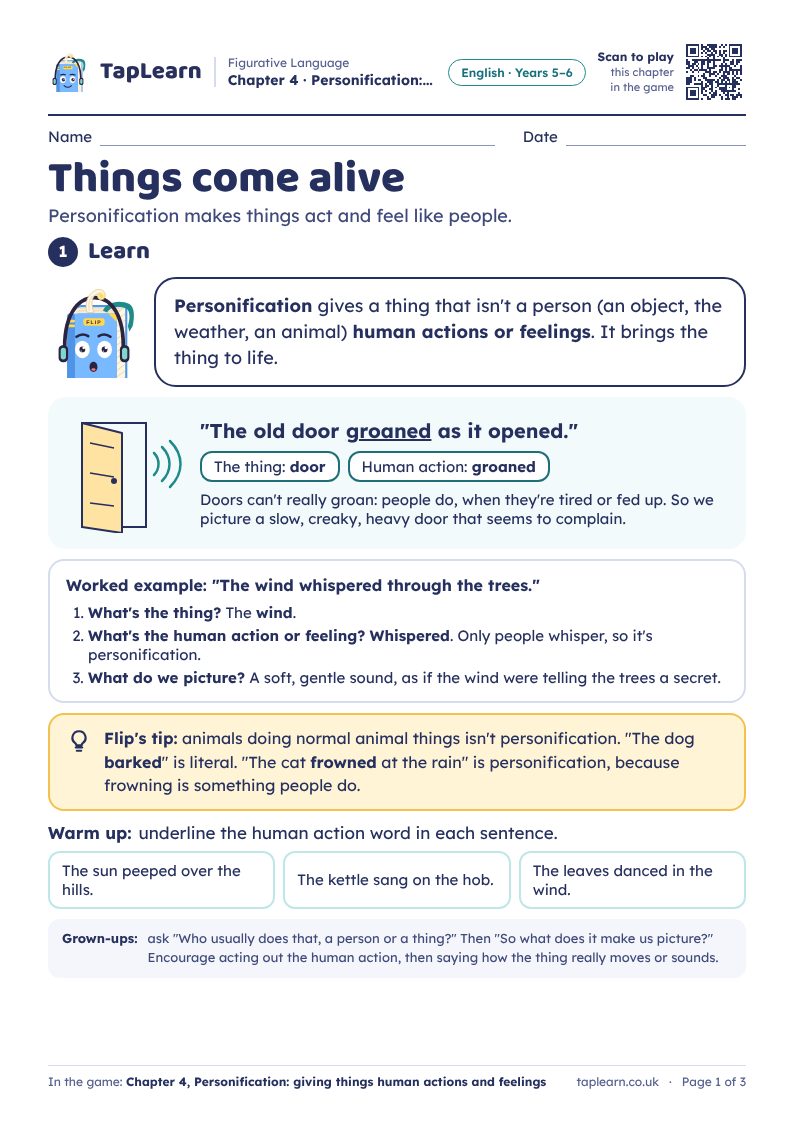
Things Come Alive is a printable personification worksheet for Years 5 and 6 (ages 9 to 11) that teaches children to spot when things are given human actions or feelings, find the human word and explain what it makes us picture. It covers the Years 5 and 6 English statement to discuss and evaluate how authors use language, including figurative language, considering the impact on the reader.
Free to print, no account needed.
Print it on A4, in colour or black and white. Do it after the chapter, or before it to see what your child already knows.
What's on the worksheet
Your child spots personification, finds the human action or feeling word, and explains what it makes us picture. Includes a window watch activity and an answers sheet.
- Page 1 · Learn
- The old door groaned explained, a worked example on the wind whispered, Flip's tip that animals doing animal things isn't personification, and an underline-the-action warm-up.
- Page 2 · Try it together
- Window watch: choose three things outside, notice how each really moves or sounds, then give it a matching human action like the clouds are racing and act it out.
- Page 3 · Practise
- Tick sentences with personification, ring the thing and underline the human words, choose actions that fit a mood, write your own, and a challenge about the jealous moon.
- Answers sheet
- Every answer, mix-ups like picking the thing instead of the action word, and talking kitchen and weather report ideas.
3 A4 pages and an answers sheet · about 25 minutes
Using it at home
- Encourage your child to act out the human action, then say how the thing really moves or sounds.
- In window watch, ask "Why did you choose that action?" Slow clouds might stroll while fast ones race.
- Ask what the toaster, fridge and kettle would say if they could talk, and give each a human mood.
Watch out for
- Counting animals doing animal things, like a dog barking.
- Ask "Do dogs really do that?" Personification is a human action or feeling.
- Picking the thing instead of the action word, like door instead of groaned.
- Ask "Which word is something a person would do?"
- Reading it literally, picturing flowers with real legs.
- Ask "How does the thing really move? What does the human word help us see?"
Questions from the worksheet
- Tick each sentence that uses personification: The dog barked at the postman. / The flowers nodded in the breeze. / The old car coughed up the hill.
- Draw a ring round the thing. Underline the human action or feeling words: The angry storm punched the windows.
- Ring the human action that fits the mood. A scary night: The branches clawed / tickled at my window.
- Ava says, "In 'The jealous moon sulked behind a cloud', the personification word is 'moon'." Is she right? Explain.
The answers are on the answers sheet, for grown-ups.
National curriculum in England
This worksheet practises this statement from the Years 5–6 english programme of study:
- Discuss and evaluate how authors use language, including figurative language, considering the impact on the reader
In the classroom
- Do window watch as a class from the classroom window, collecting personification sentences on the board.
- Use Practise C as a mood discussion: why does clawed fit a scary night better than tickled?
Questions and answers
What is personification?
Personification gives something that isn't a person, such as an object, the weather or an animal, human actions or feelings, like "the old door groaned".
Is 'the dog barked' personification?
No. Dogs really bark, so it's literal. "The cat frowned at the rain" is personification because frowning is something people do.
How do you find the personification in a sentence?
Find the thing, then find the word that describes a human action or feeling. In "the wind whispered", the personification word is whispered.
More worksheets from Similes and Metaphors: Paint Word Pictures with Quill
- Chapter 1: Literal and figurative language worksheet: Literal or word picture? Free
- Chapter 2: Similes worksheet: Spotting similes Free
- Chapter 3: Metaphors worksheet: Mighty metaphors Free
- Chapter 5: Effect on the reader worksheet: See it, feel it Free
- Chapter 6: Figurative language in stories worksheet: Word pictures in stories Free
 TapLearn