Metaphors worksheet for Years 5–6: Mighty metaphors
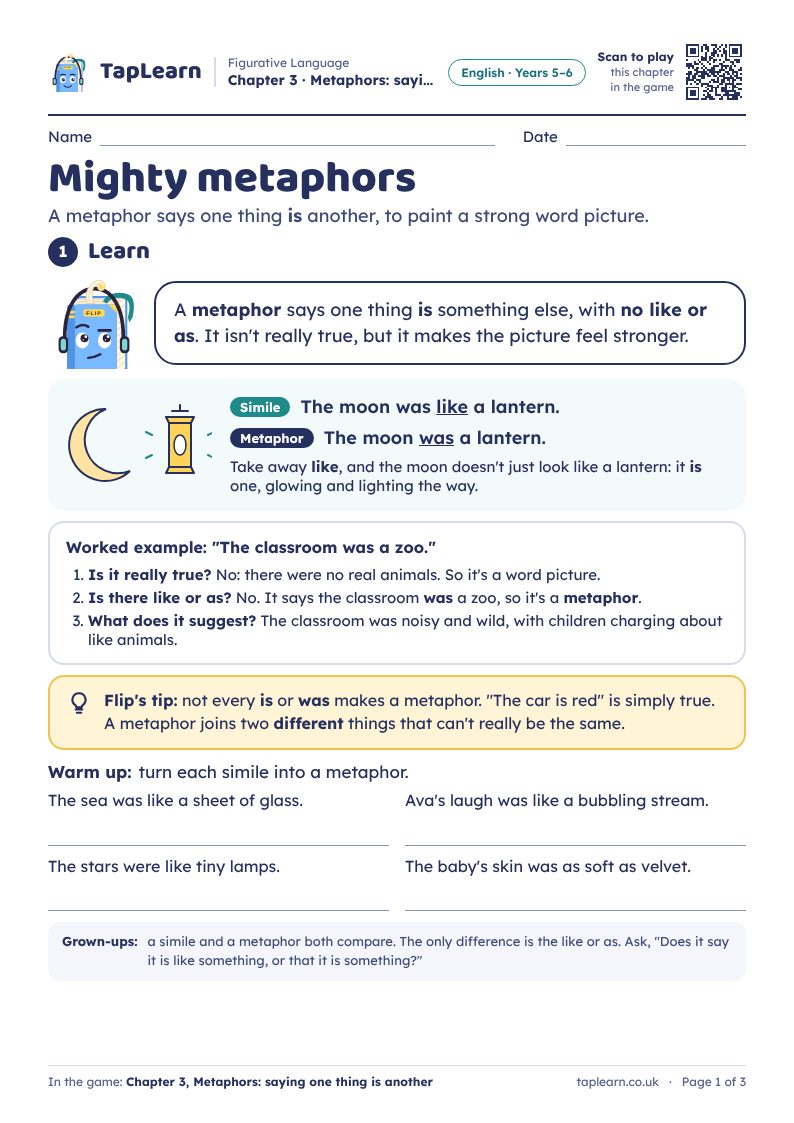
Mighty Metaphors is a printable metaphors worksheet for Years 5 and 6 (ages 9 to 11) that teaches children to spot metaphors that say one thing is another, tell them from similes and plain sentences, and explain what they suggest. It covers the Years 5 and 6 English statement to discuss and evaluate how authors use language, including figurative language, considering the impact on the reader.
Free to print, no account needed.
Print it on A4, in colour or black and white. Do it after the chapter, or before it to see what your child already knows.
What's on the worksheet
Your child spots metaphors that say one thing is another, tells them apart from similes and plain sentences, and explains what they suggest. Includes a simile-to-metaphor game and an answers sheet.
- Page 1 · Learn
- The moon was like a lantern compared with the moon was a lantern, a worked example on the classroom was a zoo, Flip's tip on is and was, and a simile-to-metaphor warm-up.
- Page 2 · Try it together
- Simile to metaphor: make a simile about something at home, cross out like or as to make a metaphor, read both aloud and decide which sounds stronger. Then label sentences S, M or L.
- Page 3 · Practise
- Match metaphors to what they suggest, write metaphors about a thunderstorm and a cold morning, fix Sam's mislabelled simile, and a challenge about my dog is a Labrador.
- Answers sheet
- Every answer, mix-ups like thinking any is or was makes a metaphor, and family metaphors and switch-it games.
3 A4 pages and an answers sheet · about 25 minutes
Using it at home
- When your child labels a sentence, ask "Does it say it is like something, or that it is something?"
- In simile to metaphor, either answer about which is stronger is fine. What matters is the reason.
- Describe each person at home with a kind metaphor, such as "Dad is a walking map".
Watch out for
- Mixing up metaphors and similes.
- Look for like or as: if it's there, it's a simile; if it says something is something else, it's a metaphor.
- Reading metaphors literally, like real animals in the classroom.
- Ask "What is the writer really telling us?"
- Thinking any is or was makes a metaphor, like the car is red.
- Ask "Could this really be true?" If so, it's literal.
Questions from the worksheet
- Write S for simile, M for metaphor or L for literal: Grandma's garden is a jungle. / The car is red. / The waves were like galloping horses.
- Draw a line from each metaphor to what it suggests: Her words were knives.
- Write a metaphor about a thunderstorm.
- Mia says, "'My dog is a Labrador' is a metaphor, because it says one thing is another." Is she right? Explain.
The answers are on the answers sheet, for grown-ups.
National curriculum in England
This worksheet practises this statement from the Years 5–6 english programme of study:
- Discuss and evaluate how authors use language, including figurative language, considering the impact on the reader
In the classroom
- Play switch it as a starter: say a simile and children race to turn it into a metaphor.
- Give groups a set of sentences to sort into simile, metaphor and literal, then share any they disagreed on.
Questions and answers
What is a metaphor?
A metaphor says one thing is something else, without like or as, such as "the classroom was a zoo". It isn't really true but paints a strong picture.
What is the difference between a simile and a metaphor?
A simile says something is like or as something else. A metaphor says it is that thing, which often makes the picture feel stronger.
Is every sentence with 'is' a metaphor?
No. "The car is red" and "My dog is a Labrador" are simply true, so they are literal.
More worksheets from Similes and Metaphors: Paint Word Pictures with Quill
- Chapter 1: Literal and figurative language worksheet: Literal or word picture? Free
- Chapter 2: Similes worksheet: Spotting similes Free
- Chapter 4: Personification worksheet: Things come alive Free
- Chapter 5: Effect on the reader worksheet: See it, feel it Free
- Chapter 6: Figurative language in stories worksheet: Word pictures in stories Free
 TapLearn