Adverbs worksheet for Year 3: How did it happen?
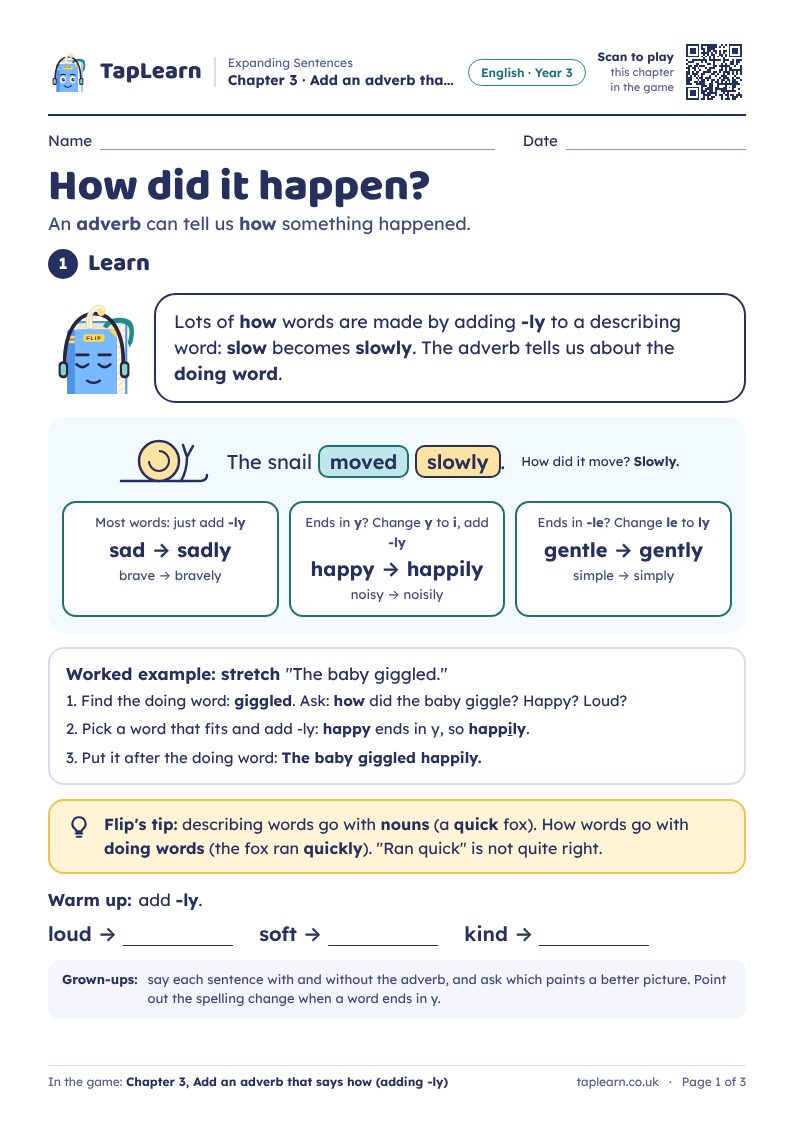
How Did It Happen? is a printable adverbs worksheet for Year 3 (ages 7 to 8) that teaches children to add -ly to describing words to make how words, with the spelling rules for words ending in y and -le. It covers the Year 2 grammar statement on using -ly to turn adjectives into adverbs, and building a richer vocabulary.
This worksheet is for members
Membership opens every chapter of every game and every worksheet, for all your children.
See the plansAlready a member? Log in to print it.
Start with the free one: Who does what? (chapter 1).
Print it on A4, in colour or black and white. Do it after the chapter, or before it to see what your child already knows.
What's on the worksheet
Your child turns adjectives into adverbs with -ly (slow to slowly, happy to happily, gentle to gently) and adds a how word that fits the action. Includes a do-it-differently acting game and an answers sheet.
- Page 1 · Learn
- Three spelling rules for -ly (sad to sadly, happy to happily, gentle to gently), a worked example stretching "The baby giggled", Flip's tip on describing and how words, and a warm-up.
- Page 2 · Try it together
- Do it differently: one person does an everyday action in a secret way, like sleepily or proudly, and the other guesses the how word. Write your favourite as a sentence.
- Page 3 · Practise
- Turn eight describing words into how words, ring the right word, choose the how word that fits, fix three mistakes, and a challenge about quiet and quietly.
- Answers sheet
- Every answer, mix-ups like forgetting y to i, and adverb-walk and spot-them ideas.
3 A4 pages and an answers sheet · about 25 minutes
Using it at home
- Say each sentence with and without the adverb, and ask which paints a clearer picture.
- In do it differently, ask "How did I do it?" rather than "What did I do?"
- Check the spelling of adverbs from words ending in y: sleepy to sleepily, grumpy to grumpily.
Watch out for
- Using the describing word instead of the how word, like "ran quick".
- Ask "How did they run?" and add -ly.
- Forgetting y to i, like "happyly".
- If the word ends in a consonant then y, change the y to i first.
- Choosing a how word that doesn't fit, like "tiptoed loudly".
- Act it out: can you really do it that way?
Questions from the worksheet
- Turn each describing word into a how word: quick, happy, sad, noisy, brave, angry, careful, gentle.
- Ring the right word: The tortoise walked (slow / slowly) across the lawn. It was a (quiet / quietly) library.
- Fix the mistake. Write each sentence correctly: The mouse tiptoed loudly. Ava smiled happyly. The rain fell heavy.
- "Mia is a quiet girl." and "Mia spoke quiet." One of these needs -ly. Which one, and why?
The answers are on the answers sheet, for grown-ups.
National curriculum in England
This worksheet practises these statements from the Years 3–4 english programme of study:
- Draft and write by: composing and rehearsing sentences orally (including dialogue), progressively building a varied and rich vocabulary and an increasing range of sentence structures (English appendix 2)
- Word: use of the suffixes –er, –est in adjectives and the use of –ly in Standard English to turn adjectives into adverbs (Year 2 english)
In the classroom
- Play do it differently as a class: one pupil acts an action in a secret way and the class guesses the adverb.
- Use Practise A as a spelling check on the -ly rules.
Questions and answers
What is an adverb?
An adverb tells us more about a verb, such as how something happened. In "The snail moved slowly", slowly is the adverb.
How do you make an adverb with -ly?
Most words just add -ly (sad to sadly). Words ending in y change y to i (happy to happily), and words ending in -le change le to ly (gentle to gently).
What is the difference between quick and quickly?
Quick describes a noun (a quick fox). Quickly says how something was done (the fox ran quickly).
 TapLearn