Expanding sentences worksheet for Year 3: Where, when and why
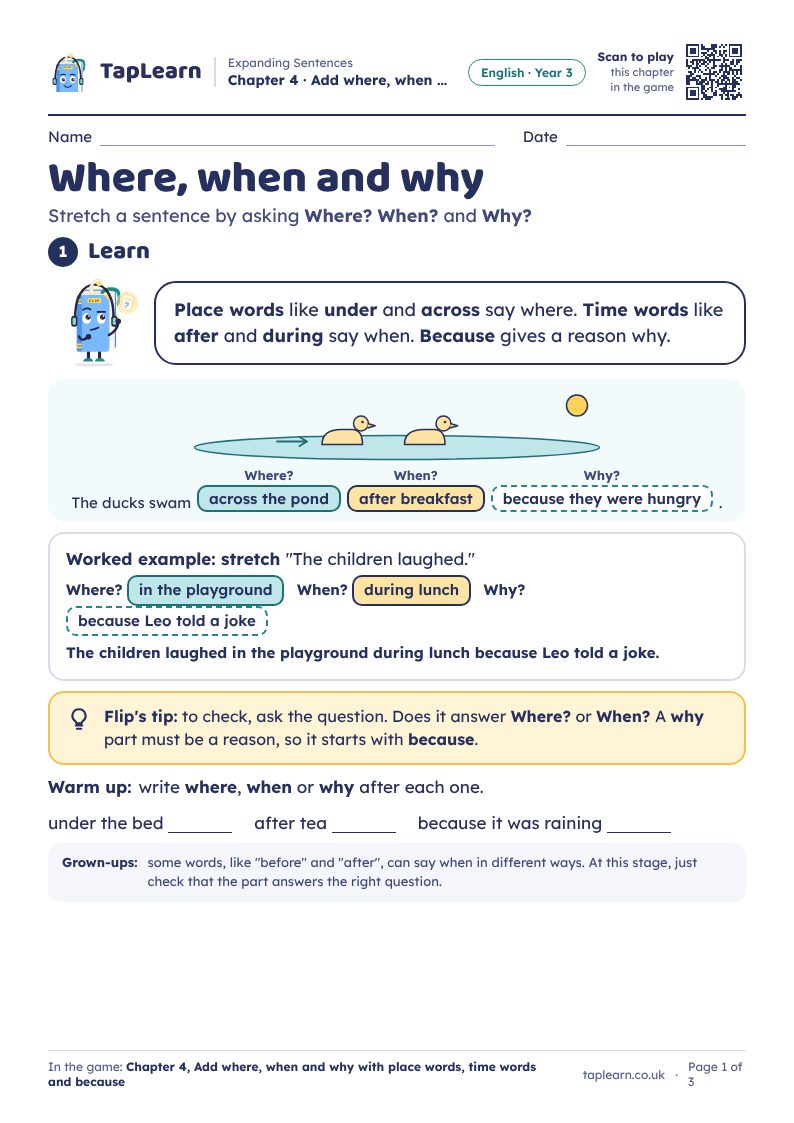
Where, When and Why is a printable expanding sentences worksheet for Year 3 (ages 7 to 8) that teaches children to stretch a short sentence by asking Where? When? and Why?, using place words, time words and because. It covers the Year 3 grammar statement on expressing time, place and cause using conjunctions, adverbs or prepositions.
This worksheet is for members
Membership opens every chapter of every game and every worksheet, for all your children.
See the plansAlready a member? Log in to print it.
Start with the free one: Who does what? (chapter 1).
Print it on A4, in colour or black and white. Do it after the chapter, or before it to see what your child already knows.
What's on the worksheet
Your child stretches sentences by adding where (under, across), when (after, during) and why (because...). Includes a hide-the-teddy game and an answers sheet.
- Page 1 · Learn
- A sentence about ducks with where, when and why parts, a worked example stretching "The children laughed", Flip's tip that a why part needs a reason, and a warm-up.
- Page 2 · Try it together
- Hide the teddy: the grown-up hides a soft toy, the child finds it and says where it was with a place word, then adds when and why. Then swap.
- Page 3 · Practise
- Tick where, when or why, fill gaps with place words, finish sentences with a reason, stretch "The fox hid", and a challenge about "because the park".
- Answers sheet
- Every answer, mix-ups like a place after because, and question-chain and lost-and-found ideas.
3 A4 pages and an answers sheet · about 25 minutes
Using it at home
- Some words, like before and after, can say when in different ways. At this stage, just check that the part answers the right question.
- In hide the teddy, if your child gives a place for why, like "because the sofa", ask "But why was Teddy there?"
- When something goes missing at home, ask your child to tell you where it was using a place word.
Watch out for
- Mixing up where and when, especially with "in".
- "In the garden" is where, "in the morning" is when. Ask the question: does it answer Where? or When?
- A place or time after "because", like "because the morning".
- Ask "But why?" until a real reason comes out.
Questions from the worksheet
- Does it say where, when or why? behind the shed, before bedtime, because she was tired, during the storm, across the field.
- Fill each gap with a place word: under, across, inside, over. The boat sailed ___ the lake. The frog hid ___ a leaf.
- Finish each sentence with a reason: The children put on their coats because...
- Stretch "The fox hid." Answer Where? When? Why?, then write the long sentence.
- Sam wrote: "The children played because the park." What is wrong with his why part? Write it a better way.
The answers are on the answers sheet, for grown-ups.
National curriculum in England
This worksheet practises these statements from the Year 3 english programme of study:
- Sentence: expressing time, place and cause using conjunctions, adverbs, or prepositions
- Develop their understanding of the concepts set out in English appendix 2 by: using conjunctions, adverbs and prepositions to express time and cause (Years 3–4 english)
In the classroom
- Play question chain as a starter: say a short sentence and pupils stretch it by answering Where? When? Why?
- Use Practise A as a quick show-me with where, when and why cards.
Questions and answers
How do you expand a sentence in Year 3?
Ask questions about it. Add where with a place word, when with a time word, and why with because and a reason.
What words say where something happened?
Place words like under, across, inside, over, behind and next to say where.
What does a why part need?
A why part needs a reason, so it starts with because: "because it was sunny", not "because the park".
 TapLearn