Improving sentences worksheet for Year 3: Check and improve
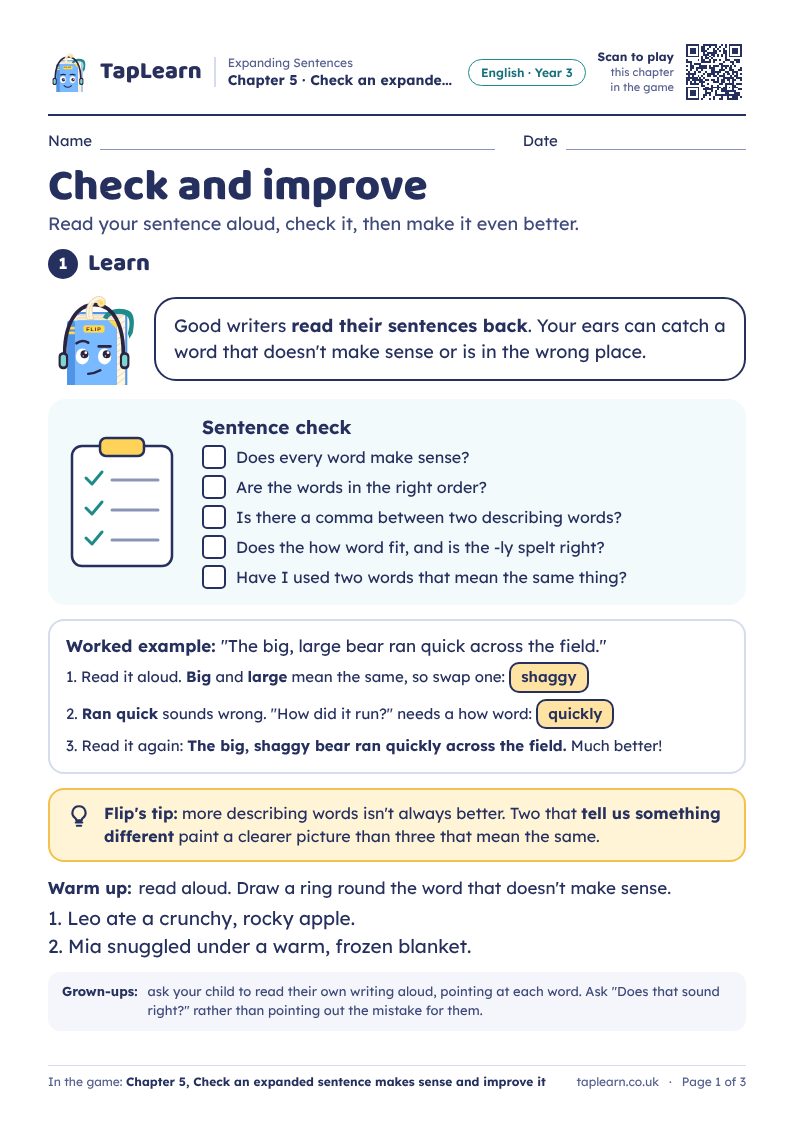
Check and Improve is a printable improving sentences worksheet for Year 3 (ages 7 to 8) that teaches children to read a sentence aloud and check every word makes sense, the order is right and the commas and -ly words are correct. It covers the Years 3 to 4 statement on assessing the effectiveness of their own and others' writing and suggesting improvements.
This worksheet is for members
Membership opens every chapter of every game and every worksheet, for all your children.
See the plansAlready a member? Log in to print it.
Start with the free one: Who does what? (chapter 1).
Print it on A4, in colour or black and white. Do it after the chapter, or before it to see what your child already knows.
What's on the worksheet
Your child reads expanded sentences aloud and spots words that don't make sense, muddled order, missing commas and -ly mix-ups, then improves them. Includes a word-shuffle game and an answers sheet.
- Page 1 · Learn
- A five-point sentence check, a worked example fixing "The big, large bear ran quick", Flip's tip that more describing words isn't always better, and a spot-the-silly-word warm-up.
- Page 2 · Try it together
- Word shuffle: the grown-up writes a long sentence one word per scrap of paper, muddles them, and the child puts them back in order, then swaps one word for a better one.
- Page 3 · Practise
- Unmuddle two sentences, fix one problem in each of five sentences, write your own long sentence and tick the check, and a challenge about three size words.
- Answers sheet
- Every answer, mix-ups like piling on words that mean the same, and spot-the-silly-word ideas.
3 A4 pages and an answers sheet · about 25 minutes
Using it at home
- Ask your child to read their own writing aloud, pointing at each word. Ask "Does that sound right?" rather than pointing out the mistake.
- For a second round of word shuffle, make one muddle on purpose, like "The mouse hungry tiny", and see if your child spots it.
- Say a sentence with one word that doesn't fit, like "I brushed my teeth with a fluffy spoon", for your child to catch.
Watch out for
- Piling on describing words that mean the same.
- Ask "What does this new word tell us that we didn't know?"
- Missing a silly word, like "a wooden snowman".
- Reading aloud slowly, finger on each word, helps.
- -ly mix-ups like "ran quick" or "happyly".
- Ask how it was done and add -ly, changing y to i where needed.
Questions from the worksheet
- The words are muddled. Write the sentence in the right order: slowly The crawled snail grey garden. across the
- Each sentence has one problem. Read it aloud, then write it correctly: The tiny, little, small mouse squeaked. The penguin slid happyly across the ice.
- Read it aloud and fix it: The wooden snowman melted in the sun. The bus red rumbled up the hill.
- Write your own long sentence. Use two describing words, a how word and a where, when or why.
- Ava wrote: "The enormous, huge, gigantic whale swam." She says more describing words always make a sentence better. Is she right?
The answers are on the answers sheet, for grown-ups.
National curriculum in England
This worksheet practises these statements from the Years 3–4 english programme of study:
- Draft and write by: composing and rehearsing sentences orally (including dialogue), progressively building a varied and rich vocabulary and an increasing range of sentence structures (English appendix 2)
- Evaluate and edit by: assessing the effectiveness of their own and others' writing and suggesting improvements
In the classroom
- Display the sentence check on the board for pupils to use when editing their own writing.
- Play word shuffle in small groups with a long sentence cut into word cards.
Questions and answers
How can children check a sentence makes sense?
Read it aloud, pointing at each word. Ears catch a word that doesn't make sense or is in the wrong place.
Are more describing words always better?
No. Two describing words that tell us something different paint a clearer picture than three that mean the same.
What should a Year 3 child check in an expanded sentence?
That every word makes sense, the words are in order, there's a comma between two describing words, and the -ly word fits and is spelt right.
 TapLearn