Adjectives worksheet for Year 3: Describing words
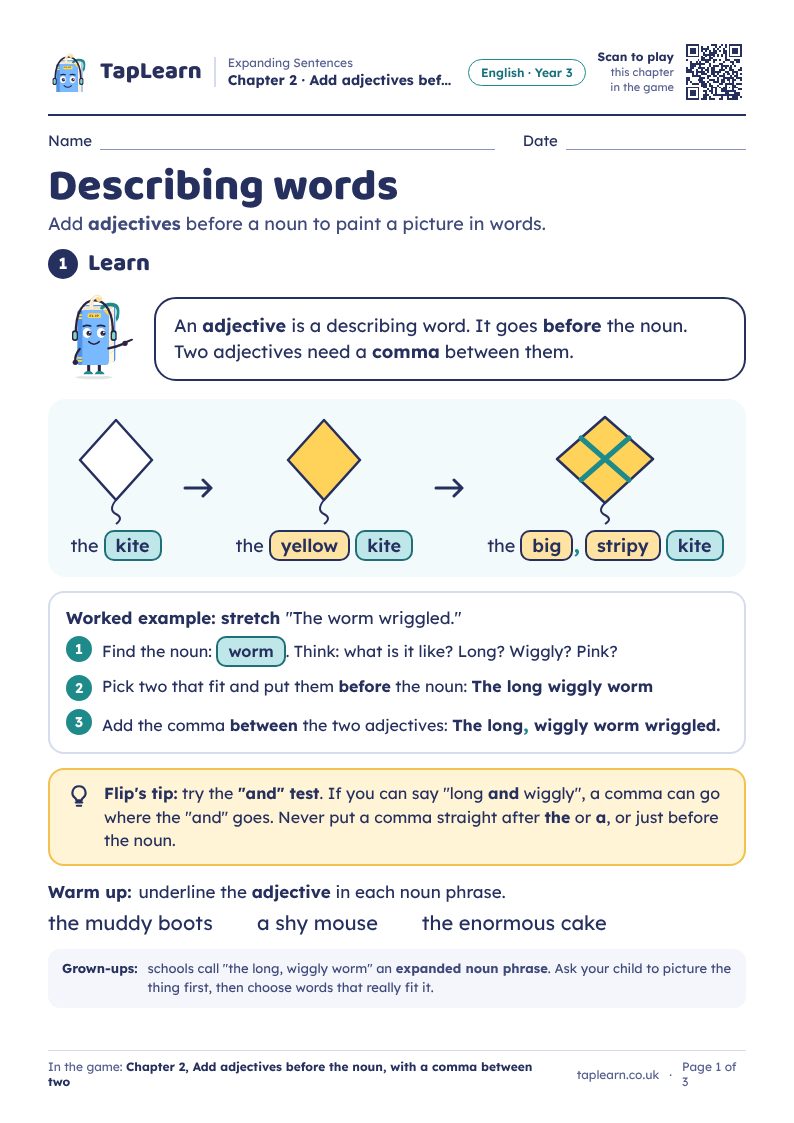
Describing Words is a printable adjectives worksheet for Year 3 (ages 7 to 8) that teaches children to put describing words before the noun and use the "and" test to place a comma between two, as in the long, wiggly worm. It covers the Year 2 grammar statements on expanded noun phrases for description and commas to separate items in a list.
This worksheet is for members
Membership opens every chapter of every game and every worksheet, for all your children.
See the plansAlready a member? Log in to print it.
Start with the free one: Who does what? (chapter 1).
Print it on A4, in colour or black and white. Do it after the chapter, or before it to see what your child already knows.
What's on the worksheet
Your child adds adjectives before a noun, chooses ones that fit, and puts a comma between two of them, as in a cold, dark night. Includes a mystery-bag describing game and an answers sheet.
- Page 1 · Learn
- The kite growing to the big, stripy kite, a worked example stretching "The worm wriggled", Flip's "and" test for commas, and an underline-the-adjective warm-up.
- Page 2 · Try it together
- Mystery bag: feel a hidden thing like a sock or an orange, say two describing words, guess what it is, then write the noun phrase with a comma between the adjectives.
- Page 3 · Practise
- Ring the describing word that fits, add commas to four noun phrases, check where the comma goes, add two adjectives to a cake and a monster, and a challenge.
- Answers sheet
- Every answer, mix-ups like a doing word instead of a describing word, and describe-and-guess ideas.
3 A4 pages and an answers sheet · about 25 minutes
Using it at home
- Schools call "the long, wiggly worm" an expanded noun phrase. Ask your child to picture the thing first, then choose words that really fit.
- In the mystery bag, if your child gives a doing word like "it rolls", ask "What is it like?"
- Praise describing words that really fit the thing, like "bumpy" for an orange.
Watch out for
- Putting the adjective after the noun, like "the frog tiny".
- Say both versions aloud: which sounds right?
- Using a doing word instead of a describing word, like "the jumped pear".
- Ask "What is it like?", not "What does it do?"
- Putting the comma straight after "the" or "a", or just before the noun.
- The "and" test shows where it goes: between the two adjectives.
Questions from the worksheet
- Each noun phrase has two adjectives but no comma. Write it again with the comma: a cold dark night, a huge hungry bear.
- Is the comma in the right place? Tick or cross: a cold, damp cave. the, old creaky gate. a slimy green, frog.
- Add two adjectives that fit, with a comma between them: the ___, ___ cake.
- Leo wrote: "I saw a rabbit fluffy in the garden." What would you change? Why?
The answers are on the answers sheet, for grown-ups.
National curriculum in England
This worksheet practises these statements from the Year 2 english programme of study:
- Sentence: expanded noun phrases for description and specification
- Punctuation: commas to separate items in a list
- Word: use of the suffixes –er, –est in adjectives and the use of –ly in Standard English to turn adjectives into adverbs
In the classroom
- Run the mystery bag with a group, collecting describing words on the board.
- Use Practise C as a mini-whiteboard check on comma placement.
Questions and answers
Where do adjectives go in a sentence?
Adjectives usually go before the noun they describe: a fluffy rabbit, not a rabbit fluffy.
When do you put a comma between adjectives?
Put a comma between two adjectives if you could say "and" between them: the long, wiggly worm.
What is an expanded noun phrase?
An expanded noun phrase is a noun with describing words added, like the big, stripy kite.
 TapLearn