How fossils form worksheet for Year 6
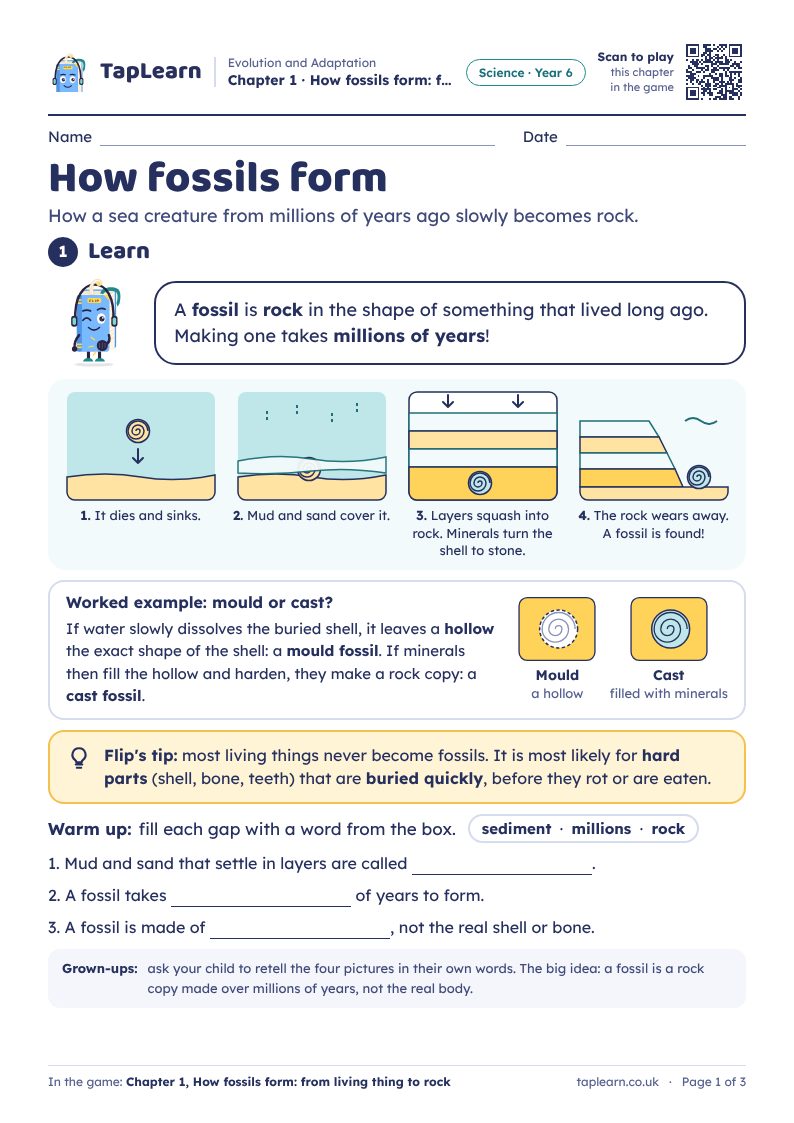
How Fossils Form is a printable science worksheet for Year 6 (ages 10 to 11) that teaches children, step by step, how a living thing from millions of years ago slowly becomes a fossil in sedimentary rock. It supports the Year 6 national curriculum in England: recognise that fossils provide information about living things that inhabited the Earth millions of years ago.
Free to print, no account needed.
Print it on A4, in colour or black and white. Do it after the chapter, or before it to see what your child already knows.
What's on the worksheet
Children learn, step by step, how a sea creature from millions of years ago becomes a fossil in sedimentary rock, and the difference between a mould and a cast. With a play-dough mould and cast activity and an answers sheet.
- Page 1 · Learn
- Four pictures show an ammonite sinking, being buried, turning to stone and being found. A worked example explains mould and cast fossils, then a word-bank warm-up.
- Page 2 · Try it together
- Make a mould and a cast: press a shell, leaf or toy into play dough, fill the hollow with a second colour and compare the copies.
- Pages 2–3 · Practise
- Number six jumbled fossil-forming steps, tick true or false, choose which of two things is more likely to fossilise, and explain why sea fossils are found in cliffs.
- Answers sheet
- Every answer by page, what to watch out for (thinking a fossil is the real bone, steps out of order) and quick ideas to go further.
3 A4 pages and an answers sheet · about 30 minutes
Using it at home
- Start with Try it together: making a play-dough mould and cast makes the idea of a rock copy easy to see. It takes about 10 minutes.
- Ask your child to retell the four pictures on page 1 in their own words before they order the steps on page 2.
Watch out for
- Thinking a fossil is the creature's real bone or shell.
- Say that minerals slowly replaced it, so the fossil is rock in the same shape. The play-dough cast shows a copy, not the real object.
- Putting the steps of fossil formation in the wrong order.
- Ask what has to happen first so there is rock at all, then retell the four pictures together.
- Thinking every living thing becomes a fossil.
- Explain that most living things rot or are eaten. Fossils need quick burial and usually hard parts like shells, bones or teeth.
Questions from the worksheet
- These steps are mixed up. Number them 1 to 6 in the right order.
- True or false: every animal that dies becomes a fossil.
- Ring the one more likely to become a fossil: a jellyfish on a beach, or a shark tooth sinking into mud? Say why.
- Ammonites lived in the sea. Why are their fossils often found high up in cliffs?
- Leo says a dinosaur skeleton in a museum is made of the dinosaur's real bones. Is he right? Explain what a fossil really is.
The answers are on the answers sheet, for grown-ups.
National curriculum in England
This worksheet practises this statement from the Year 6 science programme of study:
- Recognise that living things have changed over time and that fossils provide information about living things that inhabited the Earth millions of years ago
Source: National curriculum in England: science programmes of study (DfE)
In the classroom
- Use the four-picture strip as a starter: pupils explain each stage to a partner before ordering the steps.
- Try it together works as a table activity with modelling clay and a few shells or leaves.
Questions and answers
How do fossils form?
Most fossils form when a living thing is buried quickly by mud or sand, often under water. Over millions of years the layers squash into rock and minerals slowly replace the hard parts, leaving a rock copy.
What is the difference between a mould and a cast fossil?
A mould fossil is a hollow left in rock after a shell or bone dissolves away. A cast fossil forms when minerals fill that hollow and harden into a rock copy of the shape.
Why don't all living things become fossils?
Most living things rot or are eaten before they can be buried. Fossils usually form only from hard parts that are covered quickly by sediment.
 TapLearn