Adaptation and evolution worksheet for Year 6: How evolution happens
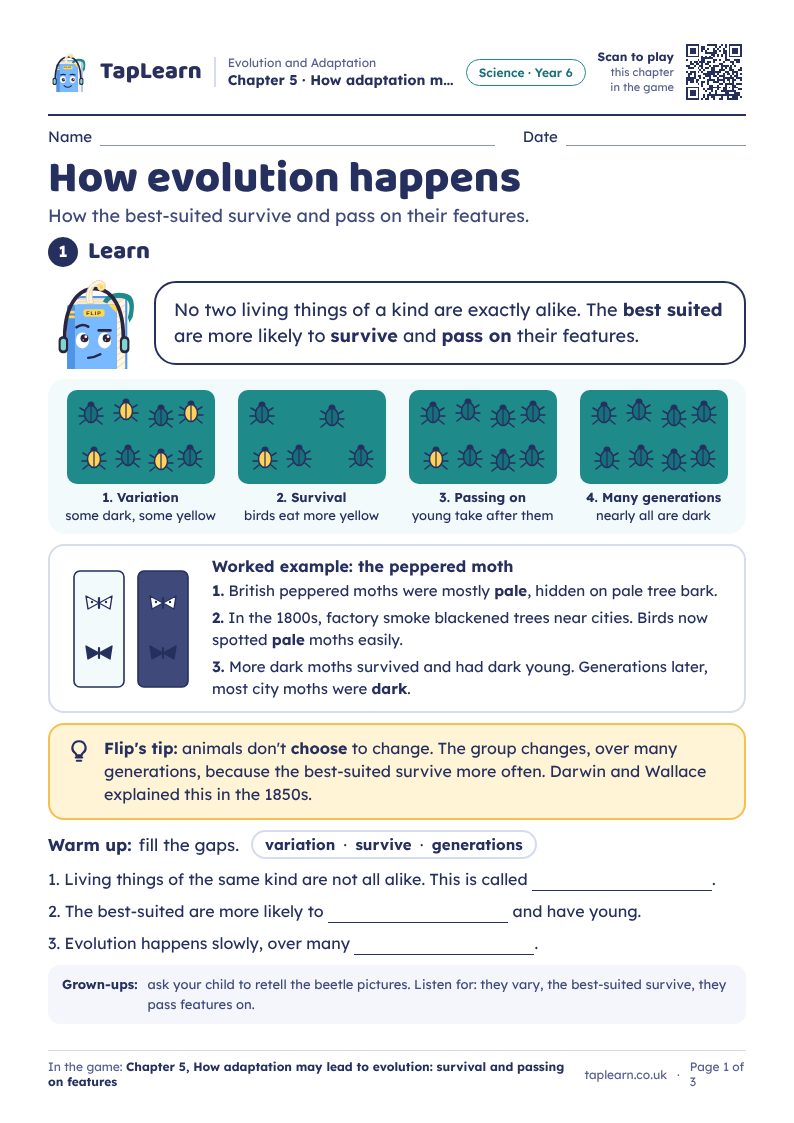
How Evolution Happens is a printable adaptation and evolution worksheet for Year 6 (ages 10 to 11) that teaches children how better adapted living things survive and pass on their features, so that over many generations a group changes. It supports the Year 6 national curriculum in England: identify how animals and plants are adapted to suit their environment and that adaptation may lead to evolution.
This worksheet is for members
Membership opens every chapter of every game and every worksheet, for all your children.
See the plansAlready a member? Log in to print it.
Start with the free one: How fossils form (chapter 1).
Print it on A4, in colour or black and white. Do it after the chapter, or before it to see what your child already knows.
What's on the worksheet
Children learn how variation, survival and passing on features can lead to evolution over many generations, with beetles, the peppered moth and hares on a snowy hillside, and tackle the giraffe-neck mix-up. With a hidden moth hunt and answers.
- Page 1 · Learn
- A four-step beetle story shows variation, survival, passing on and many generations, a worked example explains the peppered moth, and a word-bank warm-up.
- Page 2 · Try it together
- The hidden moth hunt: tear paper "moths", scatter them on newspaper and hunt them like a bird for three rounds, recording which kind becomes more common.
- Pages 2–3 · Practise
- Order a five-step story about birds' beaks, tick true or false, predict what hares on a snowy hillside will look like after many generations, and explain the peppered moth's adaptation.
- Answers sheet
- Every answer by page, what to watch out for (animals choosing to change, changes in one lifetime) and ideas to go further.
3 A4 pages and an answers sheet · about 30 minutes
Using it at home
- Play the hidden moth hunt first: three rounds take about 10 minutes, and your child sees one kind of moth become more common.
- Ask your child to retell the four beetle pictures and listen for three ideas: they vary, the best-suited survive, they pass features on.
Watch out for
- Thinking animals choose or try to change to suit their habitat.
- Say that no animal decides. The ones that happen to suit the place best survive more often and have young like them.
- Thinking a change in one animal's life, like a stretched neck, is passed on.
- Explain that only features an animal is born with can be passed on. Stretching or big muscles are not.
- Forgetting that living things of the same kind are not all the same.
- Look at a bowl of apples or a flock of pigeons together and name the differences. Without variation, no kind can do better than another.
Questions from the worksheet
- This story is mixed up. Number the steps 1 to 5 in the right order.
- True or false: animals decide to change their bodies so they suit their habitat.
- This hillside is covered in snow for most of the year. After many generations, what will most hares here look like? Why?
- Name the peppered moth's adaptation, and say how it helps the moth survive.
- Ava says giraffes have long necks because their parents stretched to reach high leaves. Is she right? Explain.
The answers are on the answers sheet, for grown-ups.
National curriculum in England
This worksheet practises this statement from the Year 6 science programme of study:
- Identify how animals and plants are adapted to suit their environment in different ways and that adaptation may lead to evolution
Source: National curriculum in England: science programmes of study (DfE)
In the classroom
- Run the hidden moth hunt in pairs on newspaper, then pool the class results to see the pattern more clearly.
- Use the giraffe Challenge as a debate: pupils explain what is wrong with the stretching idea.
Questions and answers
How can adaptation lead to evolution?
Living things of the same kind vary. Those better adapted to their environment are more likely to survive and have young with the same features, so over many generations the whole group changes.
What is the peppered moth example?
In the 1800s, factory smoke darkened trees near British cities. Dark peppered moths were better hidden from birds, so more survived, and over many generations most moths there became dark.
Who explained how evolution happens?
Charles Darwin and Alfred Russel Wallace both explained the idea in the 1850s: the best-suited living things survive and pass on their features.
 TapLearn