Fossil evidence worksheet for Year 6: Changing over time
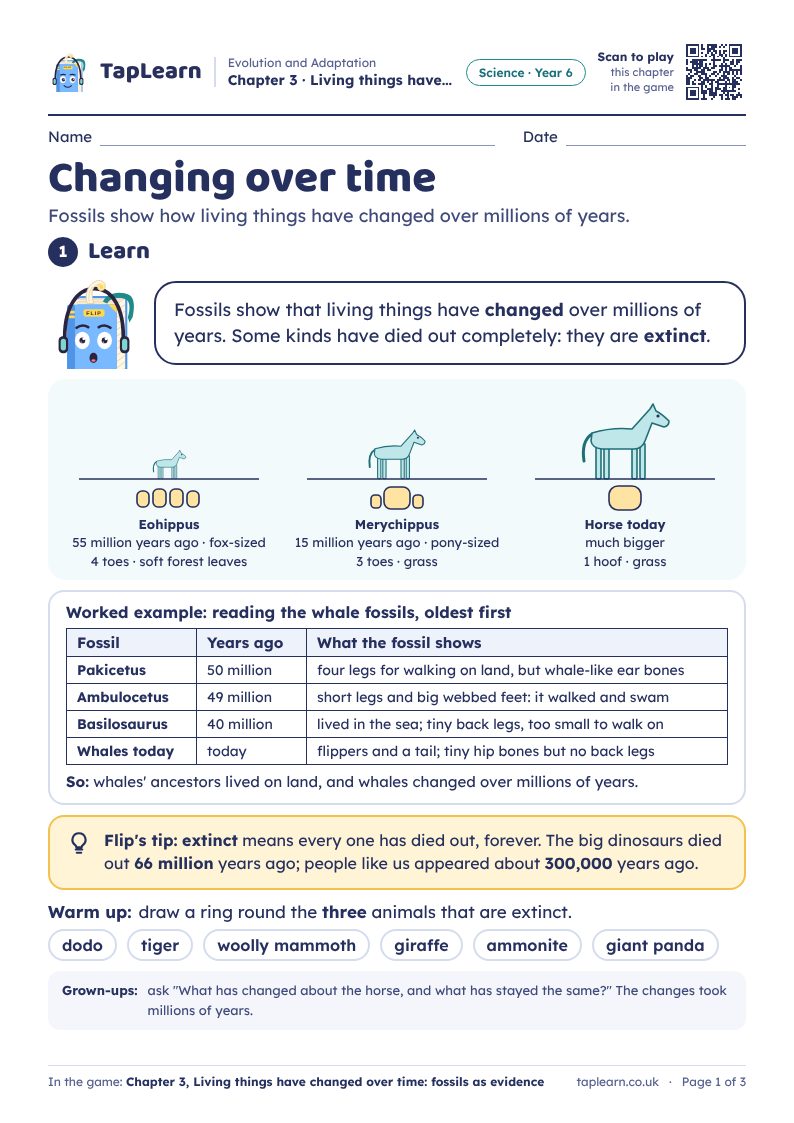
Changing Over Time is a printable fossil evidence worksheet for Year 6 (ages 10 to 11) that teaches children how fossils show horses and whales changed over millions of years, and what extinct means. It supports the Year 6 national curriculum in England: recognise that living things have changed over time and that fossils provide information about living things from millions of years ago.
This worksheet is for members
Membership opens every chapter of every game and every worksheet, for all your children.
See the plansAlready a member? Log in to print it.
Start with the free one: How fossils form (chapter 1).
Print it on A4, in colour or black and white. Do it after the chapter, or before it to see what your child already knows.
What's on the worksheet
Children use fossil evidence to describe how horses and whales have changed over millions of years, and learn what extinct means with examples like the dodo and woolly mammoth. With a toilet roll timeline activity and answers.
- Page 1 · Learn
- Pictures compare Eohippus, Merychippus and today's horse, a worked example reads four whale fossils oldest first, and a warm-up rings the extinct animals.
- Page 2 · Try it together
- The toilet roll timeline: each sheet is 10 million years, so children place the dinosaurs, early horses, early whales and the first people at the right distance from today.
- Pages 2–3 · Practise
- Compare the first horse with a horse today, put six events from 66 million to 350 years ago in order, sort extinct and living animals, and explain the whale evidence.
- Answers sheet
- Every answer by page, what to watch out for (people living with dinosaurs, extinct or endangered) and ideas to go further.
3 A4 pages and an answers sheet · about 30 minutes
Using it at home
- The toilet roll timeline takes about 10 minutes on a hallway floor. Let your child work out the sheets before placing each label.
- Ask "What has changed about the horse, and what has stayed the same?" before your child fills in the table on page 2.
Watch out for
- Thinking living things have always looked as they do today.
- Show the three horses on page 1: the change is clear, but it took millions of years and many generations.
- Thinking people lived at the same time as the big dinosaurs.
- Use the numbers: the dinosaurs died out 66 million years ago and people appeared about 300,000 years ago. The timeline shows the gap.
- Mixing up extinct and endangered animals.
- Extinct means none are left anywhere. Tigers and giant pandas are rare, but still alive.
Questions from the worksheet
- Compare Eohippus with a horse today: size, toes on each front foot, where it lived and food.
- Number these events 1 to 6, from the oldest to the most recent.
- Sort these animals into extinct and still alive today: crocodile, dodo, polar bear, Pakicetus, woolly mammoth, tiger, ammonite, giant panda.
- How do fossils show that the ancestors of whales once lived on land?
- Mia says, "Cave people had to hide from the dinosaurs." Is she right? Use the numbers on this sheet to explain.
The answers are on the answers sheet, for grown-ups.
National curriculum in England
This worksheet practises this statement from the Year 6 science programme of study:
- Recognise that living things have changed over time and that fossils provide information about living things that inhabited the Earth millions of years ago
Source: National curriculum in England: science programmes of study (DfE)
In the classroom
- Build the toilet roll timeline along a corridor as a class, with groups placing each event.
- Use the event-ordering cards as a starter, then the Challenge about cave people as an exit question.
Questions and answers
What does extinct mean?
Extinct means every single one of a kind of living thing has died out, forever. The dodo, the woolly mammoth and ammonites are extinct.
How do fossils show that horses have changed?
Fossils show that the first horses, about 55 million years ago, were the size of a fox with four toes on their front feet. Over millions of years horses grew bigger and their toes reduced to one hoof.
Did people live at the same time as dinosaurs?
No. The big dinosaurs died out about 66 million years ago, and people like us appeared only about 300,000 years ago.
 TapLearn