Adaptations worksheet for Year 6: Adapted to survive
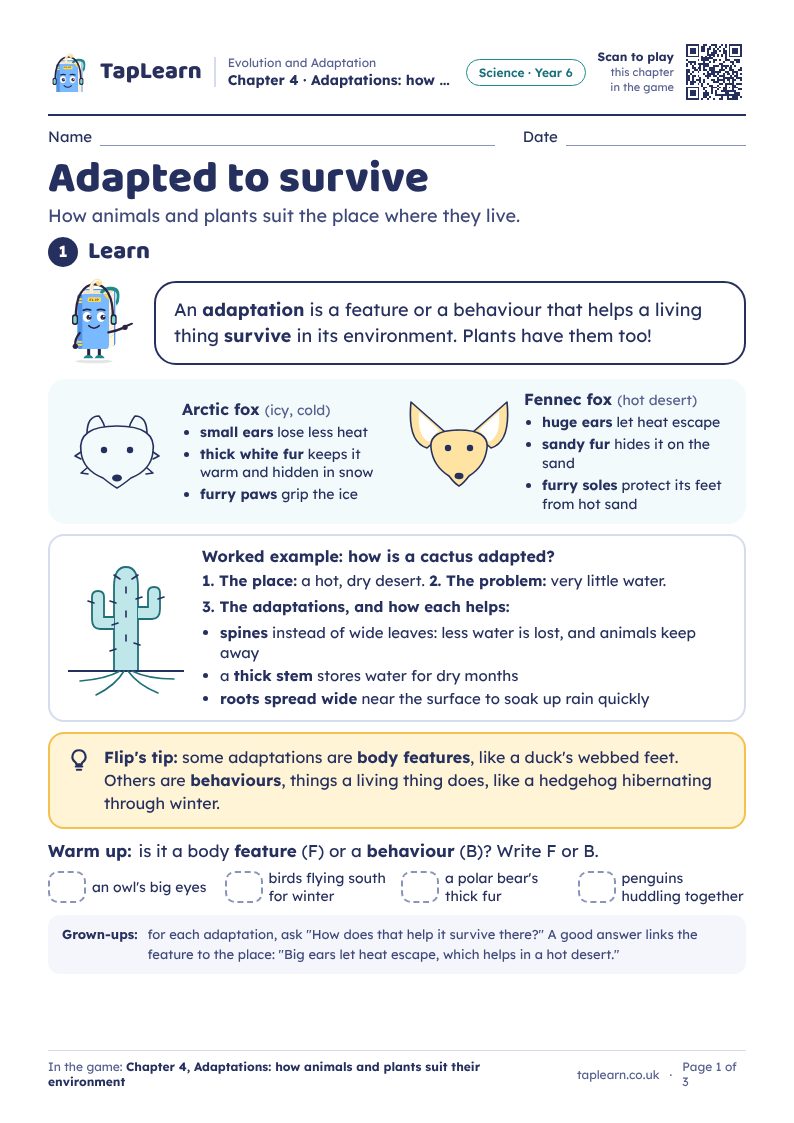
Adapted to Survive is a printable adaptations worksheet for Year 6 (ages 10 to 11) that teaches children how animals and plants suit their environment through body features and behaviour, and how each adaptation helps. It supports the Year 6 national curriculum in England: identify how animals and plants are adapted to suit their environment in different ways.
This worksheet is for members
Membership opens every chapter of every game and every worksheet, for all your children.
See the plansAlready a member? Log in to print it.
Start with the free one: How fossils form (chapter 1).
Print it on A4, in colour or black and white. Do it after the chapter, or before it to see what your child already knows.
What's on the worksheet
Children identify how animals and plants are adapted to their environment, through body features and behaviour, and explain how each adaptation helps, from Arctic and fennec foxes to a cactus. With a beak test activity and answers.
- Page 1 · Learn
- An Arctic fox and a fennec fox compared, a worked example on how a cactus is adapted to the desert, and a warm-up sorting body features from behaviours.
- Page 2 · Try it together
- The beak test: use a spoon, a clothes peg and a straw as beaks to pick up rice, pasta and water, record the results and decide which beak suits which food.
- Pages 2–3 · Practise
- Fill in an adaptations table for a polar bear, camel, water lily and owl, ring the best habitat for three living things, and invent a creature for a deep, dark sea.
- Answers sheet
- Every answer by page, what to watch out for (the camel's hump, wrong habitats, plants having adaptations) and ideas to go further.
3 A4 pages and an answers sheet · about 35 minutes
Using it at home
- Do the beak test before the practice: it takes about 10 minutes with things from the kitchen and shows why beaks differ.
- For each adaptation, ask "How does that help it survive there?" so your child links the feature to the place.
Watch out for
- Thinking a camel's hump stores water.
- It stores fat, which camels use for energy. They survive without water because their bodies lose very little of it.
- Matching an animal or plant to a habitat it does not suit.
- Ask what would happen to a polar bear in a desert: its thick fur and fat would make it far too hot.
- Thinking only animals have adaptations.
- Point to the cactus, the water lily and the pine tree: plants are adapted to their environment too.
Questions from the worksheet
- Is it a body feature or a behaviour? An owl's big eyes; birds flying south for winter; a polar bear's thick fur; penguins huddling together.
- How does each adaptation help? A polar bear's thick fur and fat; a camel's wide, flat feet; an owl's very big eyes.
- Ring the best home for a plant with a thick stem, spines and wide roots: rainforest, desert or pond.
- Invent a creature for a deep, dark, cold sea. Draw it and label two adaptations.
- Leo says, "A camel's hump is full of water." Is he right? Explain.
The answers are on the answers sheet, for grown-ups.
National curriculum in England
This worksheet practises this statement from the Year 6 science programme of study:
- Identify how animals and plants are adapted to suit their environment in different ways and that adaptation may lead to evolution
Source: National curriculum in England: science programmes of study (DfE)
In the classroom
- Run the beak test as a carousel, with a station for each beak, then compare results as a class.
- Display the invented deep-sea creatures and ask pupils to explain each other's adaptations.
Questions and answers
What is an adaptation in Year 6 science?
An adaptation is a feature or a behaviour that helps a living thing survive in its environment. A cactus's spines and a hedgehog hibernating are both adaptations.
What is the difference between a body feature and a behaviour adaptation?
A body feature is part of how the living thing is built, like a duck's webbed feet. A behaviour is something it does, like birds flying south for the winter.
Does a camel's hump store water?
No. A camel's hump stores fat, which it can use for energy. Camels cope without water because they lose very little of it and can drink a lot at once.
 TapLearn