Fossils and rock layers worksheet for Year 6: Fossil detectives
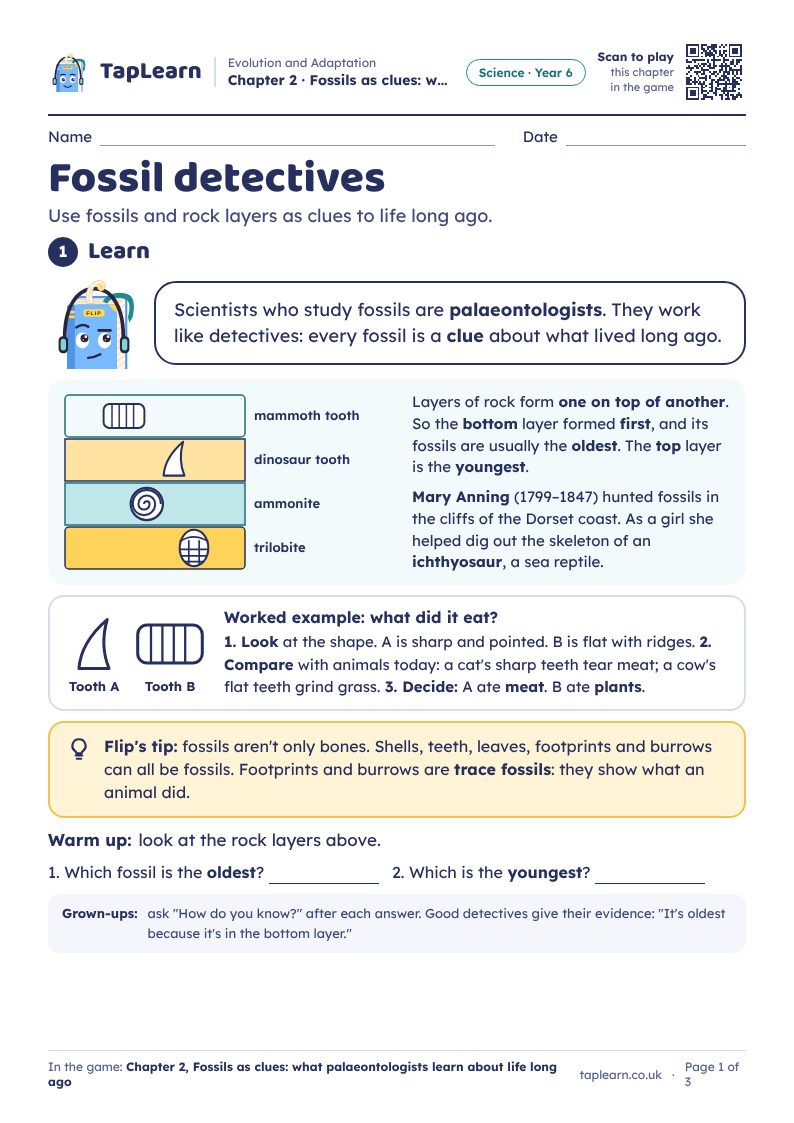
Fossil Detectives is a printable fossils and rock layers worksheet for Year 6 (ages 10 to 11) that teaches children to use fossils as clues to what lived long ago, how old it is and how it lived. It supports the Year 6 national curriculum in England: recognise that fossils provide information about living things that inhabited the Earth millions of years ago.
This worksheet is for members
Membership opens every chapter of every game and every worksheet, for all your children.
See the plansAlready a member? Log in to print it.
Start with the free one: How fossils form (chapter 1).
Print it on A4, in colour or black and white. Do it after the chapter, or before it to see what your child already knows.
What's on the worksheet
Children use fossils and rock layers as clues: deeper layers are usually older, teeth show what an animal ate and footprints show its size. They meet palaeontologist Mary Anning. With a layer-dig activity and answers.
- Page 1 · Learn
- A cliff with four fossil layers shows why the bottom layer is usually oldest, Mary Anning's ichthyosaur find, and a worked example reading two fossil teeth.
- Page 2 · Try it together
- The layer dig: a grown-up hides five objects between folded towels or books, and the child digs down, records each find and works out which went down first.
- Pages 2–3 · Practise
- Answer questions about a cliff's layers, match fossil clues to what they tell us, compare two dinosaur trackways and name fossils that are not bones.
- Answers sheet
- Every answer by page, what to watch out for (thinking deeper means newer, mixing up teeth) and ideas to go further.
3 A4 pages and an answers sheet · about 30 minutes
Using it at home
- Do the layer dig first: hiding objects between towels shows why the bottom layer went down first. It takes about 10 minutes.
- After each answer, ask "How do you know?" so your child gives the clue, such as "it's in the bottom layer".
Watch out for
- Thinking fossils in deeper rock layers are younger.
- Say that the bottom layer was laid down first and everything else piled on top, so deeper is usually older.
- Mixing up meat-eating and plant-eating teeth.
- Sharp, pointed teeth tear meat; flat, ridged teeth grind plants. Let your child feel their own front and back teeth.
- Thinking fossils are only dinosaur bones.
- Point out that shells, leaves, footprints and burrows are fossils too, and most fossils are small sea creatures.
Questions from the worksheet
- Look at the layers in this cliff. Which layer formed first?
- Write the fossils in order, oldest first.
- Match each fossil clue to what it tells us: sharp, pointed teeth; flat, ridged teeth; sea shells in rock on a hilltop; a line of fossil footprints.
- Name three kinds of fossil that are not bones.
- Sam says the fossil in the bottom layer is the youngest because he found it last. Is he right? Explain.
The answers are on the answers sheet, for grown-ups.
National curriculum in England
This worksheet practises this statement from the Year 6 science programme of study:
- Recognise that living things have changed over time and that fossils provide information about living things that inhabited the Earth millions of years ago
Source: National curriculum in England: science programmes of study (DfE)
In the classroom
- Run the layer dig as a group activity with books or trays, then use the cliff questions as a quick mini-whiteboard check.
- The Challenge about Sam works well as a talk-partner question to address the deeper-is-newer mix-up.
Questions and answers
What does a palaeontologist do?
A palaeontologist is a scientist who finds and studies fossils. They use them as clues to what lived long ago, how old it is and how it lived.
Why are deeper rock layers usually older?
Sedimentary rock forms in layers, one on top of another. The bottom layer was laid down first, so its fossils are usually the oldest.
Who was Mary Anning?
Mary Anning (1799–1847) collected fossils from the cliffs of the Dorset coast. As a girl she helped uncover the skeleton of an ichthyosaur, an ancient sea reptile.
 TapLearn