Grouping living things worksheet for Year 4
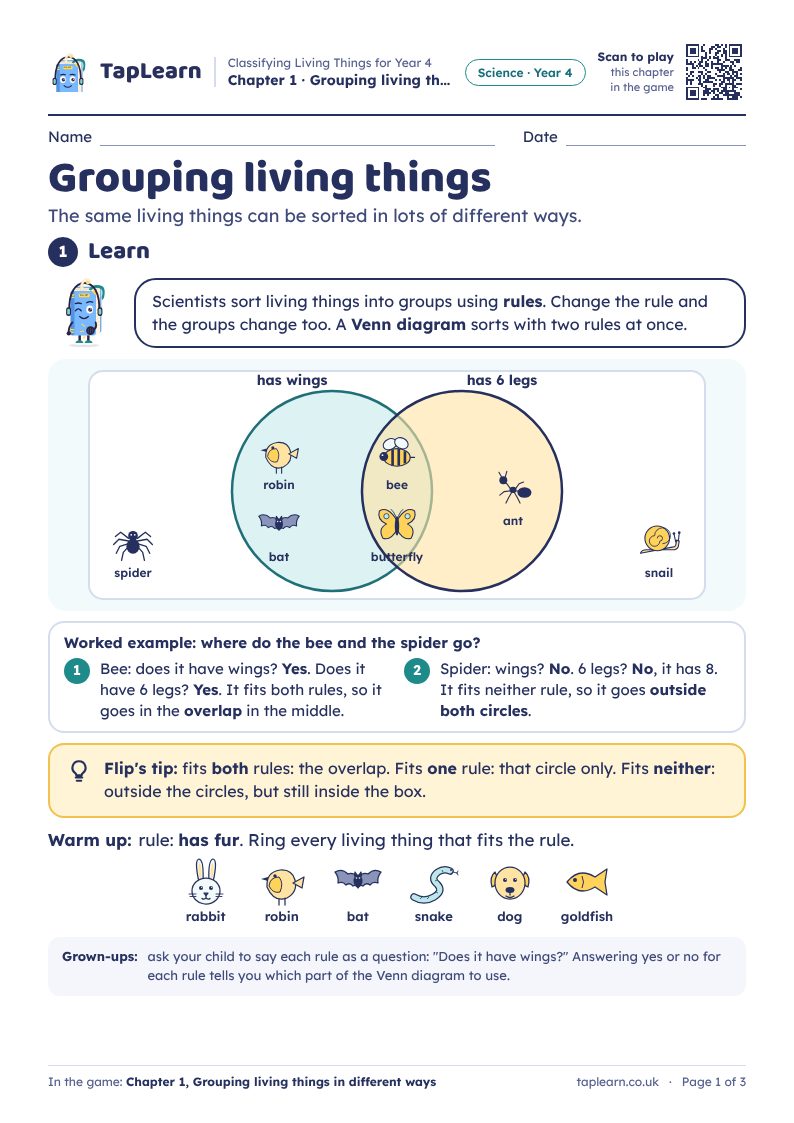
Grouping Living Things is a printable grouping living things worksheet for Year 4 (ages 8 to 9) that teaches children to sort the same living things in different ways using rules and Venn diagrams. It follows the Year 4 national curriculum in England: recognise that living things can be grouped in a variety of ways.
Free to print, no account needed.
Print it on A4, in colour or black and white. Do it after the chapter, or before it to see what your child already knows.
What's on the worksheet
Sort the same living things in different ways using rules, and place animals in a Venn diagram, including the overlap. With a sort it two ways activity using toy animals and string loops, practice questions and answers.
- Page 1 · Learn
- Flip explains sorting rules with a Venn diagram of has wings and has 6 legs, then a worked example places a bee in the overlap and a spider outside both circles. A warm-up rings animals with fur.
- Page 2 · Try it together
- Sort it two ways: sort 8 toy animals or name cards by one rule, then a new rule, then use two loops of string as a Venn diagram to sort by both rules at once.
- Pages 2–3 · Practise
- Sort animals by has legs, complete a has fur and can fly Venn diagram, work out the rule behind two groups and invent a rule of your own. Then a challenge about where a bat goes.
- Answers sheet
- Every answer by page, what to watch out for (missing the overlap, leaving out things that fit neither rule) and quick ideas to go further.
3 A4 pages and an answers sheet · about 30 minutes
In the classroom
- Use hoops on the floor as a giant Venn diagram and give out animal picture cards for groups to place.
- Try the what's the rule? question as a starter: show two groups on the board and let pairs suggest rules.
Questions from the worksheet
- Rule: has legs. Write each animal in the right group: snake, worm, goldfish, snail, frog, spider, robin, dog.
- Write each animal's name in the right place on a Venn diagram of has fur and can fly: bat, rabbit, robin, butterfly, dog, snake, goldfish.
- What is the rule? Group 1: robin, penguin, owl. Group 2: bat, whale, dog.
- Mia says, "A bat can fly, so it only goes in the 'can fly' circle." Is she right? Explain.
The answers are on the answers sheet, for grown-ups.
National curriculum in England
This worksheet practises this statement from the Year 4 science programme of study:
- Recognise that living things can be grouped in a variety of ways
Source: National curriculum in England: science programmes of study (DfE)
Using it at home
- Do Try it together first with toys you already have. Let your child choose the rules: any rule works if every animal gets a clear yes or no.
- When placing animals in the Venn diagram, ask both rule questions aloud for each one. Two yeses means the middle.
Watch out for
- Putting living things that fit both rules outside the middle of the Venn diagram.
- Ask both questions for each one. If both answers are yes, it goes in the overlap where the circles cross.
- Leaving out living things that fit neither rule.
- They still belong in the diagram, inside the box but outside both circles.
Questions and answers
What does grouping living things mean in Year 4?
It means sorting animals and plants into groups using rules, such as can fly or has 4 legs. Year 4 children learn that the same living things can be grouped in many different ways.
Where do things go in a Venn diagram if they fit both rules?
Things that fit both rules go in the overlap, where the two circles cross. Things that fit neither rule go outside both circles but inside the box.
More worksheets from Classifying Living Things for Year 4: A Nature Sort with Hoot
- Chapter 2: Vertebrates and invertebrates worksheet Free
- Chapter 3: Flowering and non-flowering plants worksheet Free
- Chapter 4: Classification key questions worksheet: Good key questions Free
- Chapter 5: Using classification keys worksheet Free
- Chapter 6: Making a classification key worksheet: Make your own key Free
 TapLearn