Vertebrates and invertebrates worksheet for Year 4
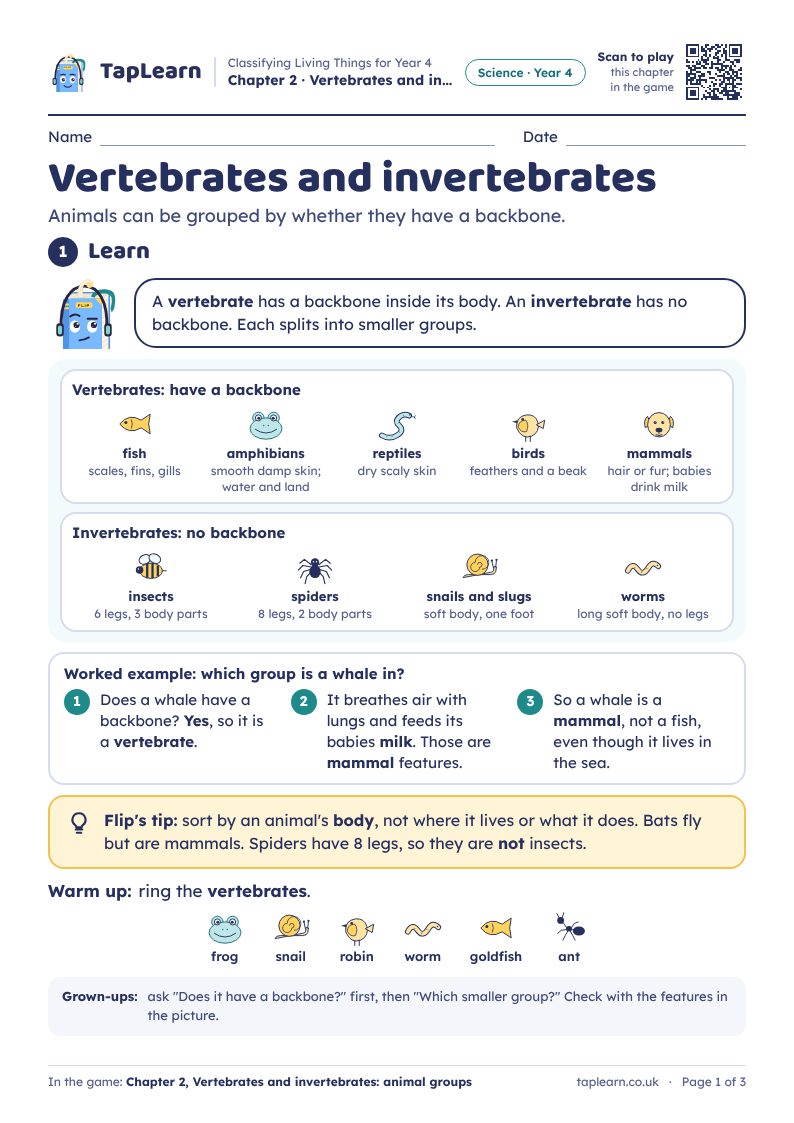
Vertebrates and Invertebrates is a printable vertebrates and invertebrates worksheet for Year 4 (ages 8 to 9) that teaches children to sort animals by whether they have a backbone and then into groups such as mammals, birds, insects and spiders. It follows the Year 4 national curriculum in England: recognise that living things can be grouped in a variety of ways.
Free to print, no account needed.
Print it on A4, in colour or black and white. Do it after the chapter, or before it to see what your child already knows.
What's on the worksheet
Sort animals into vertebrates and invertebrates, then into groups such as mammals, birds, insects and spiders, including tricky ones like whales and bats. With a backbone hunt activity, practice questions and answers.
- Page 1 · Learn
- Flip shows the five vertebrate groups and four invertebrate groups with their features, then a worked example explains why a whale is a mammal. A warm-up rings the vertebrates.
- Page 2 · Try it together
- Backbone hunt: feel the bumps of a backbone, then find 5 animals outside, from a window or in a book, and record whether each has a backbone and its group.
- Pages 2–3 · Practise
- Sort 8 animals into vertebrates and invertebrates, match each vertebrate group to its feature, count legs to tell insects from spiders and name the group of a bat, penguin, frog, lizard and shark.
- Answers sheet
- Every answer by page, what to watch out for (whales as fish, bats as birds, spiders as insects) and quick ideas to go further.
3 A4 pages and an answers sheet · about 30 minutes
In the classroom
- Use the Learn picture as a sorting frame on the board and let groups place animal cards, defending each choice with a feature.
- Run the backbone hunt in the school grounds as a minibeast search, recording finds in the table.
Questions from the worksheet
- Write each animal in the right column, vertebrates or invertebrates: snake, ladybird, bat, slug, penguin, spider, whale, worm.
- Draw a line to match each vertebrate group to its feature: fish, amphibians, reptiles, birds, mammals.
- Insect or spider? Count the legs of an ant, a spider, a bee and a butterfly.
- Which vertebrate group? bat, penguin, frog, lizard, shark.
- Sam says, "A whale lives in the sea and swims, so it is a fish." Is he right? Explain.
The answers are on the answers sheet, for grown-ups.
National curriculum in England
This worksheet practises this statement from the Year 4 science programme of study:
- Recognise that living things can be grouped in a variety of ways
Source: National curriculum in England: science programmes of study (DfE)
Using it at home
- Start by feeling a backbone together: the row of bumps makes the word vertebrate real before the sorting begins.
- When your child names a group, ask "How do you know?" and look for a feature: feathers, scales, fur or the number of legs.
Watch out for
- Thinking whales are fish because they live in the sea.
- Ask how it breathes and feeds its babies. Whales breathe air with lungs and feed their babies milk, so they are mammals.
- Thinking bats are birds because they have wings.
- Bats have fur, not feathers, and feed their babies milk, so they are mammals.
- Thinking spiders are insects.
- Count the legs: insects have 6 legs and 3 body parts, spiders have 8 legs and 2 body parts.
Questions and answers
What is the difference between a vertebrate and an invertebrate?
A vertebrate has a backbone inside its body and an invertebrate does not. Fish, amphibians, reptiles, birds and mammals are vertebrates; insects, spiders, snails and worms are invertebrates.
Why is a whale a mammal and not a fish?
A whale breathes air with lungs and feeds its babies milk, which are mammal features. Fish breathe with gills, so living in the sea does not make a whale a fish.
Is a spider an insect?
No. Insects have 6 legs and 3 body parts, but spiders have 8 legs and 2 body parts, so they are a separate group.
More worksheets from Classifying Living Things for Year 4: A Nature Sort with Hoot
- Chapter 1: Grouping living things worksheet Free
- Chapter 3: Flowering and non-flowering plants worksheet Free
- Chapter 4: Classification key questions worksheet: Good key questions Free
- Chapter 5: Using classification keys worksheet Free
- Chapter 6: Making a classification key worksheet: Make your own key Free
 TapLearn