Using classification keys worksheet for Year 4
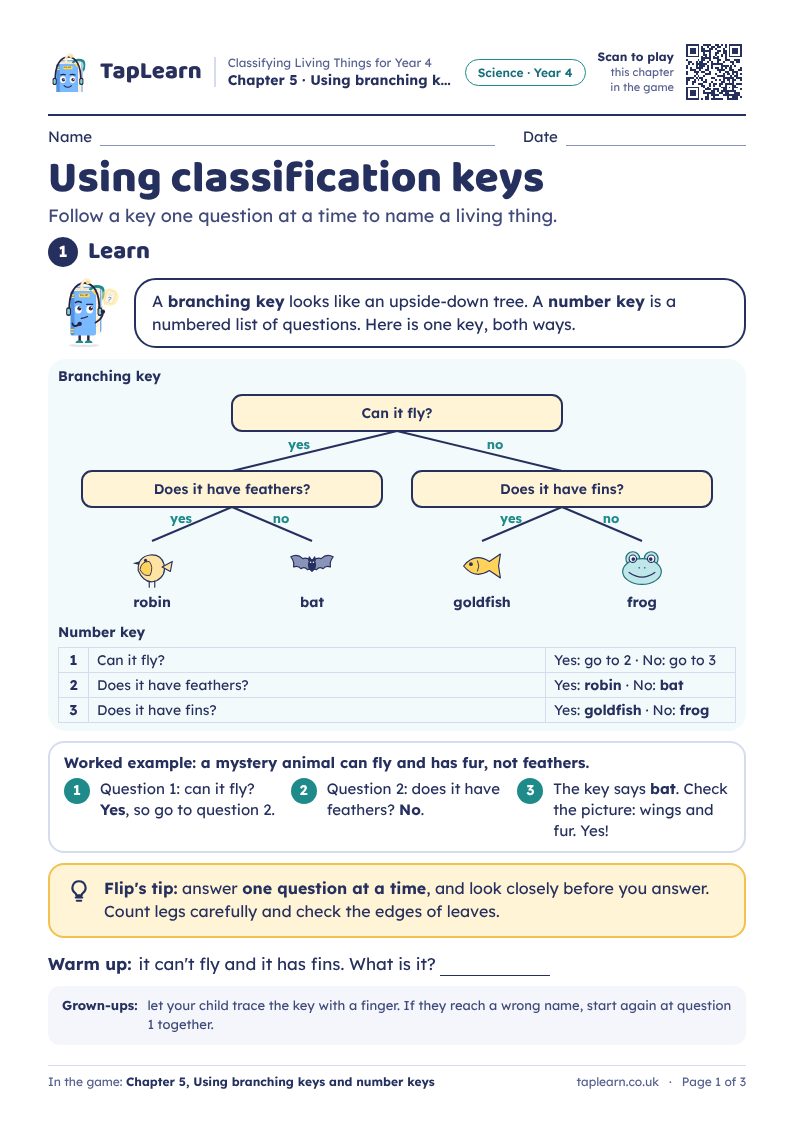
Using Classification Keys is a printable using classification keys worksheet for Year 4 (ages 8 to 9) that teaches children to follow branching keys and number keys one question at a time to identify and name living things. It follows the Year 4 national curriculum in England: explore and use classification keys to help group, identify and name a variety of living things in their local and wider environment.
Free to print, no account needed.
Print it on A4, in colour or black and white. Do it after the chapter, or before it to see what your child already knows.
What's on the worksheet
Follow branching keys and number keys, one question at a time, to identify and name animals, minibeasts and tree leaves. With a leaf detective walk using a number key, practice questions and answers.
- Page 1 · Learn
- Flip shows the same key for a robin, bat, goldfish and frog drawn as a branching key and written as a number key, then a worked example follows it to name a bat. A warm-up uses the number key.
- Page 2 · Try it together
- Leaf detective: collect a few fallen leaves and use a five-question number key to name pine, holly, horse chestnut, oak or sycamore leaves, recording the questions answered.
- Pages 2–3 · Practise
- Name four leaf pictures with the number key, name four mystery minibeasts with a branching key, find Sam's mistake with a holly leaf and trace the path to frog. Then a challenge comparing the two kinds of key.
- Answers sheet
- Every answer by page, what to watch out for (answering without looking closely, jumping ahead in a number key) and quick ideas to go further.
3 A4 pages and an answers sheet · about 35 minutes
In the classroom
- Collect leaves from the school grounds and let pairs use the number key, then compare answers.
- Use the page 1 key as a starter: give a mystery description and ask children to say each yes or no answer aloud.
Questions from the worksheet
- Use the branching key to name the mystery minibeast: it has no wings and 8 legs.
- Sam used the leaf key on a holly leaf, but got to oak. Which question did he answer wrongly? What should he have done?
- In the page 1 key, which answers lead to frog?
- Ava says, "A branching key and a number key can never be the same key." Is she right?
The answers are on the answers sheet, for grown-ups.
National curriculum in England
This worksheet practises this statement from the Year 4 science programme of study:
- Explore and use classification keys to help group, identify and name a variety of living things in their local and wider environment
Source: National curriculum in England: science programmes of study (DfE)
Using it at home
- Late autumn is a good time for the leaf detective: fallen leaves are easy to collect from a garden, park or pavement. Only pick them up from the ground.
- Let your child trace each key with a finger. If they reach the wrong name, start again from question 1 rather than correcting the answer.
Watch out for
- Answering a key question without looking closely at the living thing.
- Ask your child to point to the feature, like the prickles or the fins, before answering yes or no.
- Jumping to the next line in a number key instead of following the go to number.
- Put a finger on the number after "go to" and move straight there.
Questions and answers
What is the difference between a branching key and a number key?
A branching key is drawn like an upside-down tree, with arrows from each yes or no question. A number key writes the same questions as a numbered list with "go to" instructions. Both can identify the same living things.
How do you use a classification key?
Start at the first question and answer it by looking closely at the living thing. Follow the yes or no route to the next question, and keep going until the key gives a name.
More worksheets from Classifying Living Things for Year 4: A Nature Sort with Hoot
- Chapter 1: Grouping living things worksheet Free
- Chapter 2: Vertebrates and invertebrates worksheet Free
- Chapter 3: Flowering and non-flowering plants worksheet Free
- Chapter 4: Classification key questions worksheet: Good key questions Free
- Chapter 6: Making a classification key worksheet: Make your own key Free
 TapLearn