Flowering and non-flowering plants worksheet for Year 4
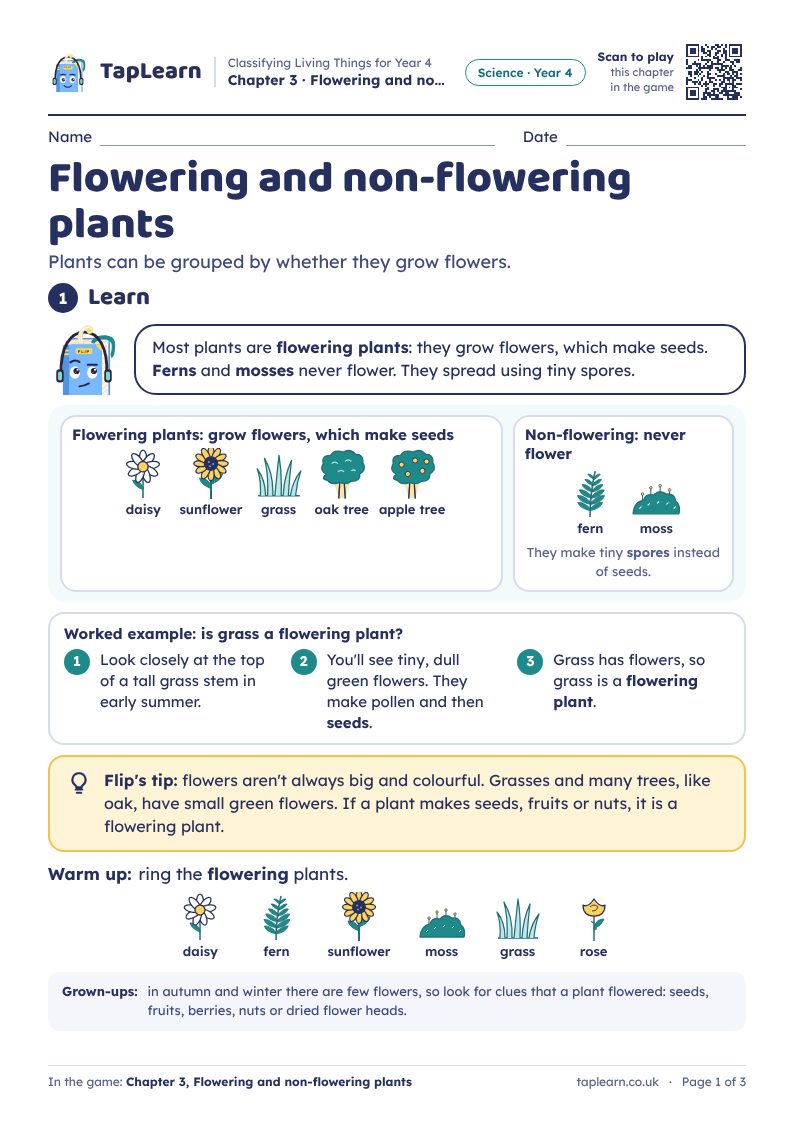
Flowering and Non-Flowering Plants is a printable flowering and non-flowering plants worksheet for Year 4 (ages 8 to 9) that teaches children to sort plants into flowering plants, including grasses and trees, and non-flowering plants such as ferns and mosses. It follows the Year 4 national curriculum in England: recognise that living things can be grouped in a variety of ways.
Free to print, no account needed.
Print it on A4, in colour or black and white. Do it after the chapter, or before it to see what your child already knows.
What's on the worksheet
Sort plants into flowering plants, including grasses and trees, and non-flowering plants such as ferns and mosses. With a plant detective activity outdoors and in the kitchen, practice questions and answers.
- Page 1 · Learn
- Flip sorts a daisy, sunflower, grass, oak tree and apple tree from a fern and moss, then a worked example finds the tiny flowers on grass. A warm-up rings the flowering plants.
- Page 2 · Try it together
- Plant detective: look closely at 5 plants for flowers or clues such as seeds and berries, check under a fern leaf for spore dots, then spot kitchen foods that come from flowering plants.
- Pages 2–3 · Practise
- Sort 7 plants into flowering and non-flowering, ring true or false, fill gaps with flowers, seeds and spores, and explain what acorns show about oak trees. Then a challenge about trees and grass.
- Answers sheet
- Every answer by page, what to watch out for (thinking grass and trees have no flowers, thinking ferns make seeds) and quick ideas to go further.
3 A4 pages and an answers sheet · about 30 minutes
In the classroom
- Bring in a fern, some moss, a grass head and a fruit, and let groups sort them and find the evidence for each choice.
- Use the true or false set as a quick show-me check with thumbs up or down, asking for a reason each time.
Questions from the worksheet
- Write each plant in the right column, flowering or non-flowering: oak tree, fern, rose, moss, grass, apple tree, sunflower.
- True or false: all flowering plants have big, colourful flowers.
- Fill the gaps: Flowering plants grow ___. These make ___. Ferns and mosses make ___ instead.
- Ava finds acorns under an oak tree. How does this tell her an oak is a flowering plant?
- Leo says, "Trees are too big to be flowering plants, and grass doesn't have flowers." Is he right? Explain.
The answers are on the answers sheet, for grown-ups.
National curriculum in England
This worksheet practises this statement from the Year 4 science programme of study:
- Recognise that living things can be grouped in a variety of ways
Source: National curriculum in England: science programmes of study (DfE)
Using it at home
- In autumn and winter, flowers are scarce, so hunt for clues instead: seeds, berries, nuts, fruits and dried flower heads all show a plant flowered.
- A fern on a wall or in a shady corner is worth finding: turning a leaf over to see the brown spore dots shows the difference clearly.
Watch out for
- Thinking grasses and trees don't have flowers.
- Look at a grass head in summer or tree blossom in spring. Seeds, nuts and fruits are clues too: they come from flowers.
- Thinking ferns and mosses make seeds.
- Turn a fern leaf over: the brown dots hold spores, not seeds. Ferns and mosses never flower.
Questions and answers
What are non-flowering plants in Year 4?
Non-flowering plants never grow flowers or seeds. In Year 4, the main examples are ferns and mosses, which spread using tiny spores instead.
Is grass a flowering plant?
Yes. Grass has small, green flowers at the top of its stems in early summer. They make pollen and seeds, so grass is a flowering plant.
Do trees have flowers?
Many trees do, such as oak, apple and horse chestnut trees. Their flowers can be small or green, but they make seeds like acorns, apples and conkers.
More worksheets from Classifying Living Things for Year 4: A Nature Sort with Hoot
- Chapter 1: Grouping living things worksheet Free
- Chapter 2: Vertebrates and invertebrates worksheet Free
- Chapter 4: Classification key questions worksheet: Good key questions Free
- Chapter 5: Using classification keys worksheet Free
- Chapter 6: Making a classification key worksheet: Make your own key Free
 TapLearn