Making a classification key worksheet for Year 4: Make your own key
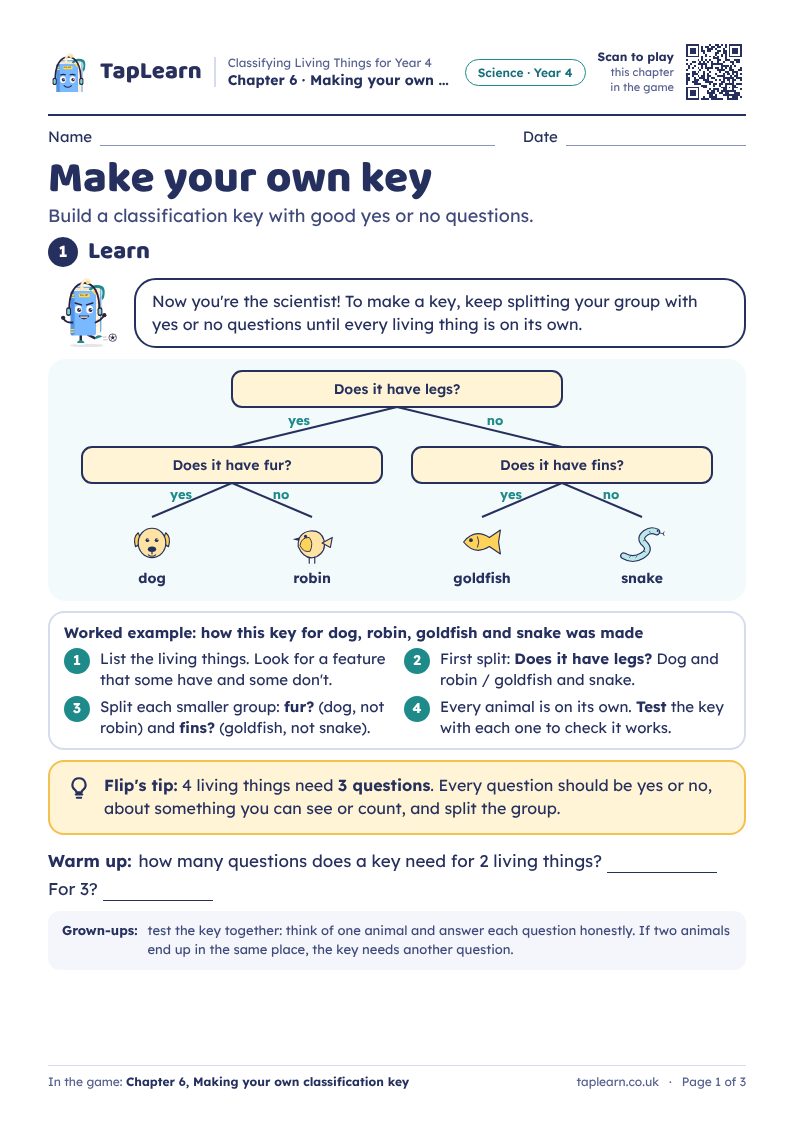
Make Your Own Key is a printable making a classification key worksheet for Year 4 (ages 8 to 9) that teaches children to build, complete and test classification keys using yes or no questions. It follows the Year 4 national curriculum in England: recognise that living things can be grouped in a variety of ways, and explore and use classification keys to identify and name them.
Free to print, no account needed.
Print it on A4, in colour or black and white. Do it after the chapter, or before it to see what your child already knows.
What's on the worksheet
Build and test your own classification keys with yes or no questions that split a group, and fill in missing questions in branching and number keys. With a toy key activity, practice questions and answers.
- Page 1 · Learn
- Flip shows a finished key for a dog, robin, goldfish and snake, then a four-step worked example explains how it was made and tested. A warm-up asks how many questions a key needs.
- Page 2 · Try it together
- Toy key: choose 4 toys, pets or pieces of fruit, write three yes or no questions on a blank branching key, then ask someone else to test it.
- Pages 2–3 · Practise
- Fill in missing questions for an owl, bat, spider and snail, finish a number key for a bee, crab, lizard and frog, fix "Is it big?" and build a key for four minibeasts. Then a challenge about 5 living things.
- Answers sheet
- Every answer by page with example questions, what to watch out for (questions that aren't yes or no, opinion questions, questions that don't split) and quick ideas to go further.
3 A4 pages and an answers sheet · about 35 minutes
Using it at home
- Use real toys or fruit for the toy key so your child can look for differences. You can help with spelling while they do the thinking.
- When the key is finished, secretly pick one item and follow the key yourself. If you reach the wrong name, find the question that needs changing together.
Watch out for
- Picking questions that can't be answered yes or no, like "How many legs?"
- Change it to a yes or no question about the same feature: "Does it have 8 legs?"
- Picking opinion questions, like "Is it big?" or "Is it cute?"
- Choose a feature everyone can see or count, such as fur, wings, legs or a shell.
- Picking questions that both living things answer the same way.
- Put the two side by side and ask, "What can you see that's different?" Use that difference.
Questions from the worksheet
- Fill in the two missing questions in a key for owl, bat, spider and snail.
- Finish this number key for bee, crab, lizard, frog. Write questions 2 and 3.
- Sam's key for rabbit, goldfish, robin and snake starts, "Is it big?" Why is this a problem? What could he ask instead?
- Make your own branching key for robin, butterfly, spider, worm.
- Leo says, "A key for 5 living things needs 5 questions." Is he right? Explain.
The answers are on the answers sheet, for grown-ups.
National curriculum in England
This worksheet practises these statements from the Year 4 science programme of study:
- Recognise that living things can be grouped in a variety of ways
- Explore and use classification keys to help group, identify and name a variety of living things in their local and wider environment
Source: National curriculum in England: science programmes of study (DfE)
In the classroom
- Give groups 4 picture cards each to build a key on a mini-whiteboard, then swap keys with another group to test them.
- Use Leo's challenge as a plenary: how many questions for 6, 8 or 10 living things?
Questions and answers
How do you make a classification key in Year 4?
List the living things, find a yes or no question that splits them into two groups, then keep splitting each group with new questions until every living thing is on its own. Test the key with each one.
How many questions does a classification key need?
A key needs one fewer question than the number of living things, because each question splits one group into two. So 4 living things need 3 questions.
 TapLearn