Classification key questions worksheet for Year 4: Good key questions
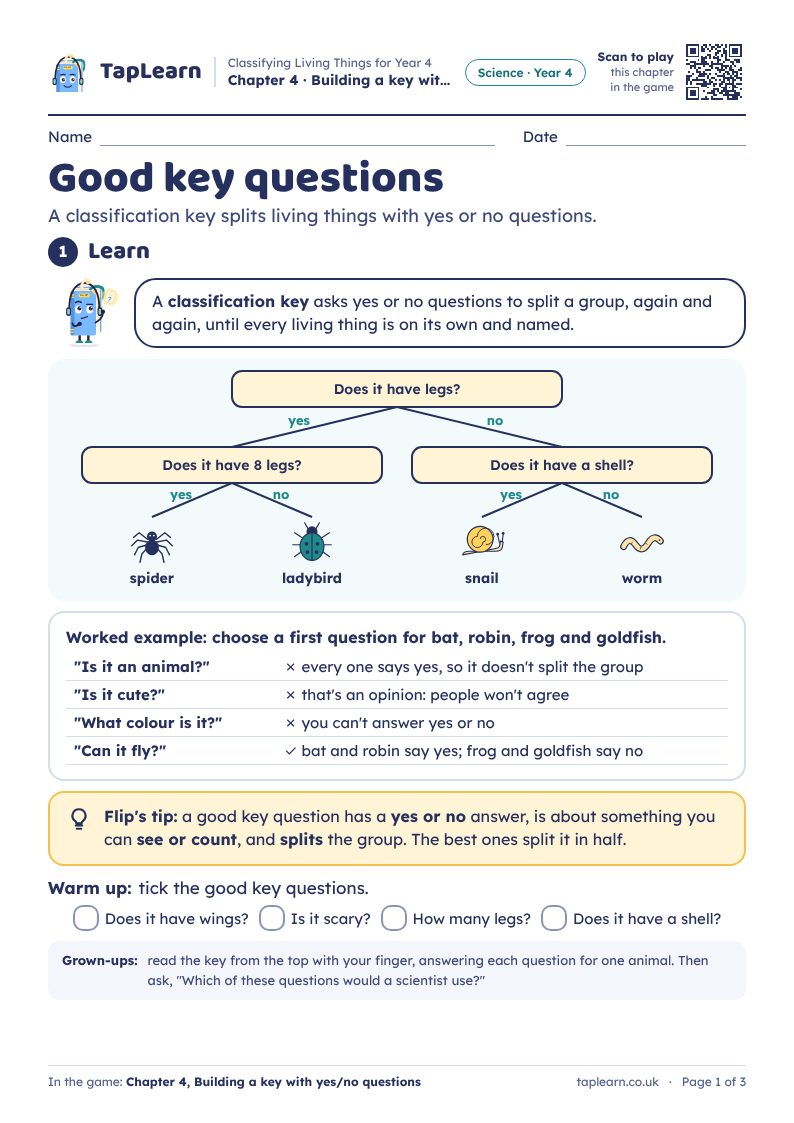
Good Key Questions is a printable classification key questions worksheet for Year 4 (ages 8 to 9) that teaches children to choose yes or no questions about features they can see or count that split a group of living things. It follows the Year 4 national curriculum in England: explore and use classification keys to help group, identify and name a variety of living things.
Free to print, no account needed.
Print it on A4, in colour or black and white. Do it after the chapter, or before it to see what your child already knows.
What's on the worksheet
Choose good yes or no questions for a classification key, about features you can see or count that split a group, and use a branching key to name minibeasts. With a yes or no guessing game, practice questions and answers.
- Page 1 · Learn
- Flip shows a branching key for a spider, ladybird, snail and worm, then a worked example tests four possible first questions for a bat, robin, frog and goldfish. A warm-up ticks the good questions.
- Page 2 · Try it together
- Yes or no detective: guess a secret animal using only yes or no questions, record each question and tick the ones about something you can see or count.
- Pages 2–3 · Practise
- Judge six questions as good or not and say why, use the key to name four mystery minibeasts, write questions to split pairs, and improve "Is it cute?". Then a challenge about "Is it an animal?"
- Answers sheet
- Every answer by page, what to watch out for (opinion questions, questions that aren't yes or no, questions that don't split) and quick ideas to go further.
3 A4 pages and an answers sheet · about 30 minutes
Using it at home
- The guessing game on page 2 works well in the car or at the table. Let your child ask the questions first, then swap.
- If your child asks an opinion question, ask, "Would everyone give the same answer?" It helps them find a feature instead.
Watch out for
- Picking opinion questions, like "Is it cute?"
- Ask, "Would everyone give the same answer?" If not, choose a feature everyone can see, like fur or a shell.
- Picking questions that can't be answered yes or no.
- Turn "What colour is it?" into "Is it red?" or "Does it have stripes?"
- Picking questions that every living thing in the group answers the same way.
- If all the answers are the same, the key can't move on. Look for a feature only some of them have.
Questions from the worksheet
- The group is bee, butterfly, spider, snail. Is "Is it pretty?" a good key question? If not, is it an opinion, not yes or no, or doesn't split?
- Use the key to name the mystery minibeast: it has no legs and a shell on its back.
- Write a yes or no question that splits a robin and a bat.
- Leo wants to split a rabbit and a goldfish. He asks, "Is it cute?" Write a better question.
- Mia's key for robin, bat, frog, goldfish starts, "Is it an animal?" Is that a good first question? Explain.
The answers are on the answers sheet, for grown-ups.
National curriculum in England
This worksheet practises this statement from the Year 4 science programme of study:
- Explore and use classification keys to help group, identify and name a variety of living things in their local and wider environment
Source: National curriculum in England: science programmes of study (DfE)
In the classroom
- Display set A on the board and let pairs sort the questions into good and not good, giving the letter for each reason.
- Play the yes or no guessing game as a whole class, recording only the questions that would work in a key.
Questions and answers
What makes a good classification key question?
A good key question can be answered yes or no, is about something you can see or count, and splits the group into two. "Does it have wings?" is good; "Is it cute?" is not.
What is a classification key?
A classification key is a set of yes or no questions that splits a group of living things again and again until each one can be named. Keys can be drawn as branching diagrams or written as numbered lists.
 TapLearn