What a habitat is worksheet for Year 2: A woodland habitat
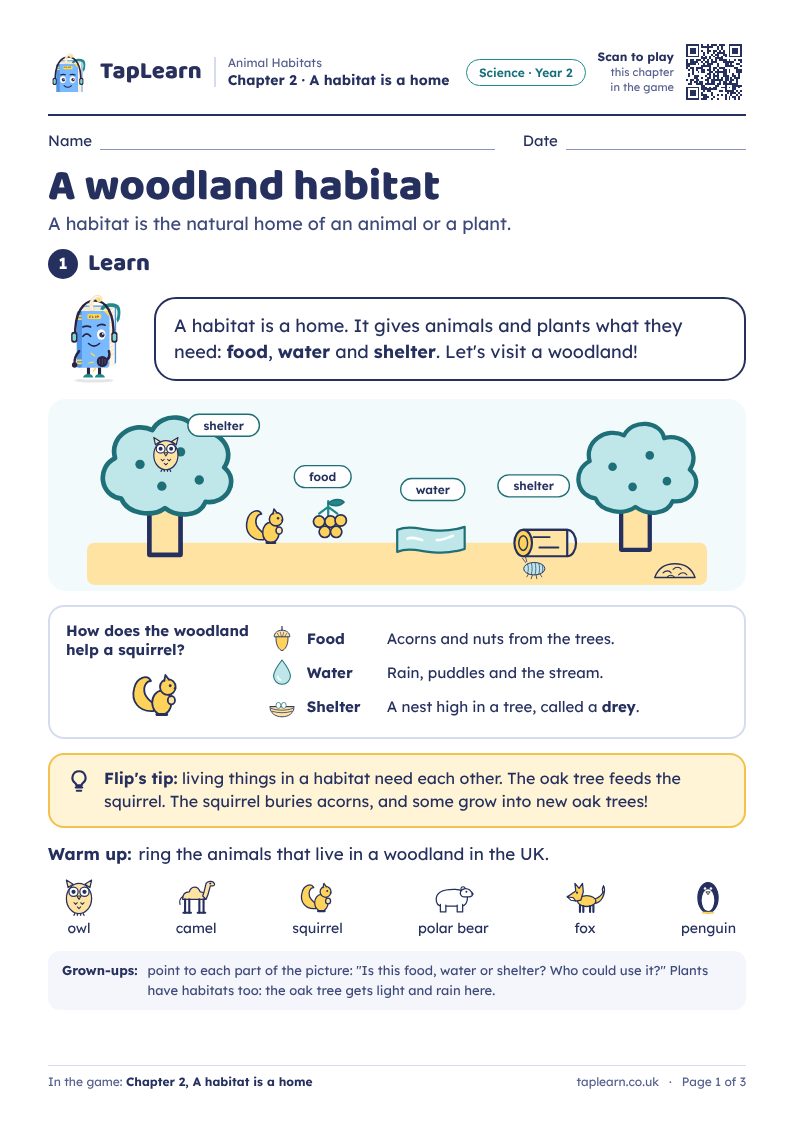
A Woodland Habitat is a printable habitats worksheet for Year 2 (ages 6 to 7) that teaches children that a habitat is a natural home giving animals and plants the food, water and shelter they need. It supports the Year 2 science national curriculum aim of describing how living things in a habitat depend on each other.
Free to print, no account needed.
Print it on A4, in colour or black and white. Do it after the chapter, or before it to see what your child already knows.
What's on the worksheet
Learn what a habitat is and how a woodland gives a squirrel food, water and shelter, and how the oak tree and squirrel need each other. With a woodland-in-a-box to build together, and answers.
- Page 1 · Learn
- How a woodland helps a squirrel with acorns, a stream and a drey, and how squirrels plant new oak trees. Warm-up: ring the animals that live in a UK woodland.
- Page 2 · Try it together
- Woodland in a box: turn a shoebox into a woodland with a twig tree, leaves, a bottle-lid stream and shelters, then give three paper woodland animals a home.
- Page 3 · Practise
- Match animals to their shelters, sort berries, a stream and a nest into food, water or shelter, explain what happens if trees are cut down, and Mia's challenge.
- Answers sheet
- All answers, three mix-ups to watch for, and habitat-spotting and animal riddle ideas.
3 A4 pages and an answers sheet · about 25 minutes
Using it at home
- Point to each part of the page 1 picture and ask "Is this food, water or shelter? Who could use it?"
- Keep the woodland box afterwards and ask "Could a camel live in our woodland? Why not?"
Watch out for
- Thinking a habitat is a house.
- A habitat is a whole natural place, like a woodland or a pond.
- Forgetting plants.
- Plants have habitats too: the oak tree needs the woodland's light and rain.
- One-way thinking about who needs whom.
- Trees feed squirrels, and squirrels plant new trees by burying acorns.
Questions from the worksheet
- Where does each animal shelter? Draw a line to its home.
- Is it food, water or shelter? Write berries, stream, acorns, puddle and nest in the right box.
- Some people cut down all the trees in a woodland. Why would the squirrels have to leave?
- Mia says, "A habitat is just the place where an animal sleeps." Is she right? What else does a habitat give an animal?
The answers are on the answers sheet, for grown-ups.
National curriculum in England
This worksheet practises these statements from the Year 2 science programme of study:
- Identify that most living things live in habitats to which they are suited and describe how different habitats provide for the basic needs of different kinds of animals and plants, and how they depend on each other
- Identify and name a variety of plants and animals in their habitats, including microhabitats
Source: National curriculum in England: science programmes of study (DfE)
In the classroom
- Groups build a woodland in a box together and present who lives there and what each animal uses.
- Exit check: pupils draw a woodland animal with its food, water and shelter labelled.
Questions and answers
What is a habitat in Year 2 science?
A habitat is the natural home of an animal or a plant. It gives living things what they need, such as food, water and shelter.
How does a woodland habitat help a squirrel?
A woodland gives a squirrel acorns and nuts to eat, rain and streams to drink, and trees for its nest, called a drey.
More worksheets from Animal Habitats: Build a Woodland with Dotty the Ladybird
- Chapter 1: What living things need worksheet Free
- Chapter 3: Animals suited to their habitats worksheet: Right animal, right home Free
- Chapter 4: Microhabitats worksheet: Tiny homes Free
- Chapter 5: Simple food chains worksheet: Who eats whom? Free
- Chapter 6: Living, dead and never alive worksheet: Living, dead or never alive Free
 TapLearn