Microhabitats worksheet for Year 2: Tiny homes
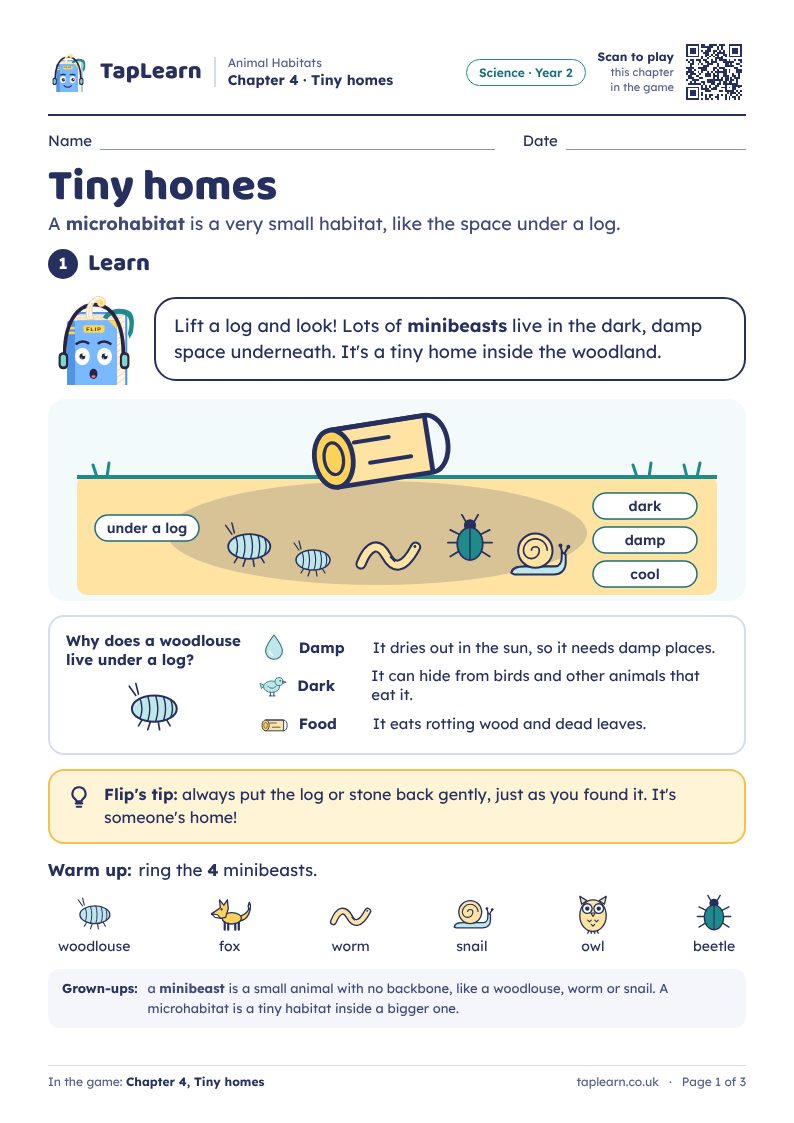
Tiny Homes is a printable microhabitats worksheet for Year 2 (ages 6 to 7) that teaches children what a microhabitat is and why woodlice, worms and snails live in dark, damp places like under a log. It covers the Year 2 science national curriculum aim of identifying and naming plants and animals in their habitats, including microhabitats.
Free to print, no account needed.
Print it on A4, in colour or black and white. Do it after the chapter, or before it to see what your child already knows.
What's on the worksheet
Find minibeasts in microhabitats, like under a log or stone, and explain why they like dark, damp places. With an outdoor tiny home hunt to record together, and answers.
- Page 1 · Learn
- Why a woodlouse lives under a log: it's damp, dark and full of rotting wood to eat. Warm-up: ring the 4 minibeasts among other animals.
- Page 2 · Try it together
- Tiny home hunt: check under a stone, in a leaf pile and on a sunny path, record dark or light and damp or dry, and count the minibeasts before putting everything back.
- Page 3 · Practise
- Match minibeasts to tiny homes, ring where a woodlouse would like to live, a word-box gap fill, draw a minibeast at home, and Leo's woodlouse-in-a-jar challenge.
- Answers sheet
- All answers, three mix-ups to watch for, and ideas for making a tiny home in a shady corner.
3 A4 pages and an answers sheet · about 25 minutes
Using it at home
- Lift stones yourself, let your child look and count without picking anything up, then put everything back and wash hands.
- No outdoor space? Look under a doormat or a plant pot by the door.
Watch out for
- Thinking minibeasts live there because it's dirty.
- They live there because it's dark, damp and cool, with food like rotting leaves and wood.
- Mixing up habitat and microhabitat.
- The woodland is the habitat; the space under a log in it is a microhabitat.
- Taking minibeasts home.
- Look, count and draw, then leave them where they live.
Questions from the worksheet
- Where would a woodlouse like to live: on a dry, sunny wall or in a pile of damp leaves?
- The space under a log is a tiny home called a ___.
- Damp places stop minibeasts drying ___.
- Leo puts a woodlouse in a dry jar on a sunny windowsill so he can watch it. Is that a good home? Where should it go?
The answers are on the answers sheet, for grown-ups.
National curriculum in England
This worksheet practises these statements from the Year 2 science programme of study:
- Identify that most living things live in habitats to which they are suited and describe how different habitats provide for the basic needs of different kinds of animals and plants, and how they depend on each other
- Identify and name a variety of plants and animals in their habitats, including microhabitats
Source: National curriculum in England: science programmes of study (DfE)
In the classroom
- Take the tiny home hunt into the school grounds in small groups and compare counts from the three places back in class.
- Set up a log pile or upturned pots in a shady corner and check it each week.
Questions and answers
What is a microhabitat?
A microhabitat is a very small habitat inside a bigger one, like the space under a log in a woodland. Minibeasts such as woodlice, worms and snails live there.
Why do minibeasts live under logs and stones?
It's dark, damp and cool under logs and stones. Damp stops minibeasts drying out, the dark helps them hide from birds, and rotting wood and leaves give them food.
More worksheets from Animal Habitats: Build a Woodland with Dotty the Ladybird
- Chapter 1: What living things need worksheet Free
- Chapter 2: What a habitat is worksheet: A woodland habitat Free
- Chapter 3: Animals suited to their habitats worksheet: Right animal, right home Free
- Chapter 5: Simple food chains worksheet: Who eats whom? Free
- Chapter 6: Living, dead and never alive worksheet: Living, dead or never alive Free
 TapLearn