What living things need worksheet for Year 2
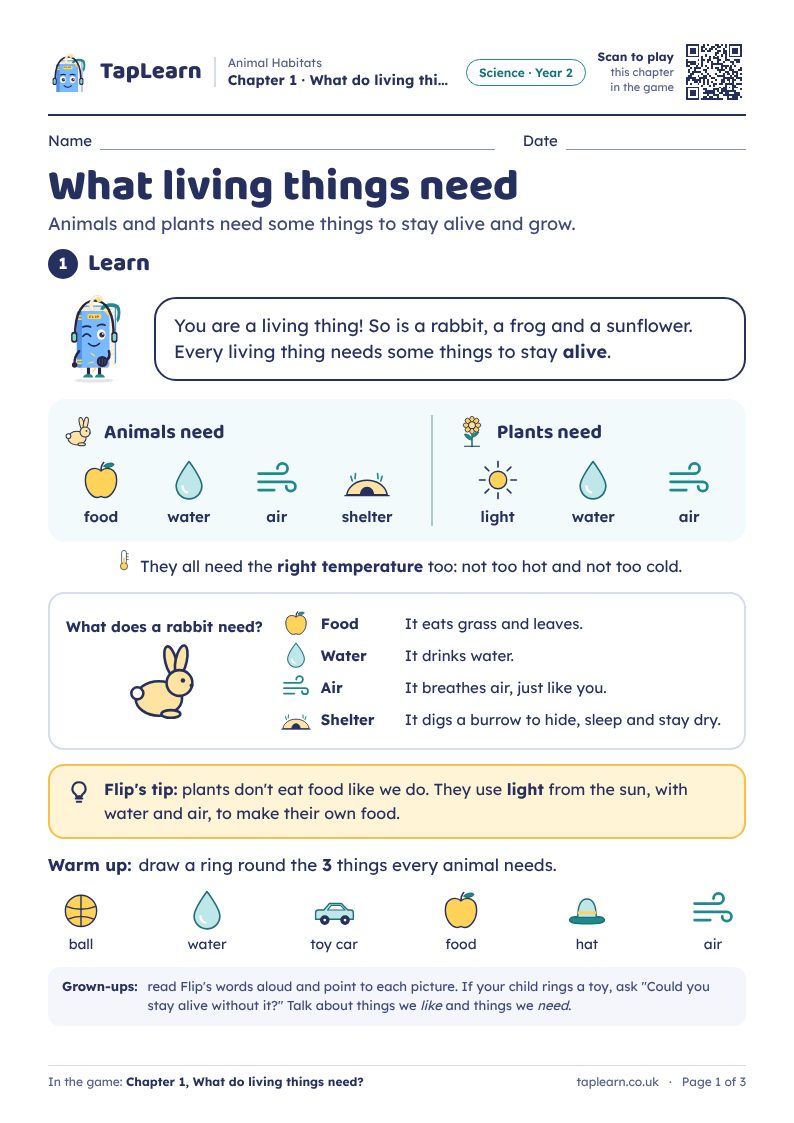
What Living Things Need is a printable science worksheet for Year 2 (ages 6 to 7) that teaches children that animals need food, water, air and shelter, and plants need light, water and air. It supports the Year 2 science national curriculum aim of describing how different habitats provide for the basic needs of different kinds of animals and plants.
Free to print, no account needed.
Print it on A4, in colour or black and white. Do it after the chapter, or before it to see what your child already knows.
What's on the worksheet
Name what animals and plants need to stay alive: food, water, air, shelter, light and the right temperature. With a needs hunt round the home and out of the window, gap-fill practice and answers.
- Page 1 · Learn
- What a rabbit needs to stay alive, with Flip's tip that plants make their own food from light, water and air. Warm-up: ring the 3 things every animal needs.
- Page 2 · Try it together
- Needs hunt: walk round your home to find where you get food, water, air, shelter and warmth, then look out of the window to find where a bird gets each one.
- Page 3 · Practise
- Match words to pictures, a word-box gap fill, spot what's missing for a hamster, a plant and a bird, and Sam's "plants don't need anything" challenge.
- Answers sheet
- All answers, four mix-ups to watch for, and two quick games: need or like, and checking a pet's or houseplant's needs.
3 A4 pages and an answers sheet · about 20 minutes
Using it at home
- If your child rings a toy in the warm-up, ask "Could you stay alive without it?" and talk about things we like and things we need.
- Do the needs hunt in daylight so you can watch the birds outside, and let your child decide where a bird would find each thing.
Watch out for
- Mixing up likes and needs, such as listing toys or sweets.
- Ask "Could you stay alive without it?"
- Thinking plants eat soil.
- Roots take in water, but plants make their own food using light.
- Forgetting air.
- We can't see it, so it gets missed, but every living thing needs air all the time.
Questions from the worksheet
- A duck drinks ___ from the pond.
- A plant in a dark cupboard grows weak. What does it need?
- The bird has food, water and air, but its tree was cut down. What does it need?
- Sam says, "Plants don't eat, so they don't need anything." Is Sam right? What does a plant need?
The answers are on the answers sheet, for grown-ups.
National curriculum in England
This worksheet practises these statements from the Year 2 science programme of study:
- Identify that most living things live in habitats to which they are suited and describe how different habitats provide for the basic needs of different kinds of animals and plants, and how they depend on each other
- Identify and name a variety of plants and animals in their habitats, including microhabitats
Source: National curriculum in England: science programmes of study (DfE)
In the classroom
- Starter: show pictures of a toy, water, a coat and food and have pupils sort them into need or like with thumbs up or down.
- Use the "what is missing?" questions as a mini-whiteboard check before moving on to habitats.
Questions and answers
What do living things need to survive?
Animals need food, water, air and shelter to survive, and plants need light, water and air. All living things also need the right temperature, not too hot and not too cold.
Do plants need food?
Plants don't eat food like animals do. They use light from the sun, with water and air, to make their own food.
More worksheets from Animal Habitats: Build a Woodland with Dotty the Ladybird
- Chapter 2: What a habitat is worksheet: A woodland habitat Free
- Chapter 3: Animals suited to their habitats worksheet: Right animal, right home Free
- Chapter 4: Microhabitats worksheet: Tiny homes Free
- Chapter 5: Simple food chains worksheet: Who eats whom? Free
- Chapter 6: Living, dead and never alive worksheet: Living, dead or never alive Free
 TapLearn