Animals suited to their habitats worksheet for Year 2: Right animal, right home
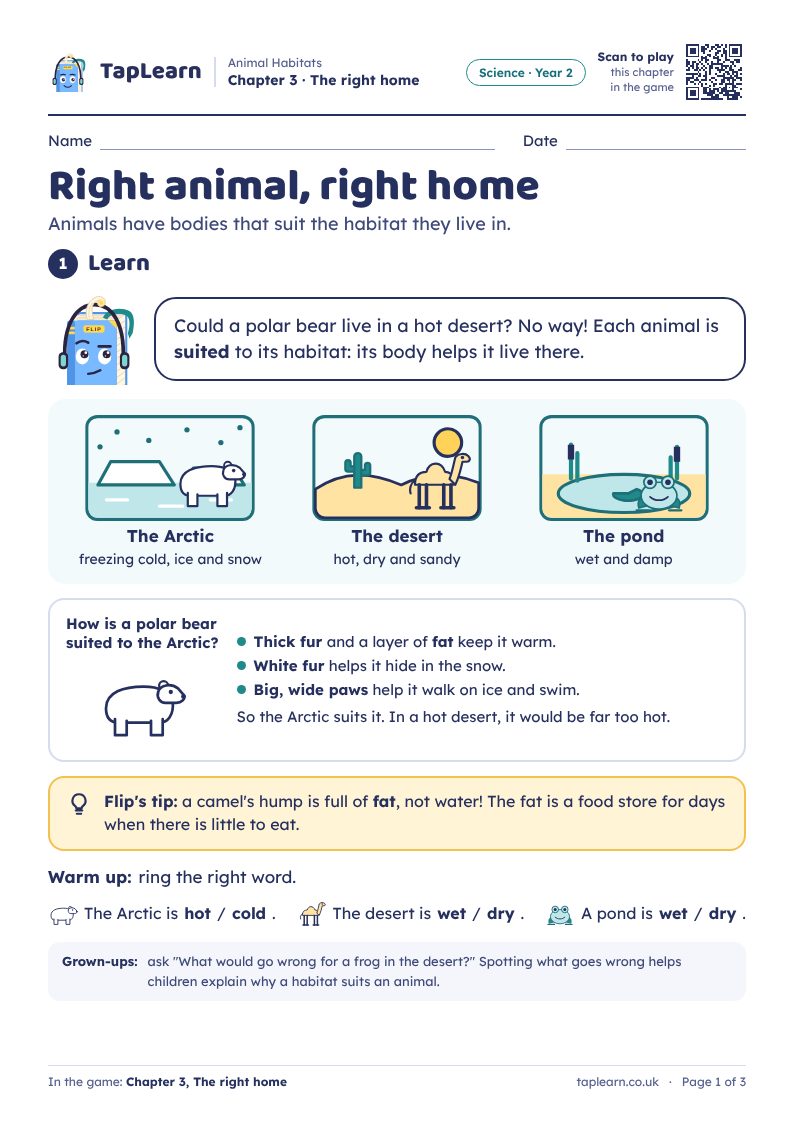
Right Animal, Right Home is a printable habitats worksheet for Year 2 (ages 6 to 7) that teaches children how a polar bear, a camel and a frog have bodies suited to the Arctic, the desert and the pond. It covers the Year 2 science national curriculum aim of identifying that most living things live in habitats to which they are suited.
Free to print, no account needed.
Print it on A4, in colour or black and white. Do it after the chapter, or before it to see what your child already knows.
What's on the worksheet
Match a polar bear, a camel and a frog to the habitats that suit them and say how their bodies help. With a blubber glove experiment to try together, and answers.
- Page 1 · Learn
- How thick fur, fat, white fur and wide paws suit a polar bear to the Arctic, and Flip's tip that a camel's hump holds fat, not water. Warm-up: hot or cold, wet or dry.
- Page 2 · Try it together
- The blubber glove: spread butter between two sandwich bags, then dip a hand in icy water with and without the glove to feel how fat keeps a polar bear warm.
- Page 3 · Practise
- Ring the habitat for a frog and a camel, explain why a frog can't live in the desert, match body parts to their jobs, tick the right homes, and Ava's challenge.
- Answers sheet
- All answers, two mix-ups to watch for, and a "pack for the trip" talk game.
3 A4 pages and an answers sheet · about 25 minutes
Using it at home
- Have a towel ready for the blubber glove and tell your child to pull their hand out as soon as it feels too cold.
- Ask "What would go wrong for a frog in the desert?": spotting what goes wrong helps children explain why a habitat suits an animal.
Watch out for
- Putting an animal in the wrong habitat, such as polar bears with penguins.
- Ask "Is it hot or cold there? Wet or dry? What would it eat?"
- Thinking a camel's hump is full of water.
- It's full of fat, a food store. Camels can go a long time without drinking, though.
Questions from the worksheet
- Why can't a frog live in the desert? Write one reason.
- How does it help? Match a camel's long eyelashes, a camel's wide feet, a frog's webbed feet and a polar bear's thick fur to their jobs.
- Is this the right home? A fish in the desert, a frog by the pond.
- Ava says, "A polar bear would be fine in the desert, because its fur is so thick." Is she right? Why?
The answers are on the answers sheet, for grown-ups.
National curriculum in England
This worksheet practises these statements from the Year 2 science programme of study:
- Identify that most living things live in habitats to which they are suited and describe how different habitats provide for the basic needs of different kinds of animals and plants, and how they depend on each other
- Identify and name a variety of plants and animals in their habitats, including microhabitats
Source: National curriculum in England: science programmes of study (DfE)
In the classroom
- Demonstrate the blubber glove to the class and let volunteers try it, recording how cold each hand felt.
- In pairs, pupils play "pack for the trip": what would you need to be more like a polar bear in the Arctic, then a camel in the desert?
Questions and answers
How are animals suited to their habitats?
Animals have bodies that help them live in their habitat. A polar bear's thick fur and fat keep it warm in the Arctic, and a camel's wide feet stop it sinking into desert sand.
What is in a camel's hump?
A camel's hump is full of fat, not water. The fat is a food store for days when there is little to eat.
More worksheets from Animal Habitats: Build a Woodland with Dotty the Ladybird
- Chapter 1: What living things need worksheet Free
- Chapter 2: What a habitat is worksheet: A woodland habitat Free
- Chapter 4: Microhabitats worksheet: Tiny homes Free
- Chapter 5: Simple food chains worksheet: Who eats whom? Free
- Chapter 6: Living, dead and never alive worksheet: Living, dead or never alive Free
 TapLearn