Simple food chains worksheet for Year 2: Who eats whom?
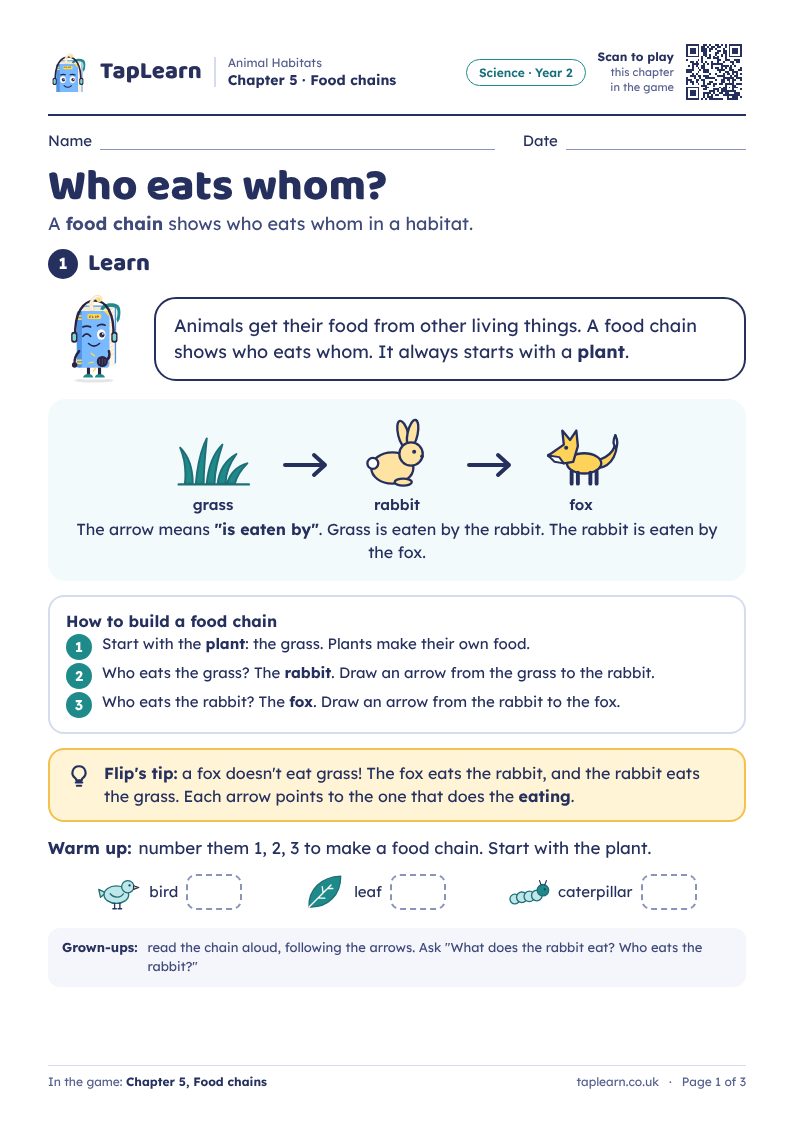
Who Eats Whom? is a printable food chains worksheet for Year 2 (ages 6 to 7) that teaches children to build simple food chains starting with a plant and read each arrow as "is eaten by". It supports the Year 2 science national curriculum aim of describing how living things in a habitat depend on each other.
Free to print, no account needed.
Print it on A4, in colour or black and white. Do it after the chapter, or before it to see what your child already knows.
What's on the worksheet
Build simple food chains that start with a plant, such as grass, rabbit, fox, and point the arrows the right way. With a food chain card game to play together, and answers.
- Page 1 · Learn
- How to build the grass, rabbit, fox food chain step by step, and what the arrows mean. Warm-up: number a leaf, caterpillar and bird 1, 2, 3.
- Page 2 · Try it together
- Food chain cards: draw nine living things, find the three plants, build three chains on the table with spoons as arrows, then take away the mouse and talk about the owl.
- Page 3 · Practise
- Number food chains 1, 2, 3, tick or cross the arrows, fill gaps from the chains, explain what happens if all the grass dies, and Mia's fox-eats-grass challenge.
- Answers sheet
- All answers, three mix-ups to watch for, and human food chain and line-up games.
3 A4 pages and an answers sheet · about 25 minutes
Using it at home
- Read each chain aloud together, following the arrows: "Grass is eaten by the rabbit, the rabbit is eaten by the fox."
- If your child puts the fox next to the grass, ask "Does a fox eat grass?" and let them move the cards themselves.
Watch out for
- Thinking a predator eats plants, such as "the fox eats grass".
- Point to one arrow at a time and ask "Who eats the grass?"
- Pointing the arrows the wrong way.
- The arrow means "is eaten by", so it points from the food to the eater.
- Starting a food chain with an animal.
- Every food chain starts with a plant.
Questions from the worksheet
- Number each food chain 1, 2, 3: owl, acorn, mouse. Start with the plant.
- The mouse is eaten by the ___.
- All the grass in a field dies. What happens to the rabbits? What happens to the foxes?
- Mia says, "The fox is in the same food chain as the grass, so the fox eats grass." Is she right? Who eats what?
The answers are on the answers sheet, for grown-ups.
National curriculum in England
This worksheet practises these statements from the Year 2 science programme of study:
- Identify that most living things live in habitats to which they are suited and describe how different habitats provide for the basic needs of different kinds of animals and plants, and how they depend on each other
- Identify and name a variety of plants and animals in their habitats, including microhabitats
Source: National curriculum in England: science programmes of study (DfE)
In the classroom
- Hand out food chain cards to groups and time how quickly they can build three correct chains.
- Physical food chain: pupils hold cards and line up in order, then one sits down to show what happens when a link disappears.
Questions and answers
What is a food chain for Year 2?
A food chain shows who eats whom in a habitat. It always starts with a plant, such as grass, rabbit, fox.
What do the arrows in a food chain mean?
Each arrow means "is eaten by", so it points from the food to the animal that eats it. In grass → rabbit, the grass is eaten by the rabbit.
More worksheets from Animal Habitats: Build a Woodland with Dotty the Ladybird
- Chapter 1: What living things need worksheet Free
- Chapter 2: What a habitat is worksheet: A woodland habitat Free
- Chapter 3: Animals suited to their habitats worksheet: Right animal, right home Free
- Chapter 4: Microhabitats worksheet: Tiny homes Free
- Chapter 6: Living, dead and never alive worksheet: Living, dead or never alive Free
 TapLearn