Living, dead and never alive worksheet for Year 2: Living, dead or never alive
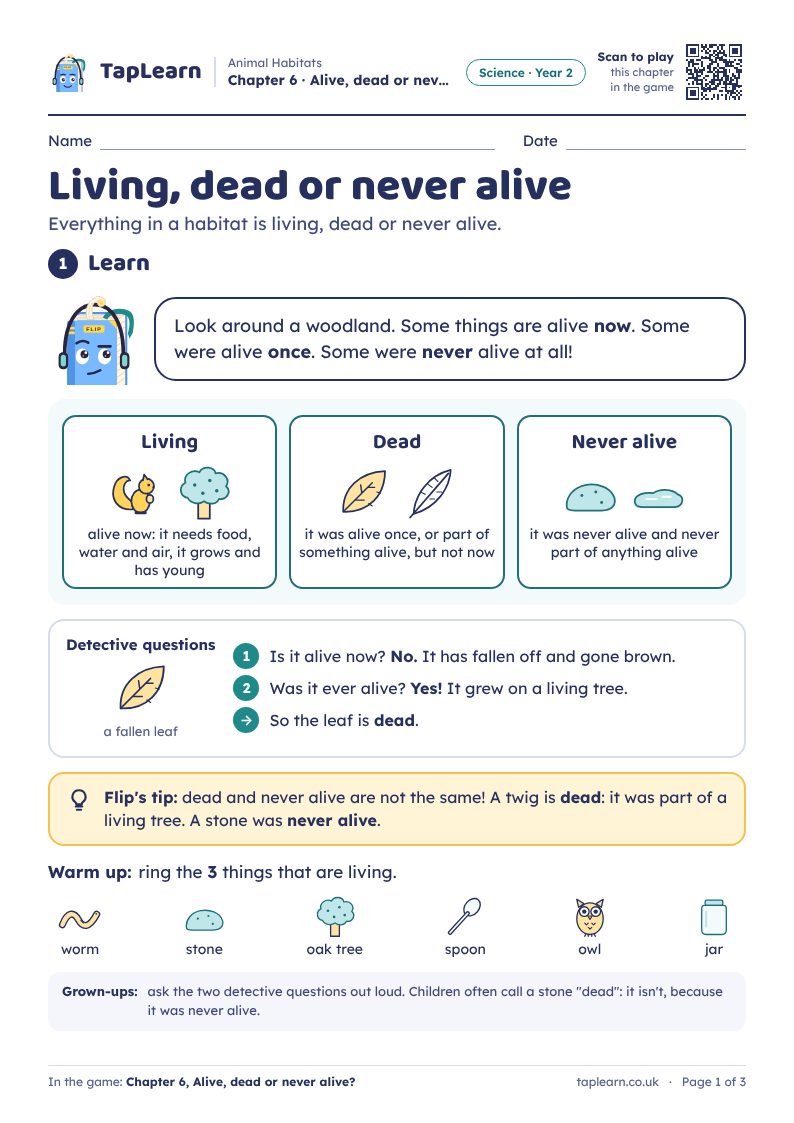
Living, Dead or Never Alive is a printable science worksheet for Year 2 (ages 6 to 7) that teaches children to sort things into living, dead and never alive using two questions: is it alive now, and was it ever alive? On it, children sort real things from home and outdoors and explain how a dead leaf differs from a stone.
Free to print, no account needed.
Print it on A4, in colour or black and white. Do it after the chapter, or before it to see what your child already knows.
What's on the worksheet
Sort things in a habitat into living, dead (once alive) and never alive using two detective questions. With a big sort of things from home, true or false practice and answers.
- Page 1 · Learn
- What living, dead and never alive mean, and the two detective questions worked through for a fallen leaf. Warm-up: ring the 3 living things.
- Page 2 · Try it together
- The big sort: collect things like a houseplant, a twig, a stone, a wooden and a metal spoon, paper and a woolly sock, and sort them onto three labelled sheets.
- Page 3 · Practise
- Sort pictures such as a log, feather, shell and glass jar, a true or false quiz, a detective question practice, draw a minibeast under a dead log, and Sam's challenge.
- Answers sheet
- All answers, three mix-ups to watch for, and walk-and-spot and kitchen sort games.
3 A4 pages and an answers sheet · about 25 minutes
Using it at home
- Ask both detective questions out loud for every object, and swap roles so your child checks your sorting.
- Leave living plants and minibeasts where they are and draw them instead of bringing them in.
Watch out for
- Mixing up dead and never alive.
- A dead leaf was once alive; a rock never was. Always ask both questions.
- Sorting things made from living things, like wooden spoons, paper or wool.
- They go on the dead sheet, because they came from trees or sheep.
- Thinking "it moves, so it's alive".
- Water, wind and cars move, but they don't grow, eat or have young.
Questions from the worksheet
- True or false? A twig was once alive.
- True or false? A stone was once alive.
- True or false? Water in a stream is alive, because it moves.
- Sam says, "A dead leaf and a stone are the same, because they're not alive." Is he right? What is different about them?
The answers are on the answers sheet, for grown-ups.
National curriculum in England
This worksheet practises these statements from the Year 2 science programme of study:
- Identify that most living things live in habitats to which they are suited and describe how different habitats provide for the basic needs of different kinds of animals and plants, and how they depend on each other
- Identify and name a variety of plants and animals in their habitats, including microhabitats
Source: National curriculum in England: science programmes of study (DfE)
In the classroom
- Give each table a tray of objects and three hoops labelled living, dead and never alive for a group sort.
- Hold up one object at a time and have pupils show L, D or N on mini-whiteboards.
Questions and answers
What is the difference between dead and never alive?
Something dead was once alive, like a fallen leaf or a twig. Something never alive was never living or part of a living thing, like a stone or a metal spoon.
Is a wooden spoon dead or never alive?
A wooden spoon is dead, because wood comes from a tree that was once alive. Paper and wool are dead for the same reason.
More worksheets from Animal Habitats: Build a Woodland with Dotty the Ladybird
- Chapter 1: What living things need worksheet Free
- Chapter 2: What a habitat is worksheet: A woodland habitat Free
- Chapter 3: Animals suited to their habitats worksheet: Right animal, right home Free
- Chapter 4: Microhabitats worksheet: Tiny homes Free
- Chapter 5: Simple food chains worksheet: Who eats whom? Free
 TapLearn