Types of adaptation worksheet for Year 6: Spotting adaptations
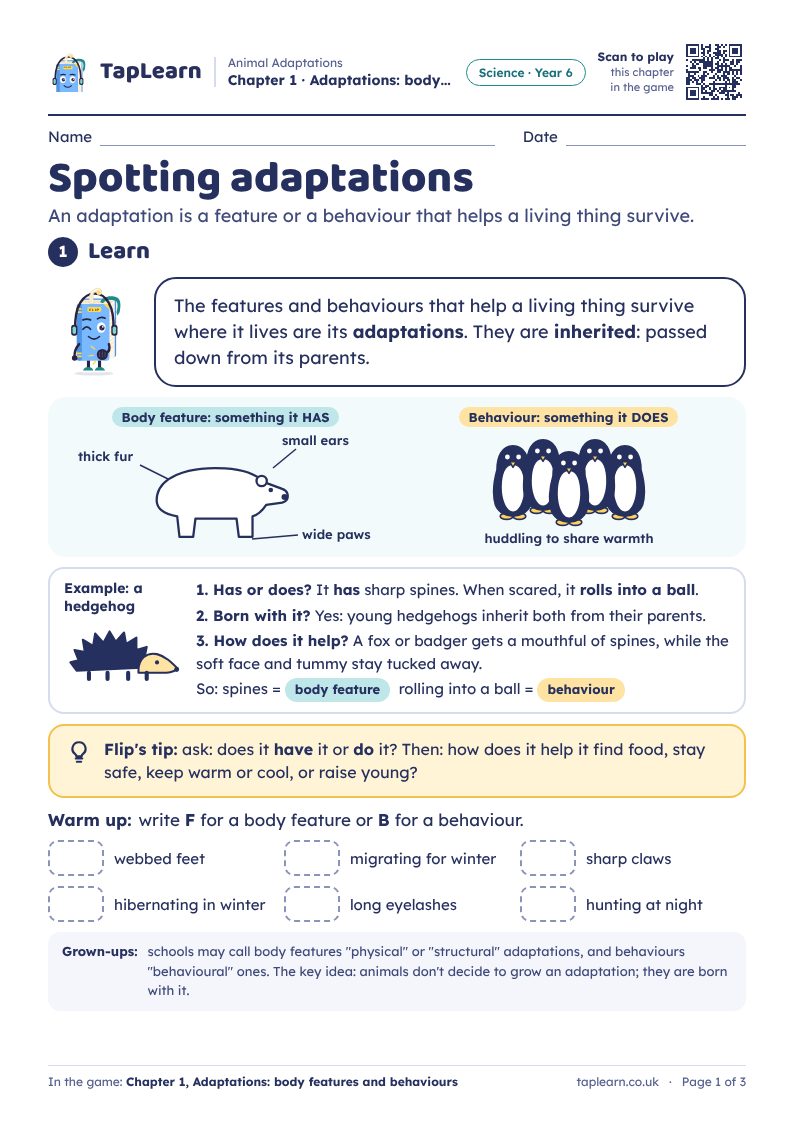
Spotting Adaptations is a printable types of adaptation worksheet for Year 6 (ages 10 to 11) that teaches children that an adaptation is an inherited body feature or behaviour, and how to tell the two apart. It supports the Year 6 science statement to identify how animals and plants are adapted to suit their environment in different ways.
Free to print, no account needed.
Print it on A4, in colour or black and white. Do it after the chapter, or before it to see what your child already knows.
What's on the worksheet
Your child learns that an adaptation is an inherited body feature or behaviour that helps a living thing survive, and sorts examples from hedgehogs to owls. Includes an adaptation hunt at a window or in the park, and an answers sheet.
- Page 1 · Learn
- Body features (something it has) and behaviours (something it does), with a hedgehog worked example and a warm-up sorting webbed feet, migrating, hibernating and more.
- Page 2 · Try it together
- Adaptation hunt: watch birds, insects, plants or a pet for 5 minutes, then record one body feature, one behaviour and how each helps it survive. Then match adaptations to how they help.
- Page 3 · Practise
- Sort adaptations into features and behaviours, ring three things that aren't inherited, describe an animal of your choice, and a challenge about ducks 'deciding' to grow webbed feet.
- Answers sheet
- Every answer with model responses, the three common mix-ups to watch for, and a 'has it or does it?' game to play with no paper.
3 A4 pages and an answers sheet · about 30 minutes
Using it at home
- Do the adaptation hunt at a window or in the park. If it's raining, a pet or an animal in a book works just as well.
- Keep one question going throughout: "Does it have it or do it?" That single question sorts almost every example on the sheet.
- Your child's school may say "physical" or "structural" for body features and "behavioural" for behaviours. Use whichever words they know.
Watch out for
- Saying the animal chose or grew an adaptation because it needed it.
- Ask: "Was it born like that? Did it get it from its parents?" Adaptations are inherited, not decided.
- Mixing up body features and behaviours.
- Thick fur is a feature; huddling is a behaviour. Ask: "Does it have it, or do it?"
- Counting anything useful as an adaptation.
- A learnt trick, an injury or a dog's coat may help, but they aren't inherited, so they aren't adaptations.
Questions from the worksheet
- Sort these adaptations into body feature or behaviour: thick fur, huddling together, a long, sticky tongue, digging a burrow, colours that match the background, playing dead.
- Ring the three that are not adaptations, because they aren't inherited: a dog that learnt to fetch, a cat's sharp claws, a fox's scar from a fight, a bat's big ears, a dog in a raincoat.
- Choose any animal. Name one body feature and one behaviour, and say how each one helps it.
- Mia says, "Ducks decided to grow webbed feet because they wanted to be good swimmers." Is Mia right? Explain your answer.
The answers are on the answers sheet, for grown-ups.
National curriculum in England
This worksheet practises this statement from the Year 6 science programme of study:
- Identify how animals and plants are adapted to suit their environment in different ways and that adaptation may lead to evolution
Source: National curriculum in England: science programmes of study (DfE)
In the classroom
- Use the warm-up as a starter: read each adaptation aloud and children show F or B on mini-whiteboards.
- Send pairs on the adaptation hunt in the school grounds, then pool the results into a class feature and behaviour chart.
Questions and answers
What is an adaptation in Year 6 science?
An adaptation is an inherited body feature or behaviour that helps a living thing survive where it lives. A hedgehog's spines and its habit of rolling into a ball are both adaptations.
What is the difference between a physical and a behavioural adaptation?
A physical (or structural) adaptation is a body feature the animal has, like thick fur. A behavioural adaptation is something it does, like huddling or hibernating.
Is a learnt behaviour an adaptation?
No. A trick an animal learns, like a dog fetching, isn't inherited from its parents, so it isn't an adaptation.
More worksheets from Animal Adaptations: Survive Every Habitat with Kiko
- Chapter 2: Desert adaptations worksheet: Desert survivors Free
- Chapter 3: Polar adaptations worksheet: Built for the cold Free
- Chapter 4: Ocean adaptations worksheet: Life in the ocean Free
- Chapter 5: Rainforest adaptations worksheet: Rainforest survivors Free
- Chapter 6: Adaptation and evolution worksheet: Adaptation to evolution Free
 TapLearn