Desert adaptations worksheet for Year 6: Desert survivors
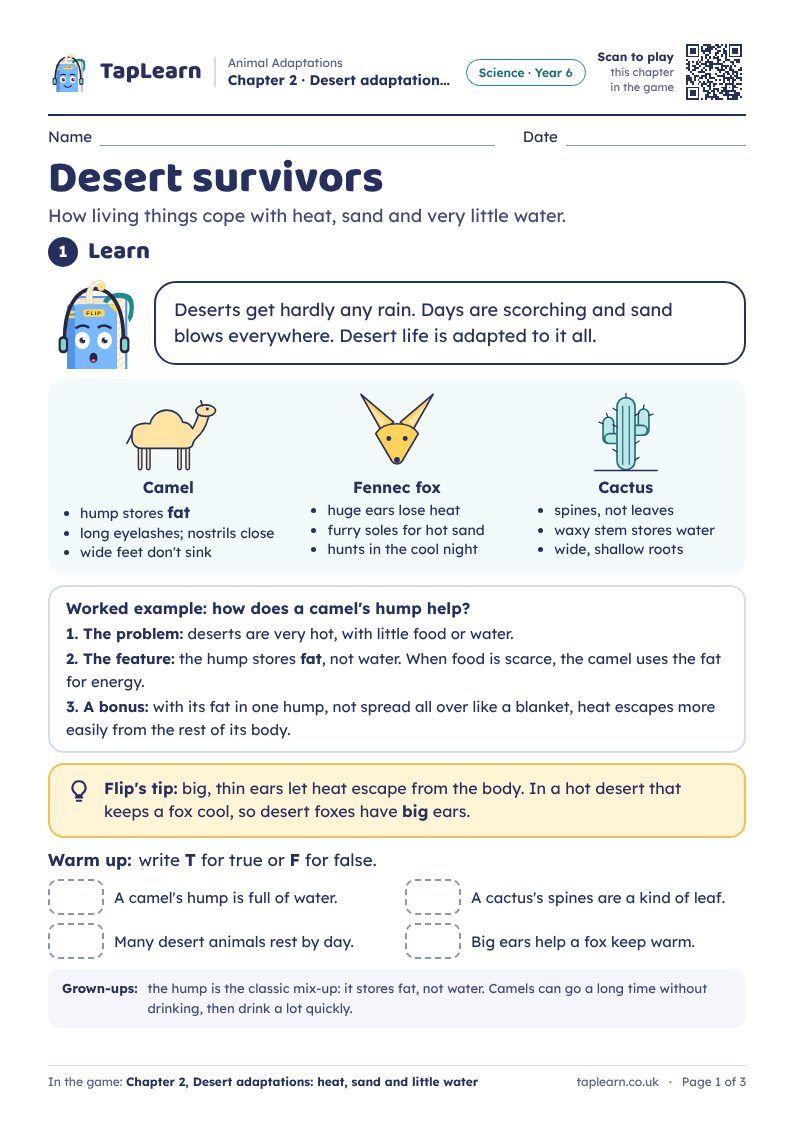
Desert Survivors is a printable desert adaptations worksheet for Year 6 (ages 10 to 11) that teaches children how camels, fennec foxes and cacti are adapted to heat, sand and very little water. It covers the Year 6 science statement to identify how animals and plants are adapted to suit their environment in different ways.
Free to print, no account needed.
Print it on A4, in colour or black and white. Do it after the chapter, or before it to see what your child already knows.
What's on the worksheet
Your child explains how camels, fennec foxes and cacti cope with heat, sand and little water, including what a camel's hump really stores. Includes a damp kitchen-roll test of water loss to do together, and an answers sheet.
- Page 1 · Learn
- The adaptations of a camel, a fennec fox and a cactus, a worked example on what a camel's hump stores, and a true-or-false warm-up.
- Page 2 · Try it together
- The thirsty towel test: lay one damp sheet of kitchen roll flat like a leaf, roll another up like a cactus stem, and compare how fast they dry in a warm spot.
- Page 3 · Practise
- Fill the gaps about camels, foxes and cacti, decide whether adaptations are features or behaviours, choose the better desert plant, design a desert animal, and a hump challenge.
- Answers sheet
- Every answer, what the towel test should show and why, the two classic mix-ups, and a plant detective activity with houseplants.
3 A4 pages and an answers sheet · about 30 minutes
Using it at home
- Start the towel test before anything else on the sheet: it needs an hour to finish, so check it again once the practise page is done.
- Add the optional cling film roll if you can. It turns the test into a model of a cactus's waxy skin.
- Ask "What would a camel need when there's no food?" before reading the worked example, and let your child guess.
Watch out for
- Thinking a camel's hump holds water.
- It stores fat, which the camel uses for energy when food is scarce. Camels save water in other ways, then drink lots when they can.
- Thinking big ears keep an animal warm.
- Big, thin ears let heat escape, which keeps a desert fox cool. Arctic foxes have small ears to keep heat in.
Questions from the worksheet
- A camel's hump stores ___, which it uses for energy.
- Is a fennec fox's huge ears a body feature or a behaviour? How does it help it survive?
- Is a lizard hiding under a rock at midday a body feature or a behaviour? How does it help?
- Design a new desert animal. Draw it and label two adaptations: one body feature and one behaviour.
- Sam says, "A camel's hump is a water tank." Is he right? What does the hump store, and how does it help?
The answers are on the answers sheet, for grown-ups.
National curriculum in England
This worksheet practises this statement from the Year 6 science programme of study:
- Identify how animals and plants are adapted to suit their environment in different ways and that adaptation may lead to evolution
Source: National curriculum in England: science programmes of study (DfE)
In the classroom
- Set up the towel test at the start of the lesson with groups making predictions, and check the results at the end.
- Use Practise D as a design challenge: groups swap their desert animals and judge whether each label explains how it helps.
Questions and answers
What does a camel's hump store?
A camel's hump stores fat, not water. The camel uses the fat for energy when food is scarce, and keeping fat in one place helps heat escape from the rest of its body.
How is a cactus adapted to the desert?
A cactus has spines instead of wide leaves and a thick, waxy stem that stores water, so it loses very little water. Its wide, shallow roots soak up rain quickly.
Why do desert foxes have big ears?
Big, thin ears let heat escape from the body, which helps a fennec fox stay cool in the hot desert.
More worksheets from Animal Adaptations: Survive Every Habitat with Kiko
- Chapter 1: Types of adaptation worksheet: Spotting adaptations Free
- Chapter 3: Polar adaptations worksheet: Built for the cold Free
- Chapter 4: Ocean adaptations worksheet: Life in the ocean Free
- Chapter 5: Rainforest adaptations worksheet: Rainforest survivors Free
- Chapter 6: Adaptation and evolution worksheet: Adaptation to evolution Free
 TapLearn