Rainforest adaptations worksheet for Year 6: Rainforest survivors
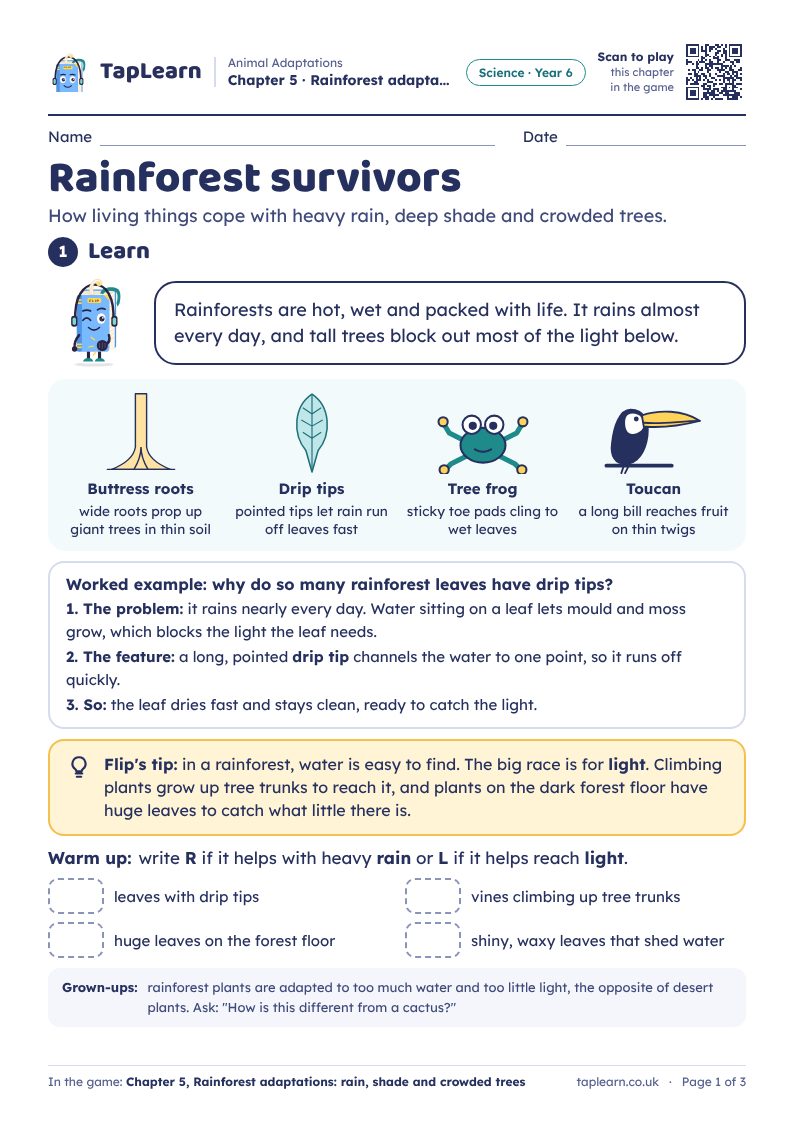
Rainforest Survivors is a printable rainforest adaptations worksheet for Year 6 (ages 10 to 11) that teaches children how rainforest plants and animals cope with heavy rain, deep shade and crowded trees. It covers the Year 6 science statement to identify how animals and plants are adapted to suit their environment in different ways.
Free to print, no account needed.
Print it on A4, in colour or black and white. Do it after the chapter, or before it to see what your child already knows.
What's on the worksheet
Your child explains how rainforest plants and animals cope with heavy rain, deep shade and crowded trees, from drip tips and buttress roots to tree frogs and toucans. Includes a drip-tip leaf test and an answers sheet.
- Page 1 · Learn
- Buttress roots, drip tips, tree frogs and toucans, a worked example on why leaves have drip tips, and a warm-up sorting adaptations for heavy rain or reaching light.
- Page 2 · Try it together
- The drip-tip test: cut a round leaf and a pointed leaf from a food bag or foil, drip water onto each and see which sheds it faster. Then match animal adaptations to how they help.
- Page 3 · Practise
- Explain buttress roots and climbing lianas, sort features from behaviours, design a plant for the dark forest floor, and a challenge comparing rainforest plants with a cactus.
- Answers sheet
- Every answer, what the drip-tip test usually shows, mix-ups like thinking slow means weak, and a houseplant hunt for rainforest features.
3 A4 pages and an answers sheet · about 30 minutes
Using it at home
- Hold both paper leaves at the same angle over a tray during the drip-tip test so the comparison is fair.
- If your child has done the desert sheet, ask "How is this different from a cactus?" to bring out too much water versus too little.
- Many houseplants come from rainforests. Look together for big leaves, pointed tips or climbing stems.
Watch out for
- Thinking all plants need to save water.
- Different habitats bring different problems. In a rainforest the problem is too much water and too little light.
- Thinking a slow animal is weak.
- A sloth's slowness is an adaptation: eagles hunt by spotting movement, so moving slowly keeps it hidden.
- Thinking bright colours always help an animal hide.
- Some animals are camouflaged, but a poison dart frog's bright colours warn predators that it is poisonous.
Questions from the worksheet
- Rainforest soil is thin, so tree roots can't grow deep. How do buttress roots help a giant tree?
- A liana is a vine that starts on the dark forest floor and climbs up a tree trunk. Why does it climb?
- Is each one a body feature or a behaviour? A sloth's long, curved claws; a sloth moving very slowly; a jaguar hunting at night.
- Design a plant for the dark rainforest floor. Draw it and label two adaptations.
- Sam says, "Rainforest plants need adaptations to find water, just like a cactus." Is Sam right? Explain.
The answers are on the answers sheet, for grown-ups.
National curriculum in England
This worksheet practises this statement from the Year 6 science programme of study:
- Identify how animals and plants are adapted to suit their environment in different ways and that adaptation may lead to evolution
Source: National curriculum in England: science programmes of study (DfE)
In the classroom
- Run the drip-tip test in pairs with each pair trying a different leaf shape, then compare which shapes shed water fastest.
- Use the warm-up as a starter, with children standing for R (heavy rain) and sitting for L (reaching light).
Questions and answers
What is a drip tip on a leaf?
A drip tip is a long, pointed end on a leaf that channels rainwater to one point so it runs off quickly. This keeps the leaf dry and clean, so mould and moss don't block its light.
How are rainforest plants adapted to get light?
Climbing plants such as lianas grow up tree trunks to reach the light at the top of the forest. Plants on the dark forest floor have huge leaves to catch what little light there is.
What are buttress roots?
Buttress roots are wide roots that spread out above the ground around a giant rainforest tree. They prop up the tall trunk in thin soil so the tree doesn't topple over.
More worksheets from Animal Adaptations: Survive Every Habitat with Kiko
- Chapter 1: Types of adaptation worksheet: Spotting adaptations Free
- Chapter 2: Desert adaptations worksheet: Desert survivors Free
- Chapter 3: Polar adaptations worksheet: Built for the cold Free
- Chapter 4: Ocean adaptations worksheet: Life in the ocean Free
- Chapter 6: Adaptation and evolution worksheet: Adaptation to evolution Free
 TapLearn