Polar adaptations worksheet for Year 6: Built for the cold
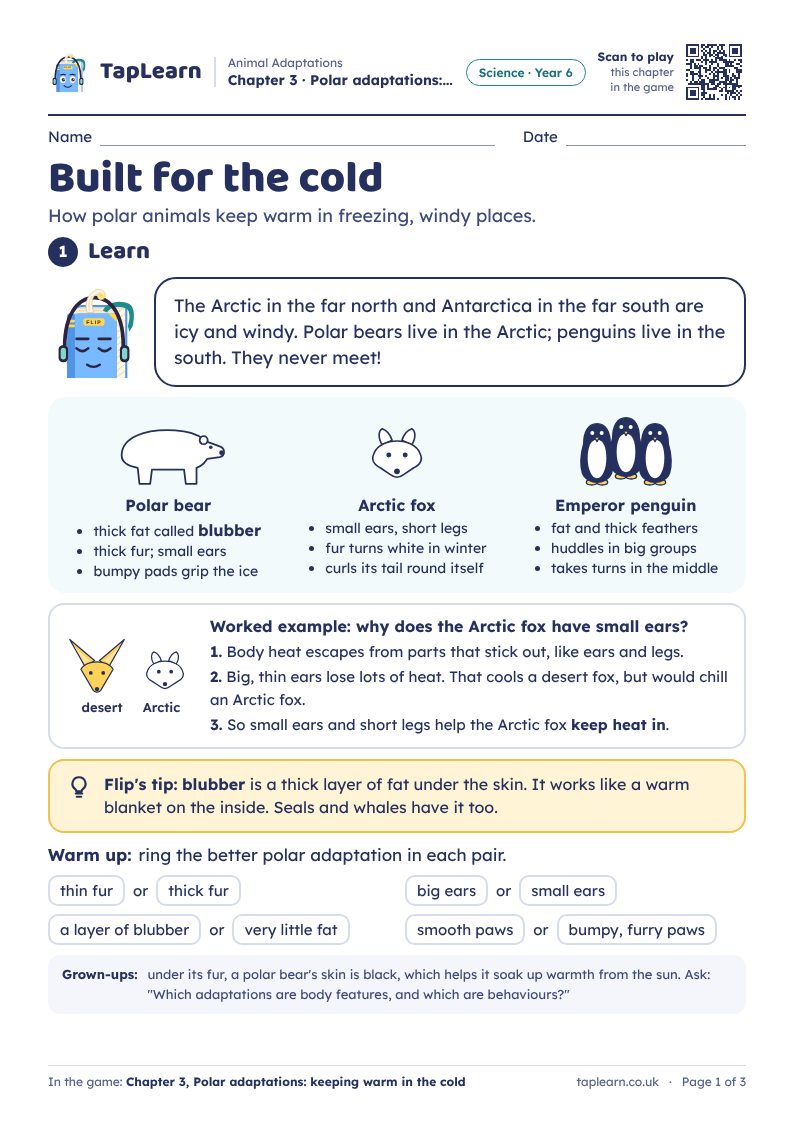
Built for the Cold is a printable polar adaptations worksheet for Year 6 (ages 10 to 11) that teaches children how polar bears, Arctic foxes and emperor penguins keep warm with blubber, fur, small ears and huddling. It covers the Year 6 science statement to identify how animals and plants are adapted to suit their environment in different ways.
Free to print, no account needed.
Print it on A4, in colour or black and white. Do it after the chapter, or before it to see what your child already knows.
What's on the worksheet
Your child explains how polar bears, Arctic foxes and emperor penguins keep warm, and why small ears save heat. Includes a blubber glove test in icy water to do together, and an answers sheet.
- Page 1 · Learn
- The adaptations of a polar bear, an Arctic fox and an emperor penguin, a worked example on why small ears save heat, and a warm-up choosing the better polar adaptation.
- Page 2 · Try it together
- The blubber glove: build a glove from two sandwich bags with butter or lard between them, then dip it and an empty bag into icy water to feel which hand gets cold first.
- Page 3 · Practise
- Match adaptations to how they help, explain an Arctic fox's changing fur and penguin huddles, identify desert and Arctic foxes by their ears, invent an Arctic animal, and a challenge.
- Answers sheet
- Every answer, what the blubber glove shows about insulation, mix-ups like polar bears living with penguins, and a human huddle activity.
3 A4 pages and an answers sheet · about 30 minutes
Using it at home
- Have a towel ready for the blubber glove and tell your child to take their hands out as soon as either feels too cold.
- Ask your child to predict which hand will feel cold first before dipping, then compare their prediction with what happened.
- If your child has done the desert sheet, put the two fox pictures side by side and ask what the ears tell you.
Watch out for
- Thinking big ears keep animals warm.
- Heat escapes from parts that stick out, so big ears lose heat. Compare the desert fox and the Arctic fox side by side.
- Putting polar bears and penguins in the same place.
- Polar bears live in the Arctic, in the north. Penguins live in the southern half of the world. They never meet.
- Thinking a polar bear's white fur is mainly for warmth.
- Thick fur keeps the bear warm, but the white colour is mostly camouflage for creeping up on seals.
Questions from the worksheet
- An Arctic fox is brown-grey in summer and white in winter. How does this help?
- Emperor penguins huddle in big groups. Is this a feature or a behaviour? How does it help?
- Look at the two foxes. Write which one lives in the desert and which in the Arctic. Explain using the word heat.
- Invent an animal for the Arctic ice. Give it two adaptations and say how each helps.
- Ava says, "Big, fluffy ears would keep an Arctic fox warm." Is she right? Explain.
The answers are on the answers sheet, for grown-ups.
National curriculum in England
This worksheet practises this statement from the Year 6 science programme of study:
- Identify how animals and plants are adapted to suit their environment in different ways and that adaptation may lead to evolution
Source: National curriculum in England: science programmes of study (DfE)
In the classroom
- Run the blubber glove as a group investigation, timing how long each hand can stay in the icy water and recording the results.
- Use the warm-up as a quick-fire starter: children hold up one or two fingers for the better adaptation in each pair.
Questions and answers
How do polar bears keep warm?
Polar bears keep warm with a thick layer of fat called blubber, thick fur and small ears. Their black skin also soaks up warmth from the sun.
What is blubber?
Blubber is a thick layer of fat under the skin of polar animals such as polar bears, seals and whales. It insulates the body, slowing down heat loss like a blanket on the inside.
Why do Arctic foxes have small ears?
Small ears lose less heat than big ones, because heat escapes from parts of the body that stick out. Short legs help in the same way.
More worksheets from Animal Adaptations: Survive Every Habitat with Kiko
- Chapter 1: Types of adaptation worksheet: Spotting adaptations Free
- Chapter 2: Desert adaptations worksheet: Desert survivors Free
- Chapter 4: Ocean adaptations worksheet: Life in the ocean Free
- Chapter 5: Rainforest adaptations worksheet: Rainforest survivors Free
- Chapter 6: Adaptation and evolution worksheet: Adaptation to evolution Free
 TapLearn