Ocean adaptations worksheet for Year 6: Life in the ocean
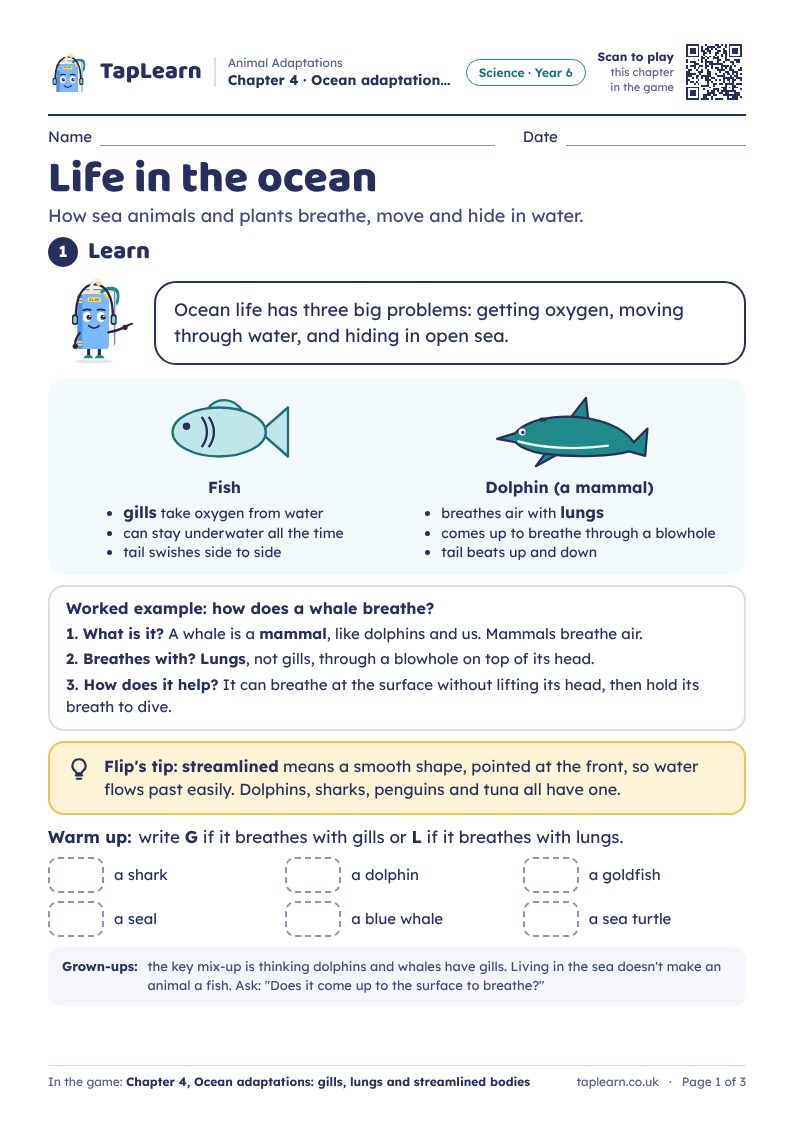
Life in the Ocean is a printable ocean adaptations worksheet for Year 6 (ages 10 to 11) that teaches children how fish breathe with gills, why dolphins and whales breathe air with lungs, and how a streamlined body helps animals swim. It covers the Year 6 science statement to identify how animals and plants are adapted to suit their environment in different ways.
Free to print, no account needed.
Print it on A4, in colour or black and white. Do it after the chapter, or before it to see what your child already knows.
What's on the worksheet
Your child compares fish, which take oxygen from water with gills, with dolphins and whales, which breathe air with lungs, and sees why streamlined bodies swim fast. Includes a play dough shape race and an answers sheet.
- Page 1 · Learn
- A fish and a dolphin compared, a worked example on how a whale breathes through its blowhole, what streamlined means, and a gills-or-lungs warm-up.
- Page 2 · Try it together
- Shape race: make a ball, a pancake and a pointed torpedo from equal lumps of play dough, then drop them in pairs into a tall glass of water to see which sinks fastest.
- Page 3 · Practise
- Match ocean adaptations to how they help, complete a gills-and-lungs table, explain why fish and dolphins can't swap homes, pick the most streamlined shape, and a dolphin challenge.
- Answers sheet
- Every answer, the usual shape race result and why, notes on sharks and sea turtles, and a gills-or-lungs naming game.
3 A4 pages and an answers sheet · about 30 minutes
Using it at home
- Split the dough into three equal lumps before shaping so the shape race is a fair test, and drop the torpedo point-first.
- Small lumps can finish close together, so race each pair twice before deciding the winner.
- Before the practise page, ask "Does it come up to the surface to breathe?" about any sea animal your child knows.
Watch out for
- Thinking dolphins and whales have gills.
- Living in water doesn't make an animal a fish. Dolphins and whales are mammals with lungs. Ask: "Does it come up to breathe?"
- Saying fish breathe water.
- Fish take in water, but their gills take the oxygen out of it.
- Thinking sharks are mammals because they look like dolphins.
- Sharks are fish with gills, even though they are big and streamlined like dolphins.
Questions from the worksheet
- Write G if it breathes with gills or L if it breathes with lungs: a shark, a dolphin, a goldfish, a seal, a blue whale, a sea turtle.
- A fish dies if it is out of water for too long. A dolphin would drown if it stayed underwater for too long. Explain why.
- Complete the table: does a killer whale breathe with gills or lungs, and does it get its oxygen from water or air?
- Leo says, "Dolphins live in the sea like fish, so they must breathe with gills." Is Leo right? Explain how you know.
The answers are on the answers sheet, for grown-ups.
National curriculum in England
This worksheet practises this statement from the Year 6 science programme of study:
- Identify how animals and plants are adapted to suit their environment in different ways and that adaptation may lead to evolution
Source: National curriculum in England: science programmes of study (DfE)
In the classroom
- Run the shape race in groups with identical lumps of dough, then compare results across the class to check the test is fair.
- Use the warm-up as a mini-whiteboard check: show an animal picture and children write G or L.
Questions and answers
Do dolphins and whales have gills?
No. Dolphins and whales are mammals, so they breathe air with lungs through a blowhole and must come up to the surface to breathe.
How do fish breathe underwater?
Fish breathe with gills, which take oxygen out of the water as it passes over them. Out of water, the gills stop working.
What does streamlined mean?
Streamlined means having a smooth shape, pointed at the front, so water flows past easily. It helps animals like dolphins, sharks and penguins swim fast using less energy.
More worksheets from Animal Adaptations: Survive Every Habitat with Kiko
- Chapter 1: Types of adaptation worksheet: Spotting adaptations Free
- Chapter 2: Desert adaptations worksheet: Desert survivors Free
- Chapter 3: Polar adaptations worksheet: Built for the cold Free
- Chapter 5: Rainforest adaptations worksheet: Rainforest survivors Free
- Chapter 6: Adaptation and evolution worksheet: Adaptation to evolution Free
 TapLearn