Adaptation and evolution worksheet for Year 6: Adaptation to evolution
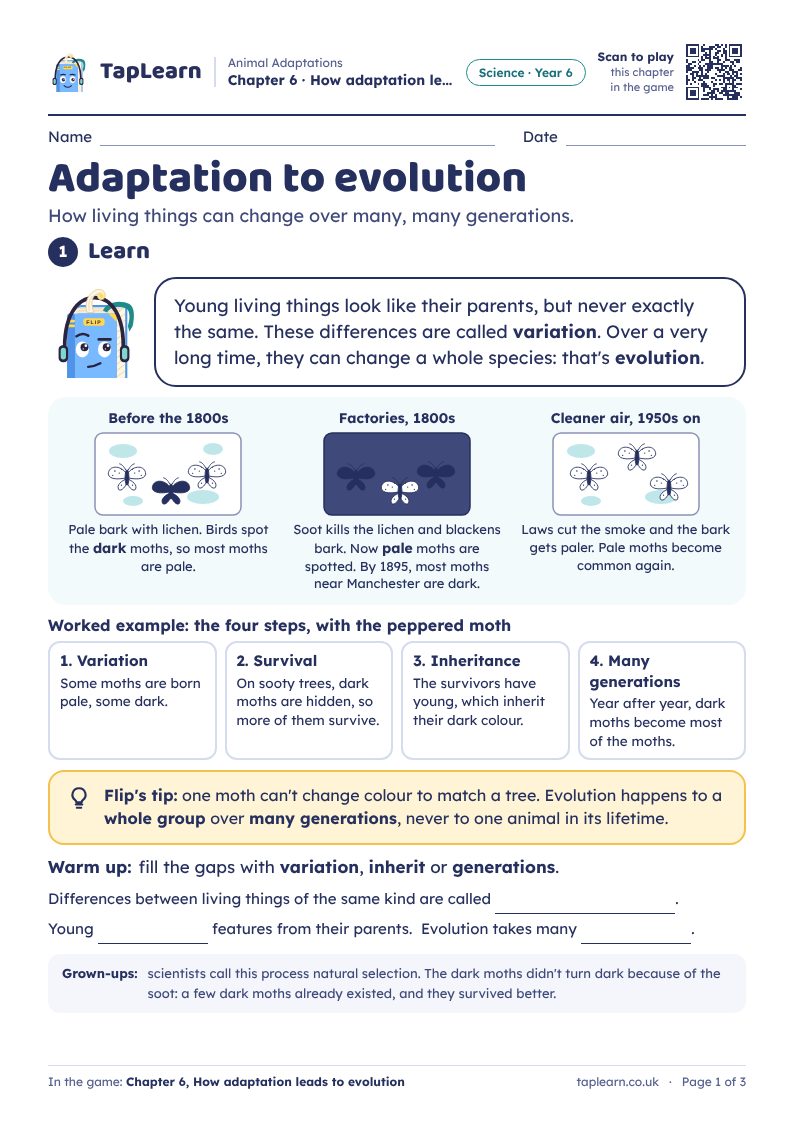
Adaptation to Evolution is a printable adaptation and evolution worksheet for Year 6 (ages 10 to 11) that uses the peppered moth to teach how variation, survival and inheritance can change a species over many generations. It covers the Year 6 science statement that adaptation may lead to evolution.
Free to print, no account needed.
Print it on A4, in colour or black and white. Do it after the chapter, or before it to see what your child already knows.
What's on the worksheet
Your child follows the peppered moth story to see how variation, survival and inheritance can change a species over many generations. Includes a hungry bird game with paper moths and an answers sheet.
- Page 1 · Learn
- The peppered moth before, during and after the factory smoke of the 1800s, the four steps of variation, survival, inheritance and many generations, and a warm-up.
- Page 2 · Try it together
- Hungry bird: scatter pale and dark paper moths on a dark cushion, let the 'bird' pick moths for 10 seconds, add babies for the survivors, and track the colours over three generations.
- Page 3 · Practise
- Order the peppered moth story, choose the right explanation of giraffes' long necks, explain how foxes got thick fur, use the four steps for pale moths, and a challenge.
- Answers sheet
- Every answer with model explanations, what the hungry bird game usually shows, the two key mix-ups, and a variation activity with apples or leaves.
3 A4 pages and an answers sheet · about 30 minutes
Using it at home
- Play at least three generations of the hungry bird game, then try a pale sheet or pillowcase and see the result reverse.
- After the game, ask "Did any one moth change colour?" The answer, no, is the most important idea on the sheet.
- Your child may hear the term "natural selection" at school. It is the name scientists give to the four steps on page 1.
Watch out for
- Thinking changes during an animal's life, like a stretched neck, are passed on.
- Stretched necks, big muscles and scars aren't passed on to young. Only inherited features are.
- Saying one animal evolved.
- One animal can't evolve. Ask: "Did one moth change, or did there end up being more dark moths?"
Questions from the worksheet
- Tick the right explanation of giraffes' long necks. What is wrong with the other?
- Long ago, some foxes in a very cold place were born with thicker fur than others. Explain how, after many generations, nearly all the foxes there could have thick fur.
- Use the four steps to explain how the pale moths became common again when the air got cleaner.
- Leo says, "When the trees went dark, the pale moths turned dark to hide." Is Leo right? Explain.
The answers are on the answers sheet, for grown-ups.
National curriculum in England
This worksheet practises this statement from the Year 6 science programme of study:
- Identify how animals and plants are adapted to suit their environment in different ways and that adaptation may lead to evolution
Source: National curriculum in England: science programmes of study (DfE)
In the classroom
- Play hungry bird in small groups and collect each group's numbers to plot the change in moth colours over generations.
- Use the giraffe question as a discussion starter: groups argue for each explanation before agreeing which one is right.
Questions and answers
How does adaptation lead to evolution?
Living things vary, and those with features that suit their environment survive and have more young, which inherit those features. Over many generations, this can change a whole species.
What is the peppered moth story?
In the 1800s, factory soot darkened tree bark, so dark peppered moths were better hidden from birds and became more common. When the air got cleaner, pale moths became common again.
What is variation in science?
Variation is the differences between living things of the same kind. Young look like their parents but are never exactly the same.
More worksheets from Animal Adaptations: Survive Every Habitat with Kiko
- Chapter 1: Types of adaptation worksheet: Spotting adaptations Free
- Chapter 2: Desert adaptations worksheet: Desert survivors Free
- Chapter 3: Polar adaptations worksheet: Built for the cold Free
- Chapter 4: Ocean adaptations worksheet: Life in the ocean Free
- Chapter 5: Rainforest adaptations worksheet: Rainforest survivors Free
 TapLearn