Alphabet order worksheet for Year 1: A to Z in order
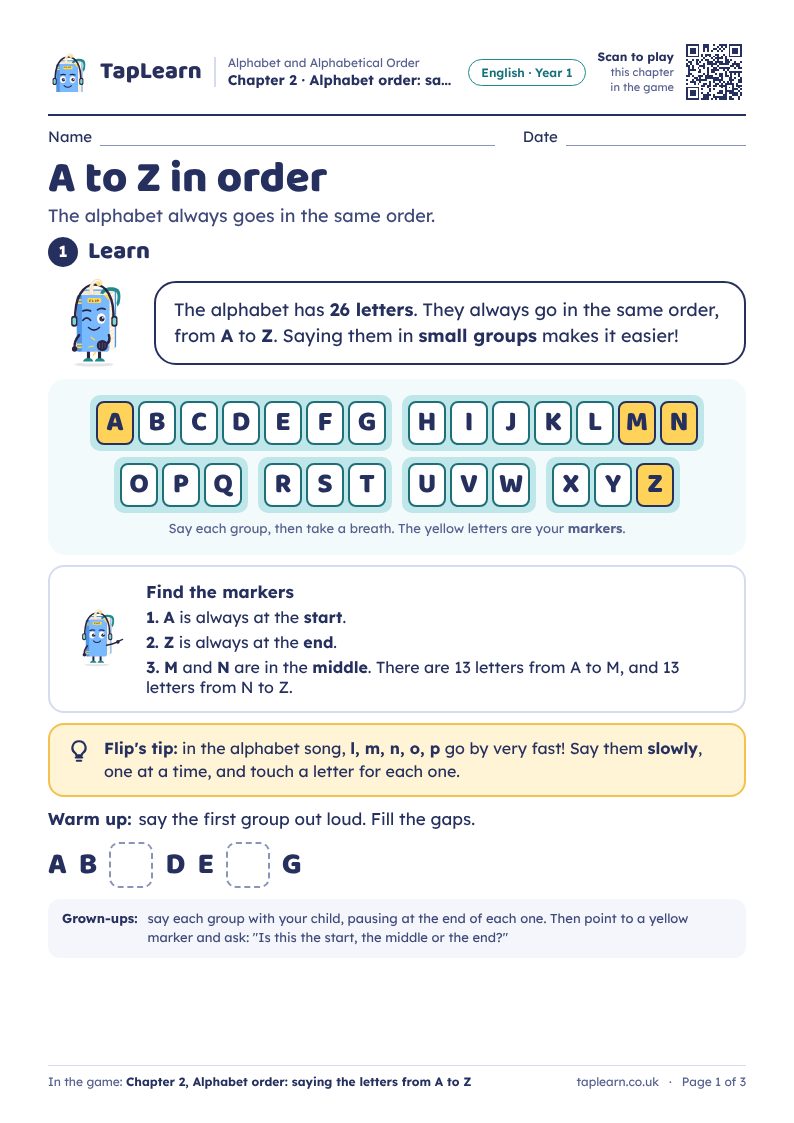
A to Z in Order is a printable alphabet order worksheet for Year 1 (ages 5 to 6) that teaches children to say the 26 letters in small groups, with A at the start, M and N in the middle and Z at the end. It covers the Year 1 spelling statement on naming the letters of the alphabet in order.
Free to print, no account needed.
Print it on A4, in colour or black and white. Do it after the chapter, or before it to see what your child already knows.
What's on the worksheet
Your child says the alphabet in order in small groups, using A, M-N and Z as markers, and slows down for l, m, n, o, p. Includes a make-your-own alphabet line activity and an answers sheet.
- Page 1 · Learn
- The alphabet split into small groups, a worked example finding the A, M, N and Z markers, Flip's tip to say l, m, n, o, p slowly, and a fill-the-gaps warm-up.
- Page 2 · Try it together
- Make an alphabet line: write A to Z on 26 pieces of paper, mix them up, place the markers first, then put the other letters in their places and read the line together.
- Page 3 · Practise
- Write missing letters in each group, write the whole alphabet, sort letters into the first or second half, join the dots from h to t, and a challenge about the song.
- Answers sheet
- Every answer, mix-ups like skipping a letter, and stop-and-go and take-turns ideas.
3 A4 pages and an answers sheet · about 20 minutes
Using it at home
- Say each group with your child, pausing at the end of each one. Then point to a marker and ask "Is this the start, the middle or the end?"
- On the alphabet line, if a letter is in the wrong place, don't move it for them. Say the group out loud together and let your child spot it.
- Chant the alphabet together and say "stop!": your child says the next letter.
Watch out for
- Running l, m, n, o, p together and missing one out.
- Slow right down and touch a letter or clap once for each name.
- Skipping a letter when saying the whole alphabet.
- Go back to the groups (ABCDEFG, HIJKLMN, OPQ, RST, UVW, XYZ) and practise the group with the gap.
- Putting m and n in the wrong halves.
- m is the last letter of the first half; n is the first letter of the second half.
Questions from the worksheet
- Say each group. Write the missing letters: A B C _ E F, H I _ K L.
- Write the whole alphabet in small letters. Some are done for you.
- Is the letter in the first half (a to m) or the second half (n to z)? c, x, k, r, f, w.
- Leo sings the song very fast and writes k l m o p. He has missed a letter. Which one? Where should it go?
The answers are on the answers sheet, for grown-ups.
National curriculum in England
This worksheet practises this statement from the Year 1 english programme of study:
- Name the letters of the alphabet: naming the letters of the alphabet in order
In the classroom
- Build a class alphabet line with letter cards, placing the markers first.
- Take turns round the class saying one letter each from a to z.
Questions and answers
How many letters are in the alphabet?
There are 26 letters in the alphabet. They always go in the same order, from A to Z.
How can children learn the alphabet in order?
Say it in small groups, like ABCDEFG and HIJKLMN, and use markers: A at the start, M and N in the middle and Z at the end.
Which letters are in the middle of the alphabet?
M and N. There are 13 letters from A to M and 13 from N to Z.
 TapLearn