Letter names worksheet for Year 1
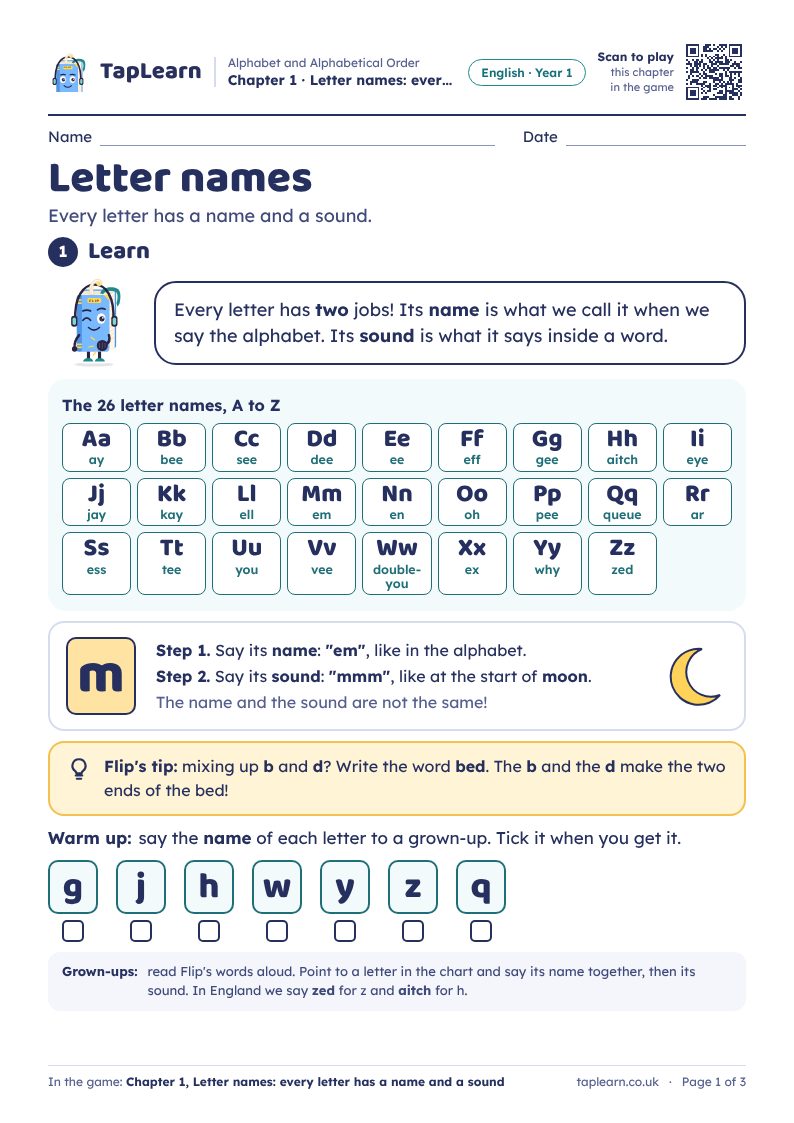
Letter Names is a printable letter names worksheet for Year 1 (ages 5 to 6) that teaches children the names of all 26 letters, from ay to zed, and that a letter's name is different from the sound it makes in a word. It covers the Year 1 spelling statement on naming the letters of the alphabet in order.
Free to print, no account needed.
Print it on A4, in colour or black and white. Do it after the chapter, or before it to see what your child already knows.
What's on the worksheet
Your child learns the names of all 26 letters and how a letter's name is different from its sound, and tells lookalike letters like b, d, p and q apart. Includes a letter detectives hunt and an answers sheet.
- Page 1 · Learn
- All 26 letter names from A to Z, a worked example saying the name and sound of m, Flip's bed trick for b and d, and a say-the-name warm-up.
- Page 2 · Try it together
- Letter detectives: point to letters on food boxes, tins, post or a book, say each letter's name and then its sound, and write 5 different letters in the table.
- Page 3 · Practise
- Write the letter for words that sound like letter names, ring letters the grown-up names, join capital and small letters, write letters from their names, and a challenge.
- Answers sheet
- Every answer, mix-ups like g and j, and number-plate and name-or-sound ideas.
3 A4 pages and an answers sheet · about 20 minutes
Using it at home
- Say the name and the sound side by side so your child hears the difference: "ess is its name, sss is its sound".
- In England we say zed for z and aitch for h. The name is the same for the capital and the small letter.
- On a walk, read out the letters on a car's number plate using letter names.
Watch out for
- Mixing up letters that look alike, such as b and d, or p and q.
- Use the bed trick and trace the letter with a finger while saying its name.
- Mixing up g and j.
- g is "gee" and j is "jay". Say "j is jay, like the start of jam".
- Picking a letter from a name's first sound, like w for "why".
- "Why" is the name of y and "double-you" is the name of w. Show the two letters side by side.
Questions from the worksheet
- These things sound just like a letter's name! Say each one. Write the letter: bee, tea, eye, pea, sea.
- Your grown-up says a letter's name. Draw a ring round that letter: "dee": b, p, d, q. "why": w, y, v, u.
- Your grown-up says a letter's name. Write the small letter: "aitch", "double-you", "zed", "en", "ar".
- Sam points to the letter s and says, "This letter is called sss." Is he right? What is its name?
The answers are on the answers sheet, for grown-ups.
National curriculum in England
This worksheet practises this statement from the Year 1 english programme of study:
- Name the letters of the alphabet: naming the letters of the alphabet in order
In the classroom
- Play name or sound? as a starter: say "em" or "mmm" and pupils call out "name!" or "sound!"
- Use Practise B as a quick show-me with letter cards.
Questions and answers
What is the difference between a letter name and a letter sound?
A letter's name is what we call it when we say the alphabet, like "em". Its sound is what it says inside a word, like "mmm" at the start of moon.
When do children learn letter names?
Children in England learn to name the letters of the alphabet in order in Year 1.
How do you say z and h in England?
In England, z is called zed and h is called aitch.
 TapLearn