Alternative spellings worksheet for Year 1: Same sound, new letters
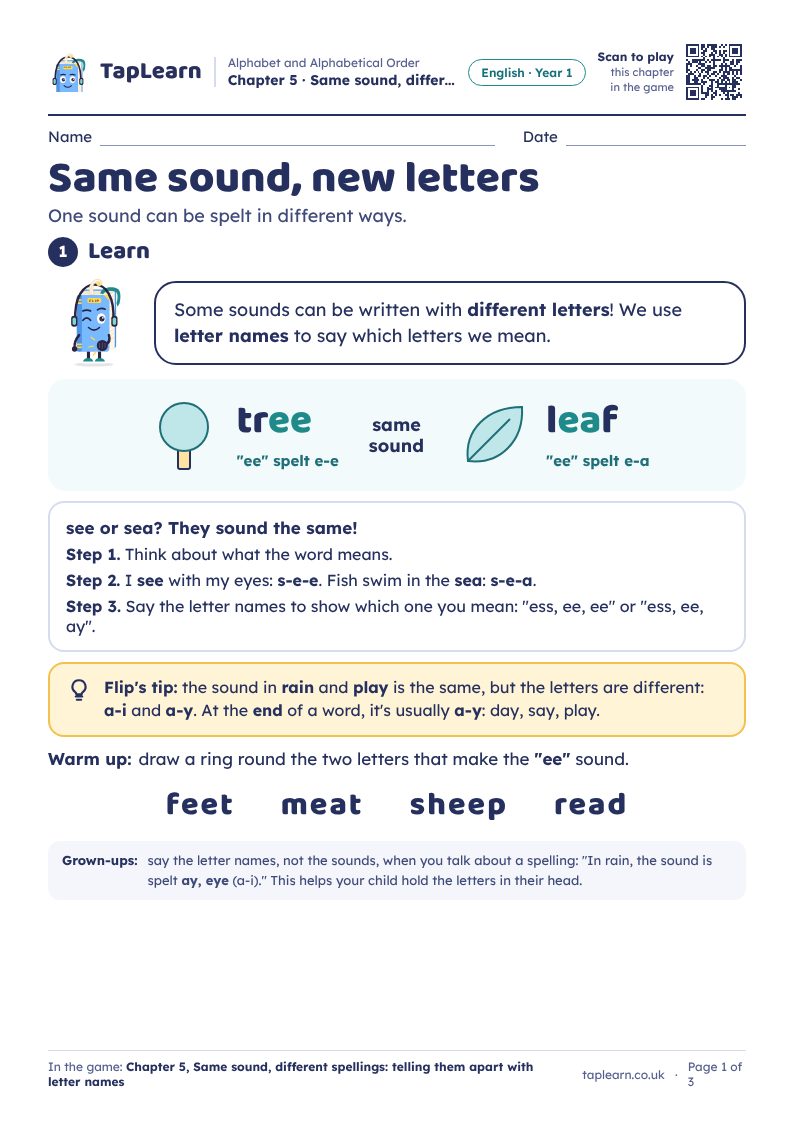
Same Sound, New Letters is a printable alternative spellings worksheet for Year 1 (ages 5 to 6) that teaches children that one sound can be spelt in different ways, like e-e in tree and e-a in leaf, and to say which letters with letter names. It covers the Year 1 spelling statement on using letter names to distinguish between alternative spellings of the same sound.
Free to print, no account needed.
Print it on A4, in colour or black and white. Do it after the chapter, or before it to see what your child already knows.
What's on the worksheet
Your child uses letter names to tell apart spellings of the same sound: e-e and e-a, a-i and a-y, and f and p-h. Includes a sound hunt in a book and an answers sheet.
- Page 1 · Learn
- Tree and leaf with the same sound spelt two ways, a worked example on see and sea, Flip's tip that a-y usually comes at the end of a word, and a ring-the-ee warm-up.
- Page 2 · Try it together
- Sound hunt in a book: read a few pages together, listen for words with the sound in rain and play, say the letters with letter names and sort them into a-i and a-y.
- Page 3 · Practise
- Sort ee words into e-e and e-a, ring the right spelling for six pictures, fill in a-i or a-y, choose see or sea, and a challenge about leef.
- Answers sheet
- Every answer, mix-ups like f for p-h, and spot-the-letters and sound-pair ideas.
3 A4 pages and an answers sheet · about 20 minutes
Using it at home
- Say the letter names, not the sounds, when you talk about a spelling: "In rain, the sound is spelt ay, eye."
- In the sound hunt, you may find other spellings, like a in baby or a-e in cake. That's fine: write them at the bottom and say the letters together.
- On a walk or a shopping list, find "ee" words and say whether they use e-e or e-a.
Watch out for
- Picking the other spelling, such as e-e in leaf or a-i in play.
- Both spellings make the sound; that word just uses the other one. Say its letters together with letter names.
- Using f for p-h, as in "fone".
- In phone, the "f" sound is spelt p-h ("pee, aitch"). Other p-h words: dolphin, alphabet, photo.
- Using a-i at the end of a word.
- English words almost never end in a-i, so the end of a word is a good clue for a-y.
Questions from the worksheet
- Does the "ee" sound use e-e or e-a? see, sea, tree, leaf, feet, eat, sheep, bean.
- Draw a ring round the right spelling: rayn or rain? fone or phone? leef or leaf?
- a-i or a-y? Write the two missing letters: tr__n, pl__, d__, w__t.
- Write see or sea to finish each sentence: I can ___ a bird in the tree. We swam in the ___ at the beach.
- Ava writes leef for leaf. Is she right? Which two letters make the "ee" sound in leaf? Say them with letter names.
The answers are on the answers sheet, for grown-ups.
National curriculum in England
This worksheet practises this statement from the Year 1 english programme of study:
- Name the letters of the alphabet: using letter names to distinguish between alternative spellings of the same sound
In the classroom
- Make two class word lists for e-e and e-a and add to them through the week.
- Play sound pairs as a starter: say boat and snow, and pupils name the letters for each sound.
Questions and answers
What are alternative spellings in phonics?
Alternative spellings are different ways of writing the same sound, like e-e in tree and e-a in leaf.
How do you know whether to use ai or ay?
At the end of a word, it's usually a-y, as in day, say and play. In the middle of a word, a-i is common, as in rain.
Why use letter names to talk about spellings?
Letter names help children say exactly which letters they mean, like "ee, ay" for the e-a in leaf.
 TapLearn