Part–whole model worksheet for Year 3: Part–whole bar models
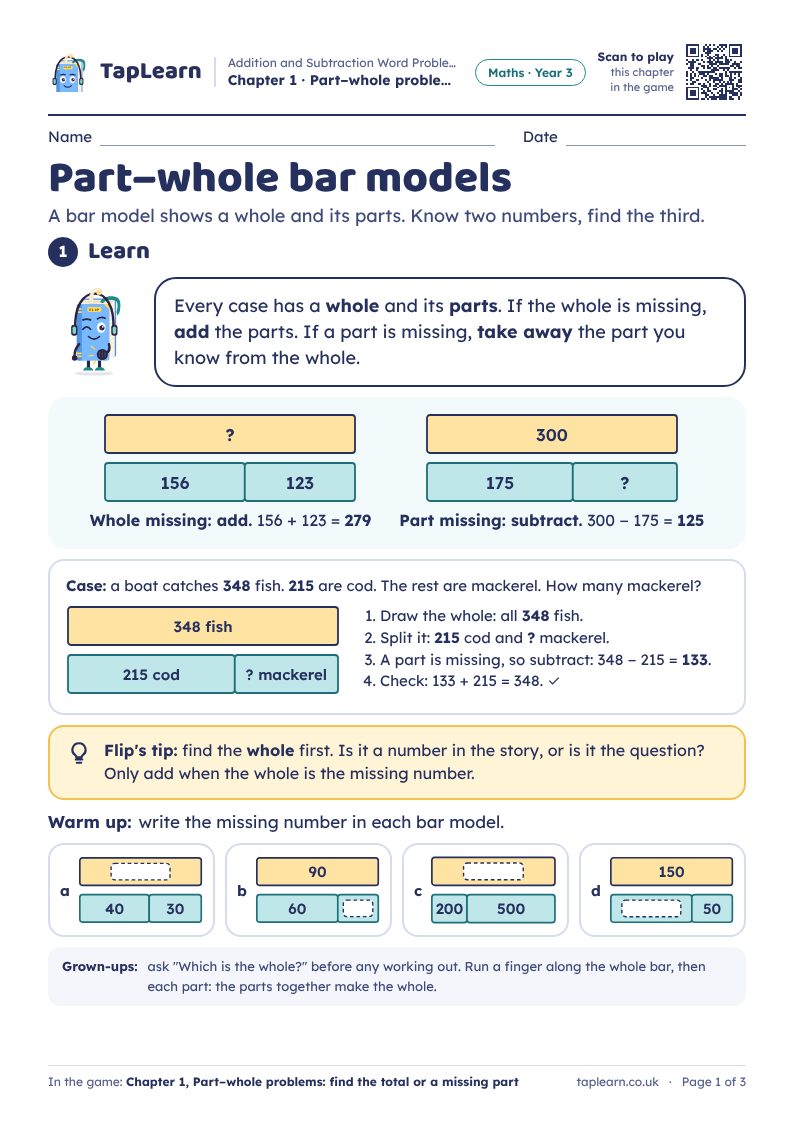
Part–Whole Bar Models is a printable part–whole model worksheet for Year 3 (ages 7 to 8) that teaches children to find the whole first, then add the parts when the whole is missing or subtract when a part is missing. It covers the Year 3 maths statement to solve problems, including missing number problems, using number facts, place value and more complex addition and subtraction.
Free to print, no account needed.
▶ Play chapter 1 in the game · How the part-whole model works
Print it on A4, in colour or black and white. Do it after the chapter, or before it to see what your child already knows.
What's on the worksheet
Your child uses a part–whole bar model to decide whether to add or subtract in word problems with numbers up to 3 digits. Includes a sort-and-split activity and an answers sheet.
- Page 1 · Learn
- Bar models showing a missing whole and a missing part, a worked case finding 133 mackerel from 348 fish, Flip's tip to find the whole first, and a missing-number warm-up.
- Page 2 · Try it together
- Sort and split: count a handful of two kinds of pasta as the whole, count one kind, draw a bar model, then subtract to find the other part and count it to check.
- Page 3 · Practise
- Fill in missing numbers in bar models, draw bar models for café, ferry and book problems and tick add or subtract, write your own story for a bar model, and a challenge.
- Answers sheet
- Every answer, mix-ups like adding when the total is already given, and story-swap and fact-family ideas.
3 A4 pages and an answers sheet · about 25 minutes
Using it at home
- Ask "Which is the whole?" before any working out, and run a finger along the whole bar, then each part.
- In sort and split, swap jobs for round 2 and ask "Why did we take away, not add?"
- Say "245 people at a match, 120 are children" and let your child ask and answer the question, then make one up for you.
Watch out for
- Adding when the total is already given, as Leo did.
- Ask "Is this number all of them, or just some?" Point to the top bar: "This is everything."
- Mixing up hundreds, tens and ones, so 765 − 432 becomes 433.
- Work column by column: hundreds 7 − 4, tens 6 − 3, ones 5 − 2.
- Drawing bars that don't match the numbers.
- They needn't be exact, but a bigger part should look bigger. It helps spot answers that don't make sense.
Questions from the worksheet
- A café sells 136 sandwiches in the morning and 152 in the afternoon. How many does it sell altogether?
- A ferry carries 465 people. 230 are grown-ups. The rest are children. How many children are there?
- Mia's book has 284 pages. She has read 150 pages. How many pages are left?
- Leo reads: "There are 360 shells in a jar. 140 are white and the rest are pink. How many are pink?" He writes 360 + 140 = 500. Is he right? Explain and find the answer.
The answers are on the answers sheet, for grown-ups.
National curriculum in England
This worksheet practises this statement from the Year 3 maths programme of study:
- Solve problems, including missing number problems, using number facts, place value, and more complex addition and subtraction
Source: National curriculum in England: mathematics programmes of study (DfE)
In the classroom
- Run sort and split in pairs with two colours of cubes, each pair drawing their bar model.
- Use Practise C as a plenary: pairs write a story for the bar model and swap to solve.
Questions and answers
What is a part–whole model?
A part–whole model shows a whole split into parts, often as a bar. If you know two of the numbers, you can find the third.
How do you know whether to add or subtract in a word problem?
Find the whole first. If the whole is missing, add the parts. If a part is missing, subtract the part you know from the whole.
How can my child check a part–whole answer?
Add the parts back together. If they make the whole, the answer is right: 133 + 215 = 348.
More worksheets from Addition and Subtraction Word Problems for Year 3: Detective Cases
- Chapter 2: Change word problems worksheet: Change stories Members
- Chapter 3: Comparison word problems worksheet: How many more or fewer? Members
- Chapter 4: Missing number problems worksheet: Missing numbers Members
- Chapter 5: Number facts and place value worksheet: Big facts from small facts Members
 TapLearn