Change word problems worksheet for Year 3: Change stories
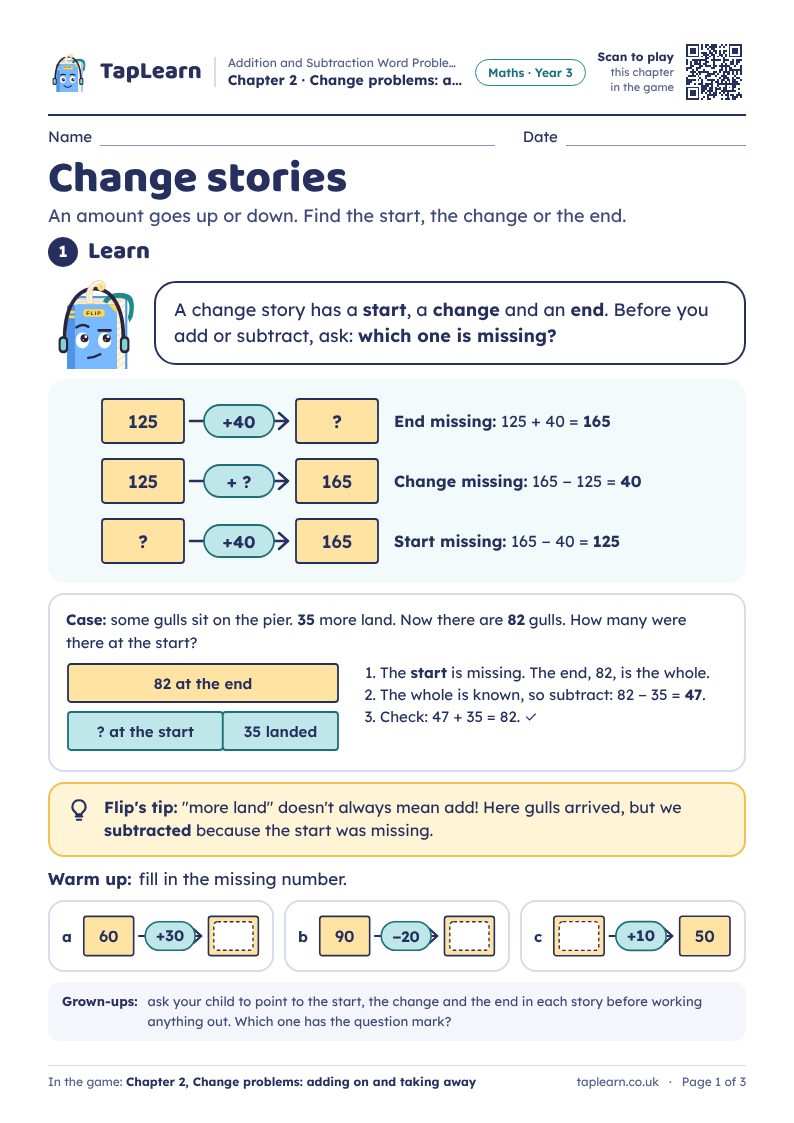
Change Stories is a printable change word problems worksheet for Year 3 (ages 7 to 8) that teaches children to spot whether the start, the change or the end is missing before choosing to add or subtract. It covers the Year 3 maths statement to solve problems, including missing number problems, using number facts, place value and more complex addition and subtraction.
This worksheet is for members
Membership opens every chapter of every game and every worksheet, for all your children.
See the plansAlready a member? Log in to print it.
Start with the free one: Part–whole bar models (chapter 1).
Print it on A4, in colour or black and white. Do it after the chapter, or before it to see what your child already knows.
What's on the worksheet
Your child solves story problems where an amount goes up or down, including finding the start or the change, not just the end. Includes a secret-start pasta game and an answers sheet.
- Page 1 · Learn
- The start, change and end in three versions of one story, a worked case finding how many gulls were on the pier at the start, Flip's tip that "more" doesn't always mean add, and a warm-up.
- Page 2 · Try it together
- The secret start: the grown-up hides some pasta in a bowl, adds 15 more and says the total, then the child undoes the change to find the start and counts to check.
- Page 3 · Practise
- Fill in missing numbers in change diagrams, tick whether the start, change or end is missing in apple, sticker, bus and bottle-top stories, ring the right sum, and a challenge.
- Answers sheet
- Every answer, mix-ups like following the action word, and bus-stop-story and check-by-undoing ideas.
3 A4 pages and an answers sheet · about 25 minutes
Using it at home
- Ask your child to point to the start, the change and the end in each story first. Which one has the question mark?
- In the secret start game, ask "We added 15, so why did you take away?" That's the key idea of the sheet.
- Make up bus stop stories: "32 on the bus, some get off, 19 left. How many got off?"
Watch out for
- Following the action word: adding for "more" or subtracting for "gave away".
- Ask "Which number is missing: the start, the change or the end?"
- Struggling with start-missing stories.
- Act them out with pasta: you can't see the start, so you undo the change.
- Giving answers that don't make sense.
- Sam gave stickers away, so he must have had more than 105 at the start.
Questions from the worksheet
- Sam had some stickers. He gave away 45. Now he has 105. How many did he have at the start?
- A bus has 38 people on it. At the next stop, some more get on. Now there are 63. How many got on?
- Some birds were on a roof. 26 flew away. 54 were left. Ring the sum that finds how many were there at the start.
- Mia reads: "Some ducks were on a pond. 30 more came. Then there were 90." She says, "More came, so I add: 90 + 30 = 120." Is she right? Explain.
The answers are on the answers sheet, for grown-ups.
National curriculum in England
This worksheet practises this statement from the Year 3 maths programme of study:
- Solve problems, including missing number problems, using number facts, place value, and more complex addition and subtraction
Source: National curriculum in England: mathematics programmes of study (DfE)
In the classroom
- Play the secret start as a whole-class demonstration with a bowl of counters, then in pairs.
- Use Practise C as a hinge question: which sum finds the start? Discuss why the others don't.
Questions and answers
What is a change word problem?
A change problem is a story where an amount goes up or down. It has a start, a change and an end, and any one of them can be the missing number.
How do you find the start in a word problem?
Undo the change. If 35 gulls landed and there are now 82, subtract: 82 − 35 = 47 were there at the start.
Does "more" always mean add?
No. In "30 more came, then there were 90", the start is missing, so you subtract: 90 − 30 = 60.
More worksheets from Addition and Subtraction Word Problems for Year 3: Detective Cases
- Chapter 1: Part–whole model worksheet: Part–whole bar models Free
- Chapter 3: Comparison word problems worksheet: How many more or fewer? Members
- Chapter 4: Missing number problems worksheet: Missing numbers Members
- Chapter 5: Number facts and place value worksheet: Big facts from small facts Members
 TapLearn