Missing number problems worksheet for Year 3: Missing numbers
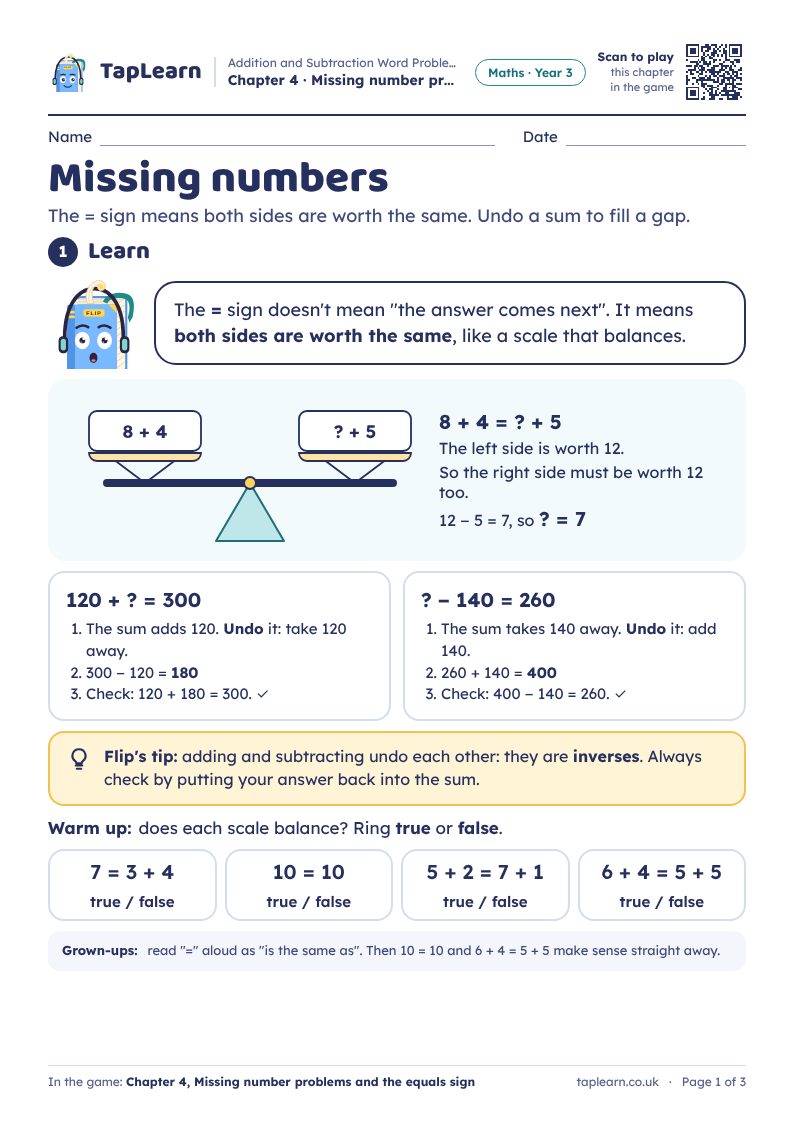
Missing Numbers is a printable missing number problems worksheet for Year 3 (ages 7 to 8) that teaches children that = means "is the same as" and to find a missing number by undoing the sum. It covers the Year 3 maths statement to solve problems, including missing number problems, using number facts, place value and more complex addition and subtraction.
This worksheet is for members
Membership opens every chapter of every game and every worksheet, for all your children.
See the plansAlready a member? Log in to print it.
Start with the free one: Part–whole bar models (chapter 1).
Print it on A4, in colour or black and white. Do it after the chapter, or before it to see what your child already knows.
What's on the worksheet
Your child learns that the equals sign means both sides are worth the same, finds missing numbers by undoing the sum, and checks with the inverse. Includes a what's-under-the-cup game and an answers sheet.
- Page 1 · Learn
- A balance showing 8 + 4 = ? + 5, worked examples for 120 + ? = 300 and ? − 140 = 260, Flip's tip that adding and subtracting are inverses, and a true-or-false balance warm-up.
- Page 2 · Try it together
- What's under the cup?: the grown-up hides pasta under a cup and says the total, the child writes a number sentence, undoes it to find the hidden number, then lifts the cup to check.
- Page 3 · Practise
- Find missing numbers and check with the inverse, decide if both sides are worth the same, write think-of-a-number sentences, check Sam's subtraction, and a challenge.
- Answers sheet
- Every answer, mix-ups like reading = as "the answer comes next", and balance-talk and think-of-a-number ideas.
3 A4 pages and an answers sheet · about 25 minutes
Using it at home
- Read "=" aloud as "is the same as". Then 10 = 10 and 6 + 4 = 5 + 5 make sense straight away.
- In what's under the cup, try a harder round where each piece of pasta is worth 10.
- Ask balance questions on a walk: "Is 20 + 30 the same as 25 + 25?"
Watch out for
- Thinking = means "the answer comes next".
- Say "is the same as" and use the balance picture.
- Doing the same calculation again instead of undoing it.
- Ask "What does the sum do to the number? How do we undo that?"
- Adding to undo 500 − ? = 270.
- Here the missing number is the gap between 270 and 500, so subtract: 500 − 270.
Questions from the worksheet
- Find the missing numbers. Check each one with the inverse: 150 + ___ = 400, ___ − 75 = 125, 35 + 25 = ___ + 50.
- Are both sides worth the same? Ring true or false: 80 + 20 = 100 + 10, 600 − 100 = 400 + 100.
- I think of a number. Leo takes 85 from his number and gets 115. Write a number sentence with a box, then find the number.
- Ella fills the gap: 8 + 5 = ? + 4. She writes 13. Is she right? What should go in the gap, and why?
The answers are on the answers sheet, for grown-ups.
National curriculum in England
This worksheet practises this statement from the Year 3 maths programme of study:
- Solve problems, including missing number problems, using number facts, place value, and more complex addition and subtraction
Source: National curriculum in England: mathematics programmes of study (DfE)
In the classroom
- Use a real or drawn balance scale as a starter for true-or-false number sentences.
- Play I think of a number as a mini-whiteboard game, with children writing the number sentence first.
Questions and answers
What does the equals sign mean?
The equals sign means both sides are worth the same, like a balanced scale. It doesn't mean "the answer comes next".
How do you find a missing number in a sum?
Undo what the sum does. For 120 + ? = 300, take 120 away: 300 − 120 = 180.
What is the inverse operation?
Adding and subtracting undo each other, so they are inverses. Check an answer by putting it back into the sum: 120 + 180 = 300.
 TapLearn