Comparison word problems worksheet for Year 3: How many more or fewer?
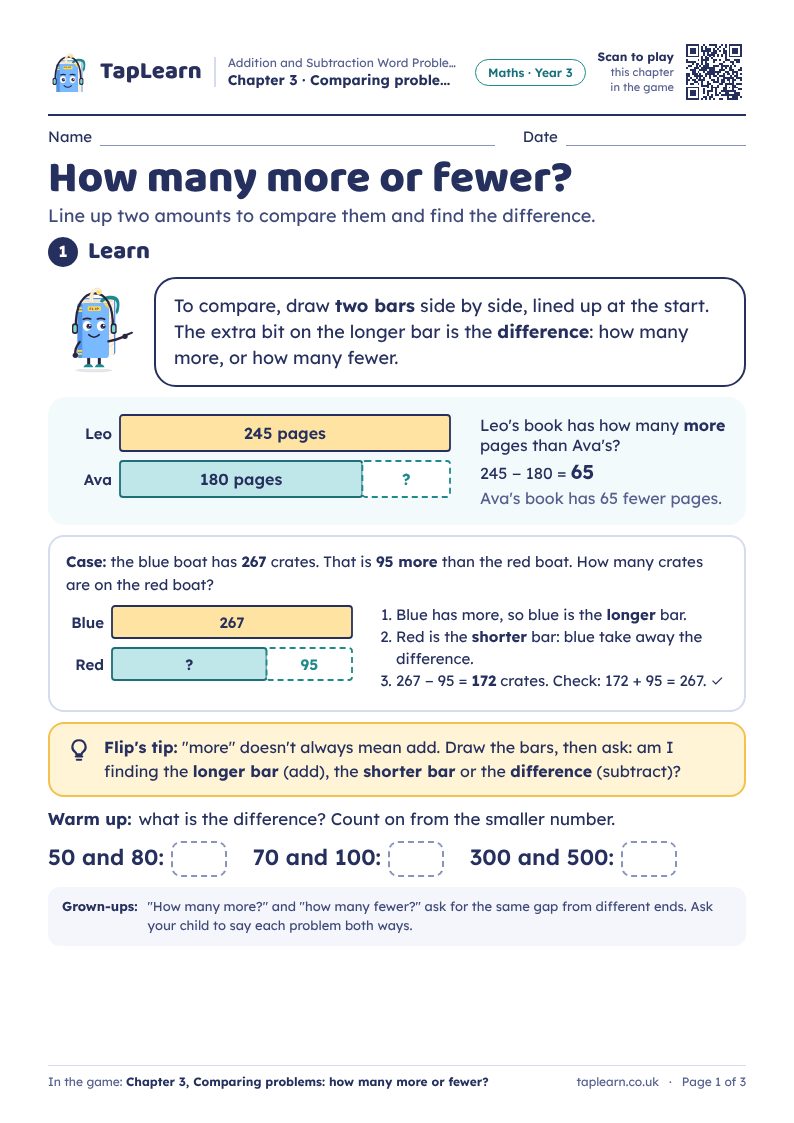
How Many More or Fewer? is a printable comparison word problems worksheet for Year 3 (ages 7 to 8) that teaches children to line up two bars and find the difference, or the longer or shorter amount. It covers the Year 3 maths statement to solve problems, including missing number problems, using number facts, place value and more complex addition and subtraction.
This worksheet is for members
Membership opens every chapter of every game and every worksheet, for all your children.
See the plansAlready a member? Log in to print it.
Start with the free one: Part–whole bar models (chapter 1).
Print it on A4, in colour or black and white. Do it after the chapter, or before it to see what your child already knows.
What's on the worksheet
Your child compares two amounts with bars side by side to answer "how many more?" and "how many fewer?" problems, and spots when "more" means subtract. Includes a book-battle activity and an answers sheet.
- Page 1 · Learn
- Two bars comparing 245 and 180 pages, a worked case finding how many crates are on the red boat, Flip's tip on longer bars, shorter bars and the difference, and a count-on warm-up.
- Page 2 · Try it together
- Book battle: find the last page numbers of two books, cut paper strips for each and line them up, then work out how many more pages the longer book has and say it both ways.
- Page 3 · Practise
- Write the difference between pairs of bars, draw bars for points, school, rope and sticker problems and tick add or subtract, answer shell questions, and a challenge.
- Answers sheet
- Every answer, mix-ups like thinking "fewer" always means take away, and taller-or-shorter and say-it-both-ways ideas.
3 A4 pages and an answers sheet · about 25 minutes
In the classroom
- Run book battle with class library books in pairs, recording differences in a table.
- Use the Ella and Max challenge for a think-pair-share on why "fewer" can mean add.
Questions from the worksheet
- Leo scored 128 points. Ava scored 45 more than Leo. How many points did Ava score?
- A rope is 240 cm long. It is 75 cm longer than a ribbon. How long is the ribbon?
- Sam has 85 stickers. That is 40 fewer than Mia has. How many stickers does Mia have?
- "Ella has 60 fewer stickers than Max. Ella has 140." Sam writes 140 − 60 = 80 stickers for Max. Is he right? Explain.
The answers are on the answers sheet, for grown-ups.
National curriculum in England
This worksheet practises this statement from the Year 3 maths programme of study:
- Solve problems, including missing number problems, using number facts, place value, and more complex addition and subtraction
Source: National curriculum in England: mathematics programmes of study (DfE)
Using it at home
- "How many more?" and "how many fewer?" ask for the same gap from different ends. Ask your child to say each problem both ways.
- In book battle, let your child choose how to work it out. Counting on in jumps of 100, 10 and 1 is a good way to find a difference.
- Compare family heights in cm: "How much taller is Dad than me?"
Watch out for
- Thinking "more" always means add.
- In the rope problem, "longer" means subtract: the ribbon is the shorter bar. Ask "Which bar is longer?"
- Thinking "fewer" always means take away.
- When the missing amount is the bigger one, as in Mia's stickers, you add.
- Drawing bars that don't line up at the start.
- The difference only shows if both bars begin at the same place.
Questions and answers
How do you solve "how many more" problems?
Draw two bars lined up at the start. The extra bit on the longer bar is the difference: subtract the smaller amount from the larger, or count on.
Does "fewer" always mean subtract?
No. If Sam has 40 fewer than Mia and you need Mia's amount, Mia has the longer bar, so you add.
What is the difference between two numbers?
It is the gap between them. The difference between 245 and 180 is 65, which you can find by subtracting or counting on.
 TapLearn