Number facts and place value worksheet for Year 3: Big facts from small facts
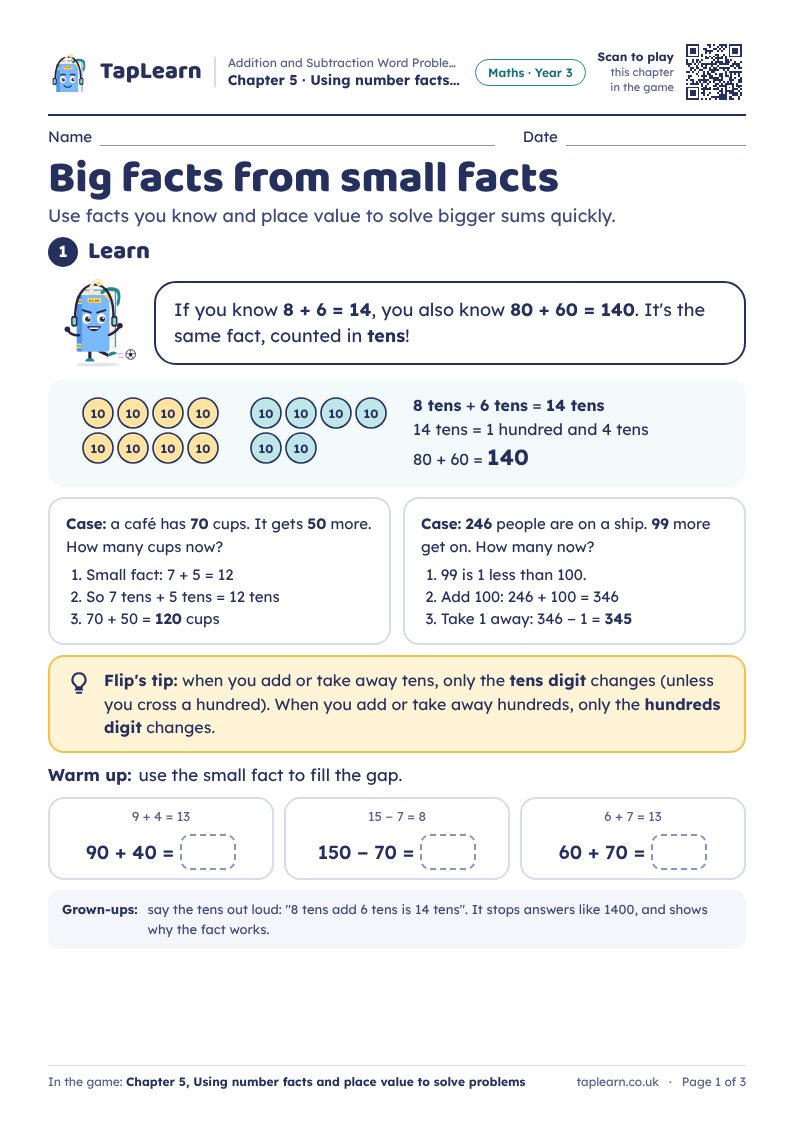
Big Facts from Small Facts is a printable number facts and place value worksheet for Year 3 (ages 7 to 8) that teaches children to use a fact like 7 + 5 = 12 to solve 70 + 50 = 120 and to add 99 by adding 100 and taking 1. It covers the Year 3 maths statement to solve problems, including missing number problems, using number facts, place value and more complex addition and subtraction.
This worksheet is for members
Membership opens every chapter of every game and every worksheet, for all your children.
See the plansAlready a member? Log in to print it.
Start with the free one: Part–whole bar models (chapter 1).
Print it on A4, in colour or black and white. Do it after the chapter, or before it to see what your child already knows.
What's on the worksheet
Your child uses known facts like 8 + 6 = 14 to solve 80 + 60 = 140, adds and takes away tens and hundreds, and adds 99 by adding 100 and taking 1. Includes a fact-makers card game and an answers sheet.
- Page 1 · Learn
- 8 tens + 6 tens = 14 tens shown with counters, worked cases for 70 + 50 cups and 246 + 99 people, Flip's tip on which digit changes, and a use-the-small-fact warm-up.
- Page 2 · Try it together
- Fact makers: make number cards 1 to 9, turn over two and add them, then say the fact in tens and in hundreds, with the other player checking by saying it in tens.
- Page 3 · Practise
- Use known facts, add and take away tens or hundreds, use 100 to add or subtract 99 and 101, solve boat, pen and bead problems in your head, match sums, and a challenge.
- Answers sheet
- Every answer, mix-ups like 80 + 60 = 1400, and make-it-bigger and mix-it-up ideas.
3 A4 pages and an answers sheet · about 25 minutes
Using it at home
- Say the tens out loud: "8 tens add 6 tens is 14 tens". It stops answers like 1400 and shows why the fact works.
- In fact makers, try a bonus round adding 99 and ask why it works: 99 is 1 less than 100.
- Say a small fact like 7 + 5 = 12 and let your child say 70 + 50 and 700 + 500.
Watch out for
- Digits in the wrong place, like 80 + 60 = 1400.
- Say it in tens, or picture the counters on page 1: 14 tens is 140.
- Changing the wrong digit, like 346 + 30 = 646.
- Ask "Are we adding tens or hundreds? Which digit should change?"
- Taking 1 more away for 370 − 99.
- Take 100, then add 1 back, because you took 1 too many.
Questions from the worksheet
- Add or take away tens or hundreds. Which digit changes? 346 + 30, 346 + 300, 582 − 40.
- Clever adding: use 100, then put 1 back or take 1 away. 154 + 99, 370 − 99, 238 + 101.
- Mia has 126 beads. She is given 99 more. How many beads now?
- Leo says, "80 + 60 = 1400, because 8 + 6 = 14 and I add the two zeros." Is he right? Explain using tens.
The answers are on the answers sheet, for grown-ups.
National curriculum in England
This worksheet practises this statement from the Year 3 maths programme of study:
- Solve problems, including missing number problems, using number facts, place value, and more complex addition and subtraction
Source: National curriculum in England: mathematics programmes of study (DfE)
In the classroom
- Play fact makers in pairs as a mental maths starter.
- Use Leo's challenge to discuss why "adding zeros" breaks, using place value counters.
Questions and answers
How do number facts help with bigger sums?
If you know 8 + 6 = 14, you also know 80 + 60 = 140, because it is the same fact counted in tens.
How do you add 99 in your head?
Add 100, then take 1 away. 246 + 99 is 246 + 100 = 346, then 346 − 1 = 345.
Which digit changes when you add tens?
Only the tens digit changes, unless you cross a hundred. When you add hundreds, only the hundreds digit changes.
 TapLearn