Story sums worksheet for Year 1
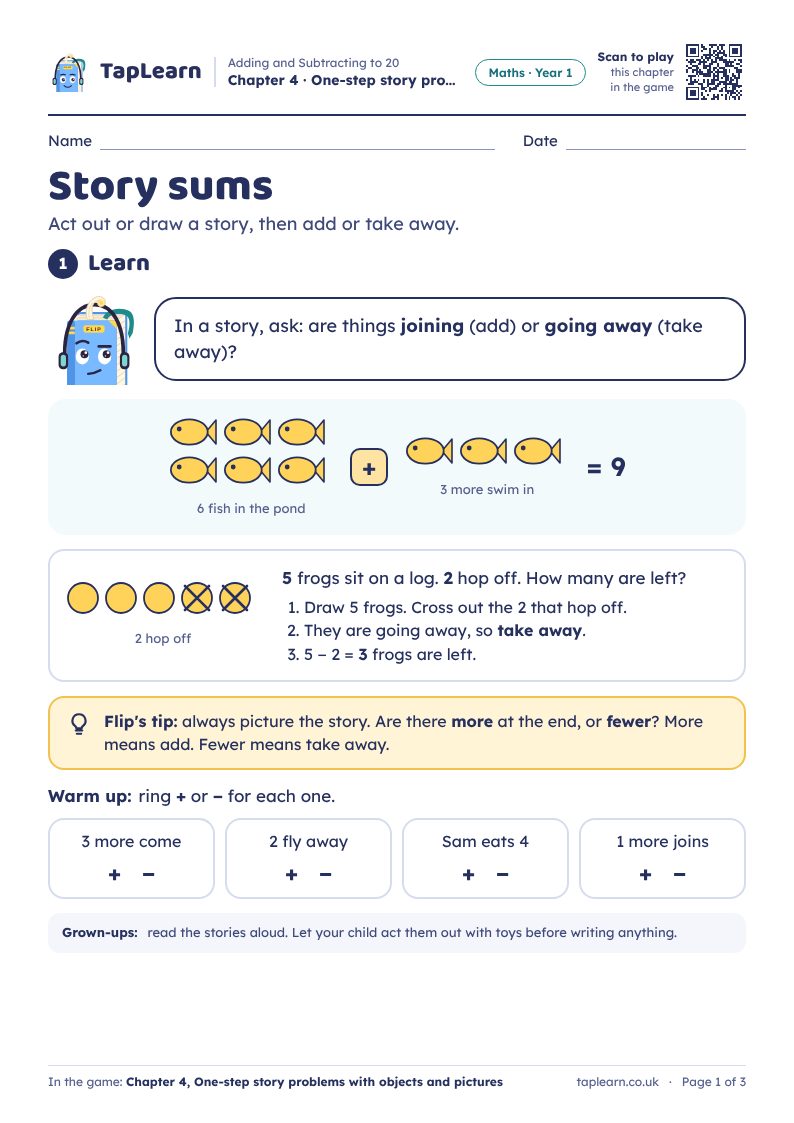
Story Sums is a printable story sums worksheet for Year 1 (ages 5 to 6) that teaches children to picture a story, decide if there are more or fewer at the end, and choose + or −. It covers the Year 1 maths statement to solve one-step problems involving addition and subtraction using objects and pictures.
Free to print, no account needed.
Print it on A4, in colour or black and white. Do it after the chapter, or before it to see what your child already knows.
What's on the worksheet
Your child solves one-step story problems by acting them out with objects or drawing them, then chooses + or − and writes the number sentence. Includes a story-time activity and an answers sheet.
- Page 1 · Learn
- 6 fish and 3 more swimming in, a worked example drawing 5 frogs and crossing out the 2 that hop off, Flip's tip that more means add and fewer means take away, and a ring-+-or-− warm-up.
- Page 2 · Try it together
- Story time: the grown-up tells a little story like "You have 6 ducks. 3 more float in", you act it out with toys, say whether it's add or take away, then swap storytellers.
- Page 3 · Practise
- Ring + or − and write number sentences for apple and fish stories, draw sticker, biscuit and bird stories, match stories to sentences, and a challenge about children leaving a pool.
- Answers sheet
- Every answer, mix-ups like writing 4 − 15, and story-swap and more-or-fewer ideas.
3 A4 pages and an answers sheet · about 20 minutes
Using it at home
- Read the stories aloud and let your child act them out with toys before writing anything.
- Snack time and bath time are great for story time. Keep the numbers to 20.
- On a walk, make up stories about things you see: "4 dogs, 1 more comes…"
Watch out for
- Choosing + when the story needs −, or the other way round.
- Ask "Will there be more or fewer at the end?" Acting it out with toys makes this clear.
- Writing the numbers in the wrong order for take away, like 4 − 15.
- Start with how many there were at the beginning.
Questions from the worksheet
- Ava has 4 apples. She picks 3 more. Ring + or −. Write the number sentence.
- Draw each story. Then write the number sentence: There are 15 biscuits. Leo eats 4.
- 11 birds sit on a fence. 0 fly away. Draw the story and write the number sentence.
- 14 children are in the pool. 3 get out. Mia says, "14 + 3 = 17." Is she right? Act it out to check.
The answers are on the answers sheet, for grown-ups.
National curriculum in England
This worksheet practises these statements from the Year 1 maths programme of study:
- Read, write and interpret mathematical statements involving addition (+), subtraction (−) and equals (=) signs
- Solve one-step problems that involve addition and subtraction, using concrete objects and pictorial representations, and missing number problems such as 7 = ? − 9
Source: National curriculum in England: mathematics programmes of study (DfE)
In the classroom
- Act out story sums with children as the fish or frogs joining and leaving.
- Tell a story and stop before the numbers, "Some birds fly away", and ask the class: more or fewer?
Questions and answers
How do you know whether to add or take away in a story problem?
Picture the story. If things are joining and there are more at the end, add. If things go away and there are fewer, take away.
Why act out story problems?
Using toys or drawings shows what is happening, so children can see whether there are more or fewer at the end.
What order do numbers go in a take-away sentence?
Start with how many there were at the beginning, then take away: 5 − 2 = 3, not 2 − 5.
 TapLearn