Number sentences worksheet for Year 1
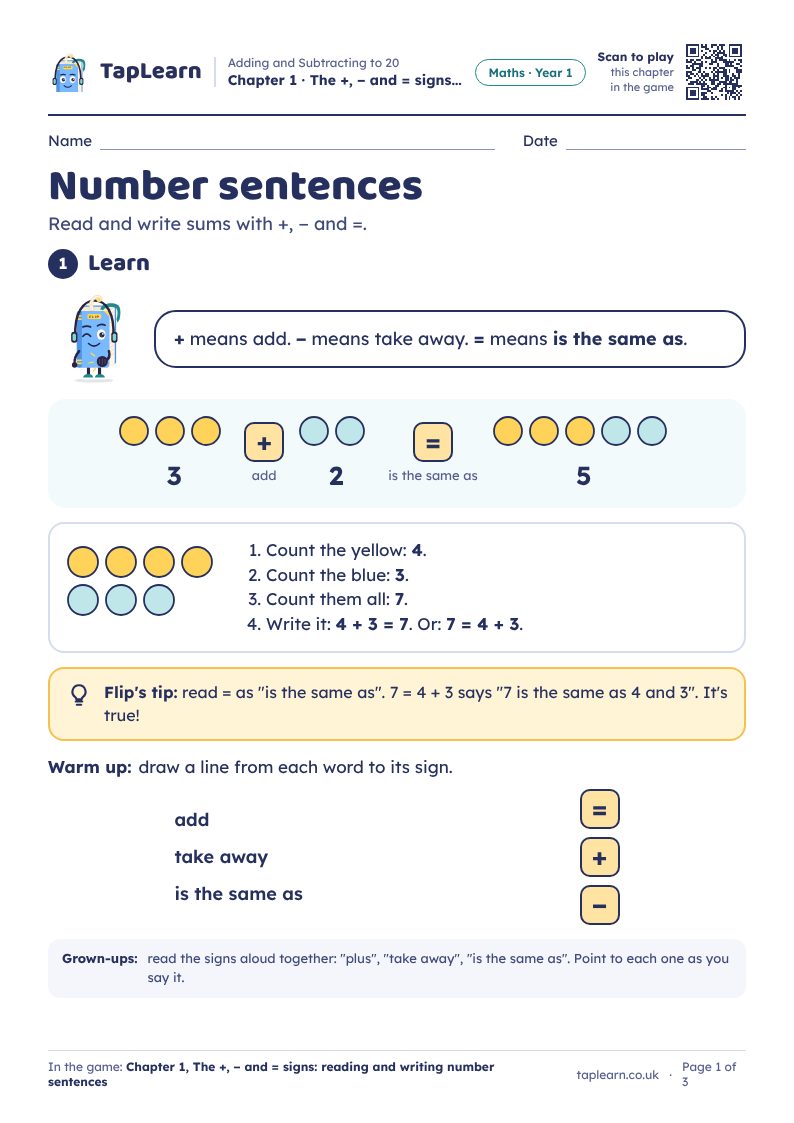
Number Sentences is a printable number sentences worksheet for Year 1 (ages 5 to 6) that teaches children what +, − and = mean and that the total can come first, as in 7 = 4 + 3. It covers the Year 1 maths statement to read, write and interpret statements involving the addition, subtraction and equals signs.
Free to print, no account needed.
Print it on A4, in colour or black and white. Do it after the chapter, or before it to see what your child already knows.
What's on the worksheet
Your child reads and writes number sentences with +, − and =, and learns that = means "is the same as", so 5 = 3 + 2 is true too. Includes a toy sums activity and an answers sheet.
- Page 1 · Learn
- What +, − and = mean, a worked example counting 4 yellow and 3 blue to write 4 + 3 = 7 and 7 = 4 + 3, Flip's tip to read = as "is the same as", and a match-the-sign warm-up.
- Page 2 · Try it together
- Toy sums: make two little groups of toys, push them together, write the number sentence like 3 + 2 = 5, then write it the other way round and check both are true.
- Page 3 · Practise
- Write + or − in sums, draw dots and cross out to show number sentences, write a sentence for each picture, decide if sentences like 6 = 6 are true, and a challenge.
- Answers sheet
- Every answer, mix-ups like thinking the answer must come at the end, and say-the-sentence and same-as ideas.
3 A4 pages and an answers sheet · about 20 minutes
In the classroom
- Run toy sums in pairs with cubes, writing each sentence both ways on mini-whiteboards.
- Use the true-or-false sentences in Practise D as a thumbs-up, thumbs-down starter.
Questions from the worksheet
- Write + or − in each box: 4 ☐ 1 = 5, 7 ☐ 3 = 4.
- Draw dots to show each number sentence. Cross out the ones taken away: 3 + 4 = 7, 6 − 2 = 4.
- Is it true? Ring yes or no: 5 = 3 + 2, 9 = 5 + 4, 6 = 6, 4 + 1 = 6.
- Sam says, "9 = 5 + 4 is wrong. The answer has to go at the end!" Is Sam right? Tell a grown-up why.
The answers are on the answers sheet, for grown-ups.
National curriculum in England
This worksheet practises this statement from the Year 1 maths programme of study:
- Read, write and interpret mathematical statements involving addition (+), subtraction (−) and equals (=) signs
Source: National curriculum in England: mathematics programmes of study (DfE)
Using it at home
- Read the signs aloud together, "plus", "take away", "is the same as", pointing to each one.
- In toy sums, you can also take some toys away and write a − sentence.
- Put 3 and 2 blocks next to a tower of 5 and ask "Is 5 the same as 3 and 2?"
Watch out for
- Thinking = means "the answer comes next", so 9 = 5 + 4 looks wrong.
- Say "is the same as" every time you read =.
- Mixing up + and −.
- Ask "Are we putting more in, or taking some away?" Then look at the picture again.
Questions and answers
What does the equals sign mean?
The equals sign means "is the same as". 7 = 4 + 3 says 7 is the same as 4 and 3.
Can the answer come before the equals sign?
Yes. The total can go at the start or the end, so 5 = 3 + 2 and 3 + 2 = 5 are both true.
What is a number sentence?
A number sentence uses numbers and signs to show a sum, like 4 + 3 = 7 or 6 − 2 = 4.
 TapLearn