Adding to 20 worksheet for Year 1: Counting on
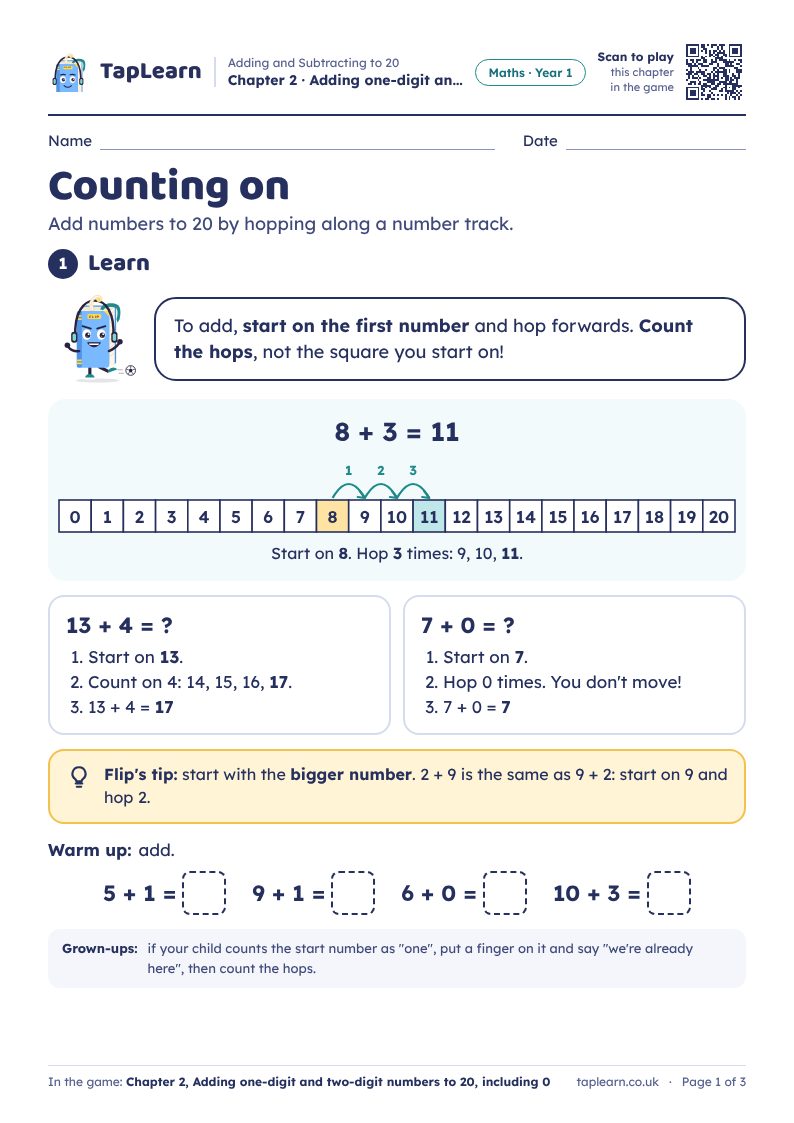
Counting On is a printable adding to 20 worksheet for Year 1 (ages 5 to 6) that teaches children to start on the first number and count the hops forwards, not the square they start on. It covers the Year 1 maths statement to add and subtract one-digit and two-digit numbers to 20, including 0.
Free to print, no account needed.
Print it on A4, in colour or black and white. Do it after the chapter, or before it to see what your child already knows.
What's on the worksheet
Your child adds one-digit and two-digit numbers to 20 by counting on along a number track, including adding 0. Includes a floor number track to jump along and an answers sheet.
- Page 1 · Learn
- 8 + 3 shown as hops on a 0 to 20 track, worked examples for 13 + 4 and 7 + 0, Flip's tip to start with the bigger number, and an adding warm-up.
- Page 2 · Try it together
- Floor hops: write 0 to 20 on paper and lay it on the floor, stand on the first number of a sum like 8 + 3, jump forwards counting the jumps aloud, then write where you land.
- Page 3 · Practise
- Draw hops on number tracks for sums like 11 + 4 and 9 + 0, count dots in tens and ones to write sums, add sums like 3 + 12 and 0 + 18, and a challenge about 8 + 3.
- Answers sheet
- Every answer, mix-ups like counting the start number, and stair-hops and clap-count ideas.
3 A4 pages and an answers sheet · about 20 minutes
In the classroom
- Make a class floor number track and have children hop out sums called by a partner.
- Use Practise C as a quick check, asking children which number they chose to start on.
Questions from the worksheet
- Draw the hops on the track. Write the answer: 6 + 3, 11 + 4, 14 + 5, 9 + 0.
- Add: 15 + 2, 3 + 12, 0 + 18, 17 + 3, 8 + 8, 11 + 0.
- Leo works out 8 + 3. He counts "8, 9, 10" and says the answer is 10. Is he right? What should he do?
The answers are on the answers sheet, for grown-ups.
National curriculum in England
This worksheet practises this statement from the Year 1 maths programme of study:
- Add and subtract one-digit and two-digit numbers to 20, including 0
Source: National curriculum in England: mathematics programmes of study (DfE)
Using it at home
- If your child counts the start number as "one", put a finger on it and say "we're already here", then count the hops.
- In floor hops, try a "jump 0" turn: your child stays still, then says what number they're on.
- On the stairs, say "we're on step 5, go up 3: which step now?"
Watch out for
- Counting the start number, so 8 + 3 becomes 10.
- Say the first number, then count on: "8… 9, 10, 11".
- Thinking adding 0 changes the number.
- Adding 0 means adding nothing, so the number stays the same.
- Starting with the small number in sums like 3 + 12.
- It's quicker to start on 12 and count on 3.
Questions and answers
What is counting on in addition?
Counting on means starting at the first number and counting forwards for the second, like 8… 9, 10, 11 for 8 + 3.
What happens when you add 0?
Adding 0 means adding nothing, so the number stays the same: 7 + 0 = 7.
Which number should you start on when counting on?
Start on the bigger number. 2 + 9 is the same as 9 + 2, so start on 9 and hop 2.
 TapLearn