Missing number problems worksheet for Year 1: Hidden numbers
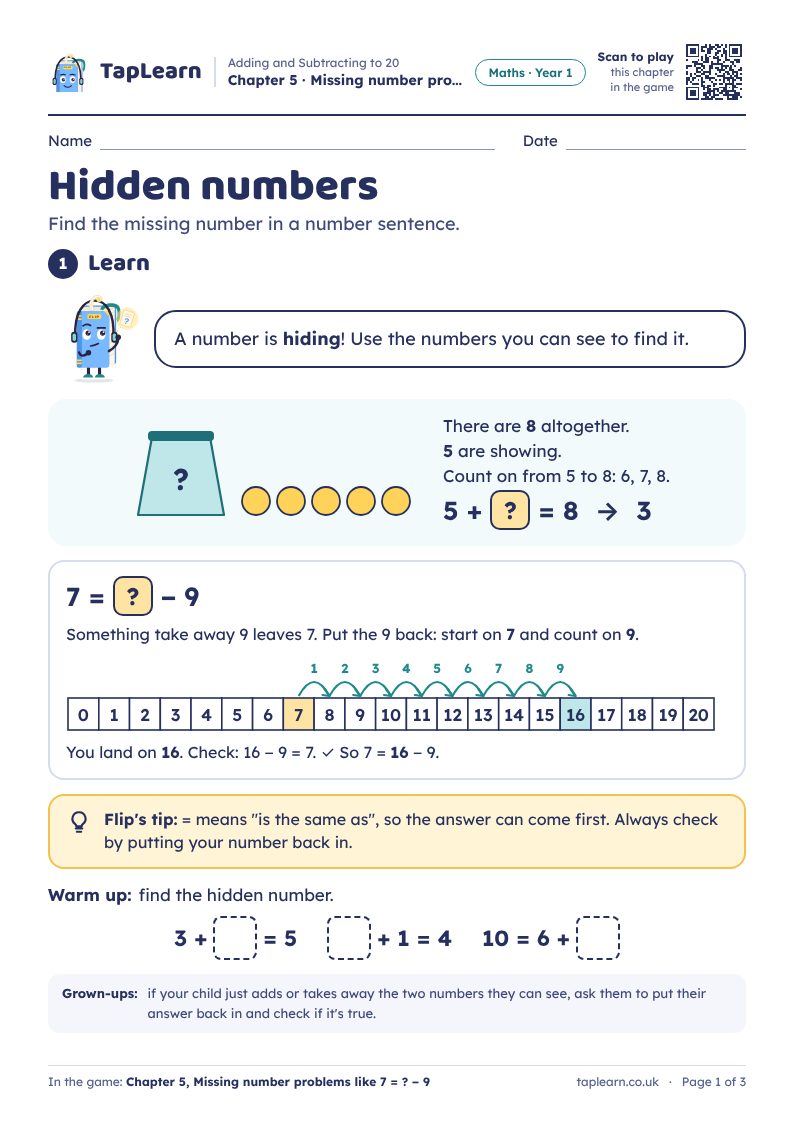
Hidden Numbers is a printable missing number problems worksheet for Year 1 (ages 5 to 6) that teaches children to use the numbers they can see to find a hidden one, then check by putting it back in. It covers the Year 1 maths statement to solve missing number problems such as 7 = ? − 9.
Free to print, no account needed.
Print it on A4, in colour or black and white. Do it after the chapter, or before it to see what your child already knows.
What's on the worksheet
Your child finds missing numbers in number sentences such as 5 + ? = 8 and 7 = ? − 9, using a number track and what's hiding under a cup. Includes an under-the-cup game and an answers sheet.
- Page 1 · Learn
- 8 altogether with 5 showing, a worked example for 7 = ? − 9 by counting on 9 from 7, Flip's tip that the answer can come first, and a find-the-hidden-number warm-up.
- Page 2 · Try it together
- Under the cup: the grown-up hides some buttons under a cup and says how many altogether, the child counts the ones showing, works out how many are hiding, then lifts the cup to check.
- Page 3 · Practise
- Find how many are hiding under cups, fill boxes in sums like ? + 4 = 11 and 7 = ? − 9 using the track, ring the number that makes it true, and a challenge about Leo writing 2.
- Answers sheet
- Every answer, mix-ups like using the two numbers shown, and fingers-behind-your-back and think-of-a-number ideas.
3 A4 pages and an answers sheet · about 20 minutes
Using it at home
- If your child just adds or takes away the two numbers they can see, ask them to put their answer back in and check.
- In under the cup, say the number sentence together each time: "5 and 3 more is the same as 8".
- Hold some fingers behind your back: "I have 10 fingers. 6 are showing. How many are hiding?"
Watch out for
- Using the two numbers shown, so 7 = ? − 9 becomes 2.
- Ask your child to put their number back in and check if it's true.
- Thinking the answer must come after =, so 13 = 10 + ? looks odd.
- Read = as "is the same as".
Questions from the worksheet
- How many are hiding under the cup? 12 altogether: 8 + ? = 12.
- Fill the box. Use the track if it helps: 5 + ? = 8, ? + 4 = 11, 13 = 10 + ?, 9 − ? = 6, ? − 2 = 10, 7 = ? − 9.
- Leo looks at 7 = ? − 9 and writes 2. Put 2 back in: is 2 − 9 the same as 7? What is the hidden number?
The answers are on the answers sheet, for grown-ups.
National curriculum in England
This worksheet practises these statements from the Year 1 maths programme of study:
- Read, write and interpret mathematical statements involving addition (+), subtraction (−) and equals (=) signs
- Solve one-step problems that involve addition and subtraction, using concrete objects and pictorial representations, and missing number problems such as 7 = ? − 9
Source: National curriculum in England: mathematics programmes of study (DfE)
In the classroom
- Play under the cup with the class using a visualiser and counters.
- Use Practise C as a mini-whiteboard check, with children showing the number that makes each sentence true.
Questions and answers
How do you solve a missing number problem in Year 1?
Use the numbers you can see to find the hidden one, often by counting on, then put it back in to check. For 5 + ? = 8, count on from 5 to 8: 3.
How do you solve 7 = ? − 9?
Something take away 9 leaves 7, so put the 9 back: start on 7 and count on 9 to reach 16. Check: 16 − 9 = 7.
Why check by putting the number back in?
It shows whether the sentence is true. If 2 − 9 isn't 7, then 2 can't be the hidden number.
 TapLearn