Prefixes and Suffixes: Year 1 Word Workshop with Pip
Learn Year 1 prefixes and suffixes: add s, es, ing, ed, er and est, and use un, by dragging tiles onto words in a lively word workshop.
- Ages 5–7
- About 40 min
- Easy start
- Phonics & Spelling
Learn Year 1 prefixes and suffixes: add s, es, ing, ed, er and est, and use un, by dragging tiles onto words in a lively word workshop.
Year 1 english · 1 Year 1 english · 2
Year 1 english · 1
Year 1 english · 3 Year 1 english · 4
Year 1 english · 3
Year 1 english · 5 Year 1 english · 6
What the chapters cover in the national curriculum in England:
Prefixes and Suffixes: Year 1 Word Workshop is an interactive game that teaches children aged 5–7 how adding s, es, ing, ed, er, est and the prefix un changes words, following the Year 1 English curriculum in England.
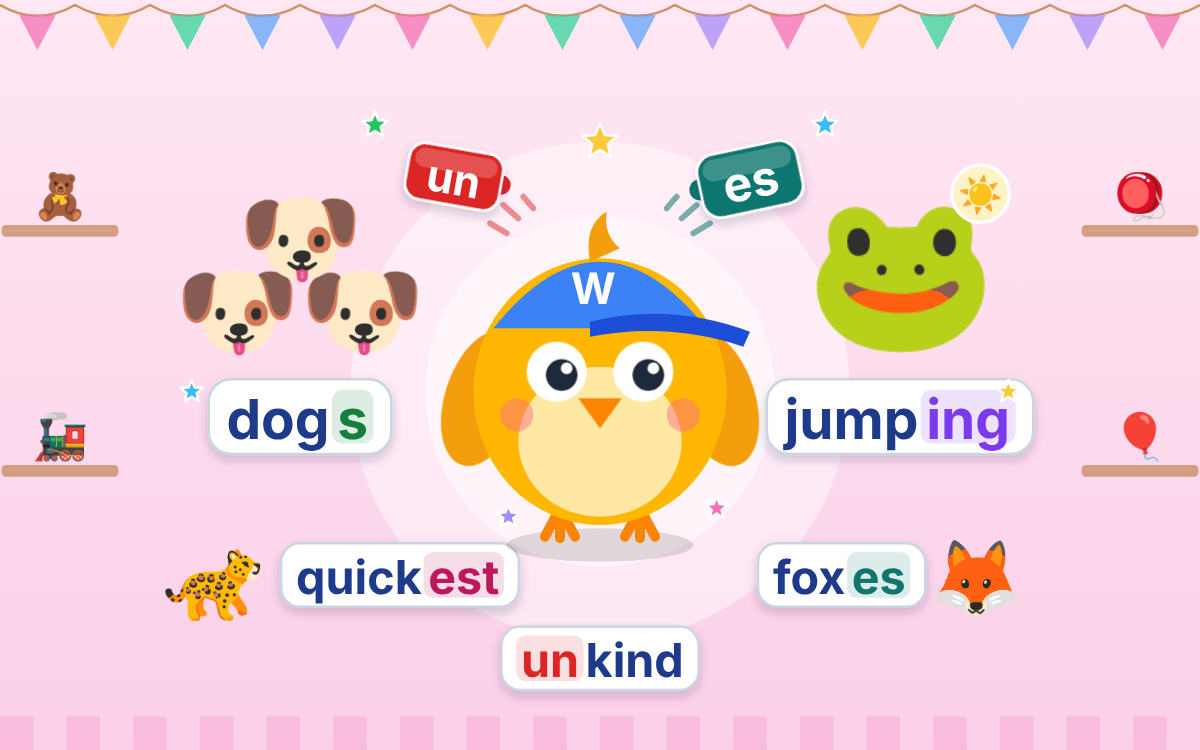
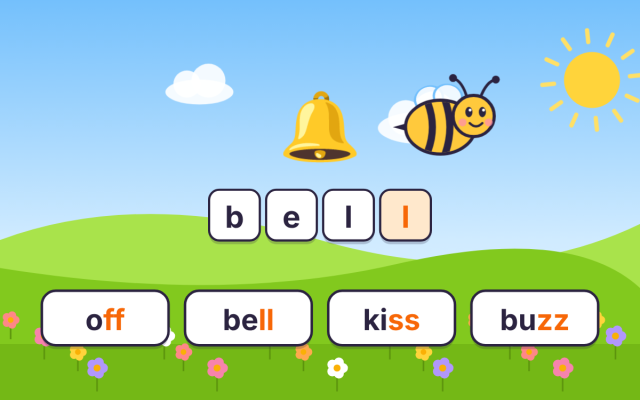
A suffix is an ending added to a root word, and a prefix goes at the start. Children drag or tap ending tiles onto root words and watch the pictures change: one dog becomes three dogs, a sapling grows taller and a boat is untied and sails away. They clap syllable beats to hear when a plural needs es, sort word cards into baskets and choose the right ending to finish sentences.
Pip, a friendly bird, reads every instruction aloud, so early readers can play on their own. A 10-question challenge at the end mixes all the endings together.
A suffix is a group of letters added to the end of a root word to change its meaning or how it is used. Adding s to dog makes dogs, and adding ing to jump makes jumping.
Add es when the plural has an extra beat, or syllable, as in fox and foxes or wish and wishes. This usually happens when a word ends in s, x, z, sh or ch. Otherwise, just add s, as in cats.
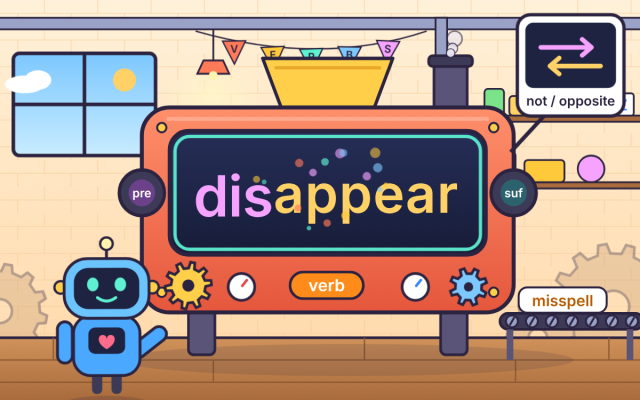
The prefix un usually means not or undo. Unkind means not kind, while untie means to undo a knot. Un always goes at the start of the root word, and the spelling of the root word stays the same.
It is made for children aged 5 to 7 and matches the Year 1 English curriculum in England. Older children who need extra practice with plurals, ing and ed endings or the prefix un will also find it useful.
The game has five short chapters, each with an animated introduction, hands-on activities and a recap, plus a 10-question final challenge. Playing everything takes about 40 minutes, and children can start any chapter from the map.
 TapLearn
Getting it ready…
Great work on chapter 1! To open the next chapters, ask a grown-up to take a look.
To play this game, ask a grown-up to take a look. There are lots of free games you can play right now too!
Create a free family account and your child can play every chapter of every game for 7 days, with no card needed. Their progress is kept. After that, the free plan is free for ever, and membership is £6.99 a month if you'd like to keep every chapter.
That's all the learning time for today. Great work! Flip will be ready to play again tomorrow.