Rounding Numbers is a free interactive game that teaches children aged 7–10 how to round whole numbers to the nearest 10, 100 and 1,000, and decimals to the nearest whole number. It follows the Year 4 rounding objectives in the KS2 maths curriculum.
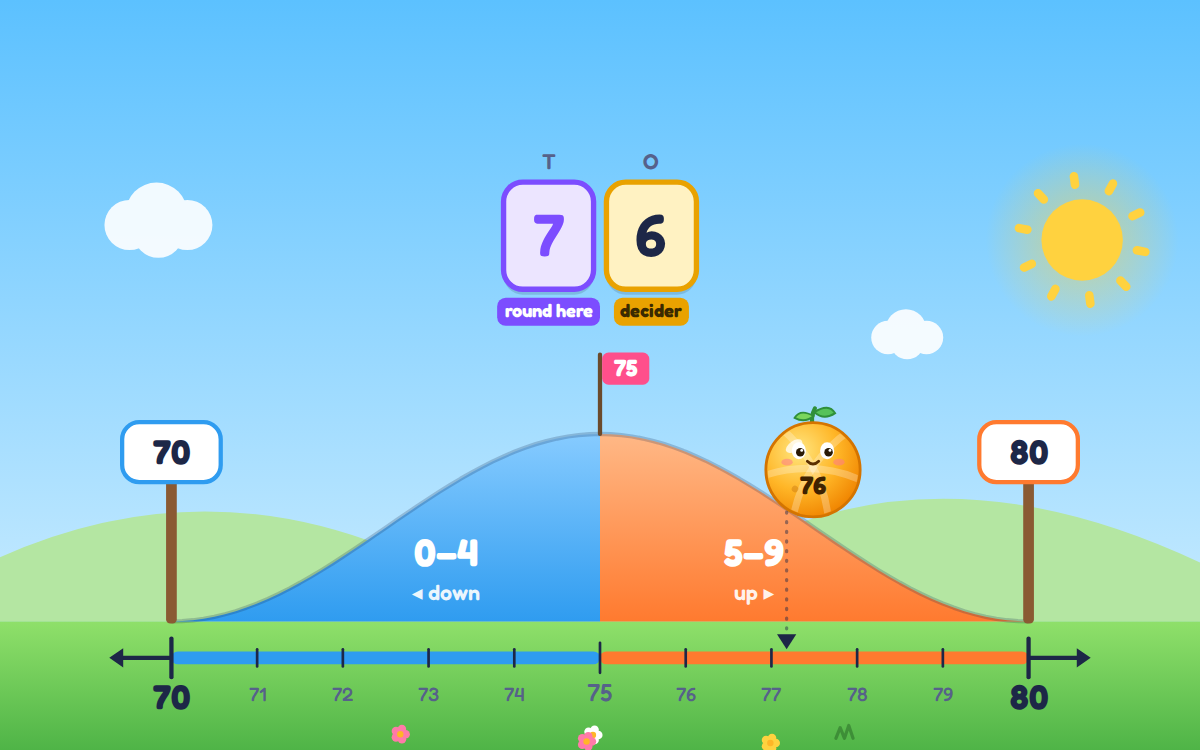
Children build each idea step by step with Pip, a talking ball who loves rolling down hills. They draw a number line, tap the two multiples a number sits between and watch a hill grow with the halfway point at its top. Wherever Pip stands, he rolls to the nearer multiple, and from exactly halfway he always rolls up.
Next, they use place value: tap the digit in the rounding place, then the digit to its right, which decides the answer. Digits 0–4 round down and 5–9 round up. A mixed Roll Rally challenge tests everything at the end.
Questions and answers
How do you round a number to the nearest 10?
To round to the nearest 10, look at the ones digit: if it is 5 or more, round up to the next ten, and if it is 4 or less, round down. For example, 73 rounds to 70 and 78 rounds to 80.
Why do numbers ending in 5 round up?
Numbers ending in 5 sit exactly halfway between two multiples, so the school rule is that halfway always rounds up. This gives everyone the same answer, which is why 75 rounds to 80 and 3.5 rounds to 4.
How do you round a decimal to the nearest whole number?
To round a decimal to the nearest whole number, look at the tenths digit just after the decimal point. If it is 5 or more, the ones digit goes up by one; if it is 4 or less, the ones digit stays the same, so 3.7 rounds to 4.
What age is this rounding game for?
This game is designed for children aged 7 to 10 and matches the Year 4 rounding objectives in the UK National Curriculum. Younger players can start with Tens Hill, while confident children can jump straight to the Roll Rally challenge.
What does the rounding game include and how long does it take?
The game has five guided chapters, from Tens Hill to Decimal Dunes, plus an eight-question Roll Rally challenge, and takes about 30 minutes to play through. Pip reads every instruction aloud, and progress is saved so children can carry on later.
Can we count your visit? We'd like to use one cookie, only on this site, to see how families find and use TapLearn, so we can make it better. No adverts, and nothing is shared. How we measure
Create a free family account and your child can play every chapter of every game for 7 days, with no card needed. Their progress is kept. After that, the free plan is free for ever, and membership is £6.99 a month if you'd like to keep every chapter.

 TapLearn