What children learn about time, year by year
The national curriculum in England builds telling the time up slowly:
- Reception: time words in everyday routines, such as before, after, morning, night and "first, then".
- Year 1: o'clock and half past, and drawing the hands on a clock face to show them. Children also learn the days of the week, the months, and words like today, yesterday and tomorrow.
- Year 2: quarter past and quarter to, and telling the time to five minutes. Children learn that there are 60 minutes in an hour and 24 hours in a day.
- Year 3: reading an analogue clock to the nearest minute, including clocks with Roman numerals from I to XII. Children also learn 12-hour and 24-hour times, am and pm, noon and midnight, seconds, and how many days there are in each month and in a leap year.
- Year 4: converting between analogue and digital times, in both 12-hour and 24-hour form.
Children get there at different speeds. Telling the time often clicks only after lots of real-life practice, so don't worry if it takes a while.
Analogue or digital first?
Schools start with the analogue clock (the one with hands), and it's worth doing the same at home. A clock face shows time moving and shows how much of the hour is left, which is how children come to understand "quarter to" or "ten minutes until". A digital display is easier to read aloud, but "8:45" doesn't tell a child that it's nearly 9 o'clock.
Your child will see both kinds every day, so as they learn each analogue time, show them the digital version next to it. "Half past four" is the same as 4:30.
Step by step at home
- Get a clock your child can see. An analogue clock at their eye level, or a simple watch, makes a big difference.
- Start with the short hand only. Cover the minute hand and ask: "Which number is the short hand pointing at, or just past?" This gives a rough time on its own, such as "just after 3".
- O'clock and half past. Link them to real events: "Tea is at 5 o'clock", "Swimming is at half past 10."
- Quarters. Fold a paper circle, or cut a pizza or a sandwich, into quarters to show "quarter past" and "quarter to".
- Count in fives. Count round the clock in fives, from 5 at the 1 up to 60 at the 12. This uses the 5 times table, and it's the key to "twenty past" and "twenty-five to".
- Minutes past, then minutes to. Children usually find "to" harder, because the counting goes backwards from the 12. Give it extra time.
- Durations. Ask "How long until...?" and "How long did it take?", and use a kitchen timer.
Everyday ideas
- Put your child in charge of telling you when it's time to leave, or when the oven timer is nearly done.
- Read the times off TV listings, cinema times or bus and train timetables, which often use the 24-hour clock.
- Make a simple picture timetable for a weekend day with clock faces drawn on it.
- Play "What time will it be in half an hour?" in the car or on the walk to school.
- Look out for Roman numerals on church clocks, watches and clock towers.
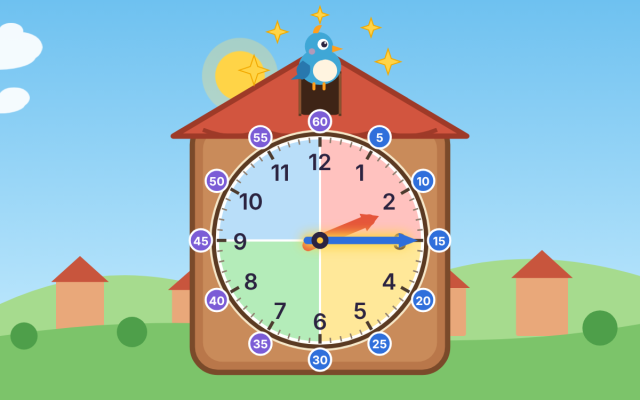
Telling the Time: Fix the Clocks of Time Town with Koo
Learn all about telling the time: read clocks to five minutes, quarter past and quarter to, draw the hands an…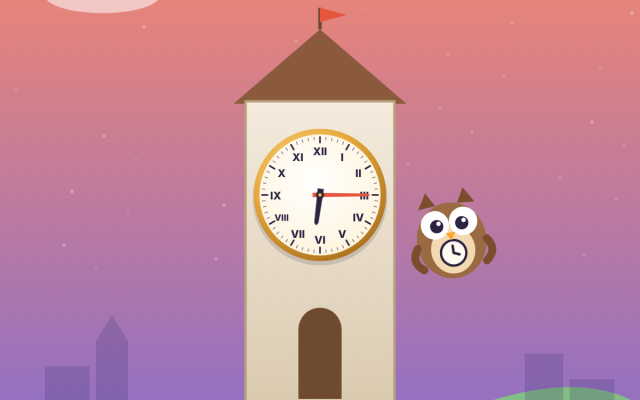
Telling the Time: A Clock Town Adventure with Tock the Owl
Learn telling the time on Roman numeral, 12-hour and 24-hour clocks, then set clock hands, sort am and pm and…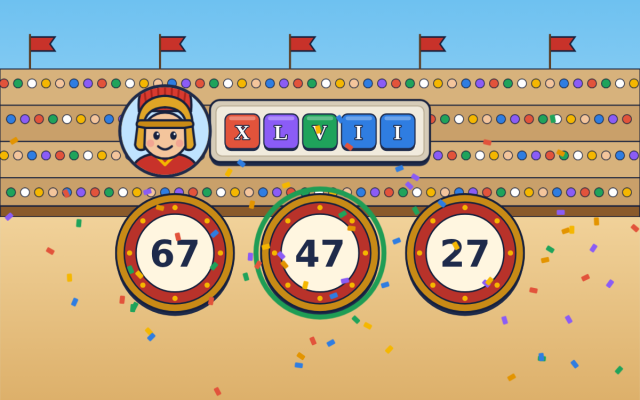
Roman Numerals: A Quest Through Ancient Rome with Cato
Learn to read Roman numerals from I to C by counting apples, calling up Roman soldiers, opening Colosseum gat…- Chapter 1 of Telling the Time: Fix the Clocks of Time Town with KooQuarter past, half past and quarter toCan tell quarter past, half past and quarter to on a clockFree taster
- Chapter 2 of Telling the Time: Fix the Clocks of Time Town with KooMinutes past the hour: counting in fivesCan tell and write the time to five minutes, past and to the hourMembers
- Chapter 2 of Telling the Time: A Clock Town Adventure with Tock the OwlTelling the time to the nearest minute: past and toCan read and estimate the time to the nearest minute, using past and toMembers
If it isn't clicking yet
Lots of children mix up the two hands, or say "twenty past" when they mean "twenty to". Go back one step, use real clocks rather than worksheets, and keep sessions short. Ask the class teacher which step your child is working on at school, so you're both practising the same thing. On TapLearn, the skills report shows which times your child is secure with and which mix-ups are worth a closer look.
 TapLearn