Statutory spellings worksheet for Year 3: Tricky must-know words
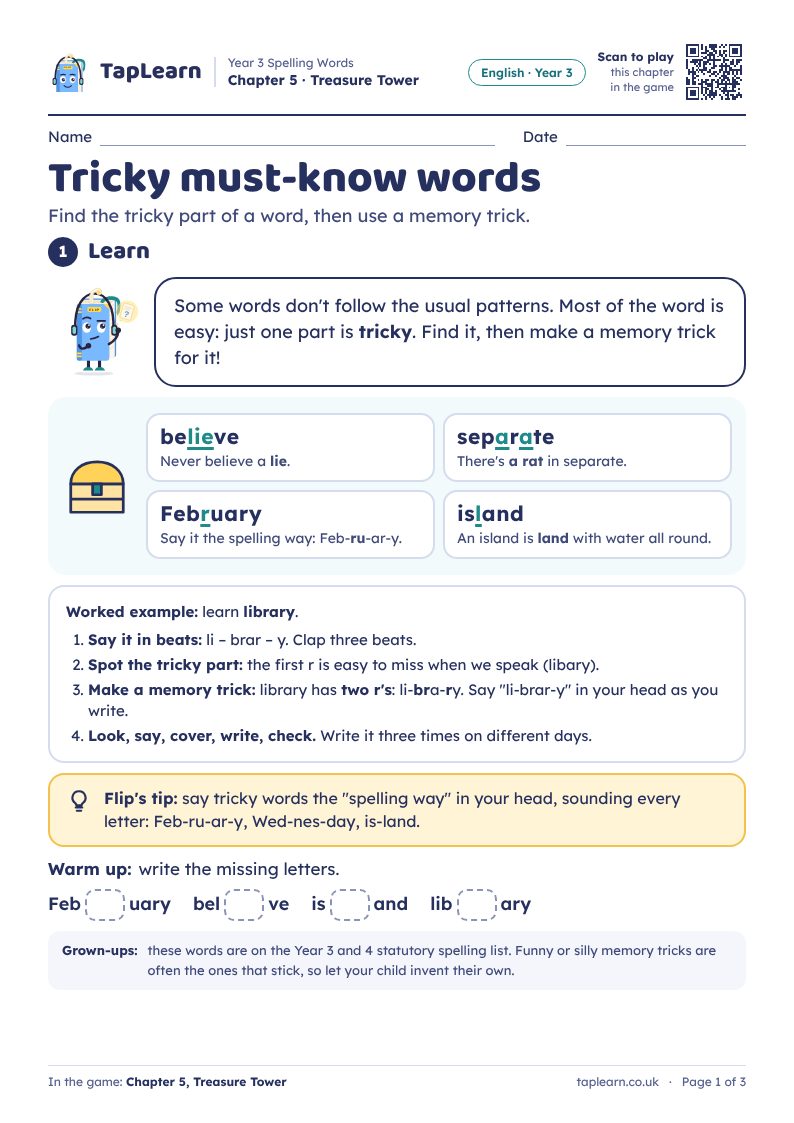
Tricky Must-know Words is a printable statutory spellings worksheet for Year 3 (ages 7 to 8) that teaches children to find the one tricky part of a word like believe or February and make a memory trick for it. On the sheet, children use look, say, cover, write, check and write memory tricks for words on the Year 3 and 4 list.
This worksheet is for members
Membership opens every chapter of every game and every worksheet, for all your children.
See the plansAlready a member? Log in to print it.
Start with the free one: Sneaky sound spellings (chapter 1).
Print it on A4, in colour or black and white. Do it after the chapter, or before it to see what your child already knows.
What's on the worksheet
Your child spells Year 3 must-know words like believe, separate, February and island by finding the tricky part and using a memory trick. Includes a look, say, cover, write, check activity and an answers sheet.
- Page 1 · Learn
- Believe, separate, February and island with memory tricks, a worked example learning library, Flip's tip to say words the spelling way, and a missing-letters warm-up.
- Page 2 · Try it together
- Look, say, cover, write, check: underline the tricky part of believe, surprise, height, favourite and grammar, say it the spelling way, cover it, write it from memory and check.
- Page 3 · Practise
- Ring the correct spelling, write the must-know word for each clue, underline the tricky part of words like caught and women and write a memory trick, and a challenge about beleive.
- Answers sheet
- Every answer, mix-ups like Febuary and hieght, and three-a-day and trick-swap ideas.
3 A4 pages and an answers sheet · about 25 minutes
In the classroom
- Play trick swap: pupils invent silly memory tricks for tricky words and share them.
- Use Practise A as a quick spelling check on mini whiteboards.
Questions from the worksheet
- Draw a ring round the correct spelling: beleive / believe, seperate / separate, Febuary / February, libary / library, hieght / height.
- Write the must-know word that matches each clue: The month after January. A place where you can borrow books. Land with water all around it.
- Underline the tricky part of each word. Then write a memory trick for one of them: caught, straight, women, busy, answer, guard.
- Sam wrote: "I beleive in dragons." He says, "It sounds right, so it must be right." Is he right? How could he remember the spelling?
The answers are on the answers sheet, for grown-ups.
Using it at home
- These words are on the Year 3 and 4 statutory spelling list. Funny or silly memory tricks often stick, so let your child invent their own.
- In look, say, cover, write, check, talk about the tricky parts: surprise (the r after su), height (eigh, like eight), grammar (two m's).
- Pick three must-know words a day and spell them aloud at breakfast and again at bedtime.
Watch out for
- Spelling by sound, like iland, enuff or suprise.
- Ask, "Is this a word we can sound out, or a tricky one?"
- Missing a sound that's hard to hear, like Febuary or libary.
- Say it the spelling way, sounding every letter.
- Swapping letters round, like beleive or hieght.
- Use a memory trick for the tricky part, like a lie in believe.
Questions and answers
What are statutory spellings in Year 3?
Statutory spellings are the words on the Year 3 and 4 word list that children are expected to spell, like believe, February, island and separate.
How can children remember how to spell believe?
Use a memory trick for the tricky part: never believe a lie. The word lie is hidden inside believe.
What is look, say, cover, write, check?
It's a way to learn a spelling: look at the word, say it, cover it, write it from memory, then check it letter by letter.
 TapLearn