Suffixes worksheet for Year 3: Adding suffixes
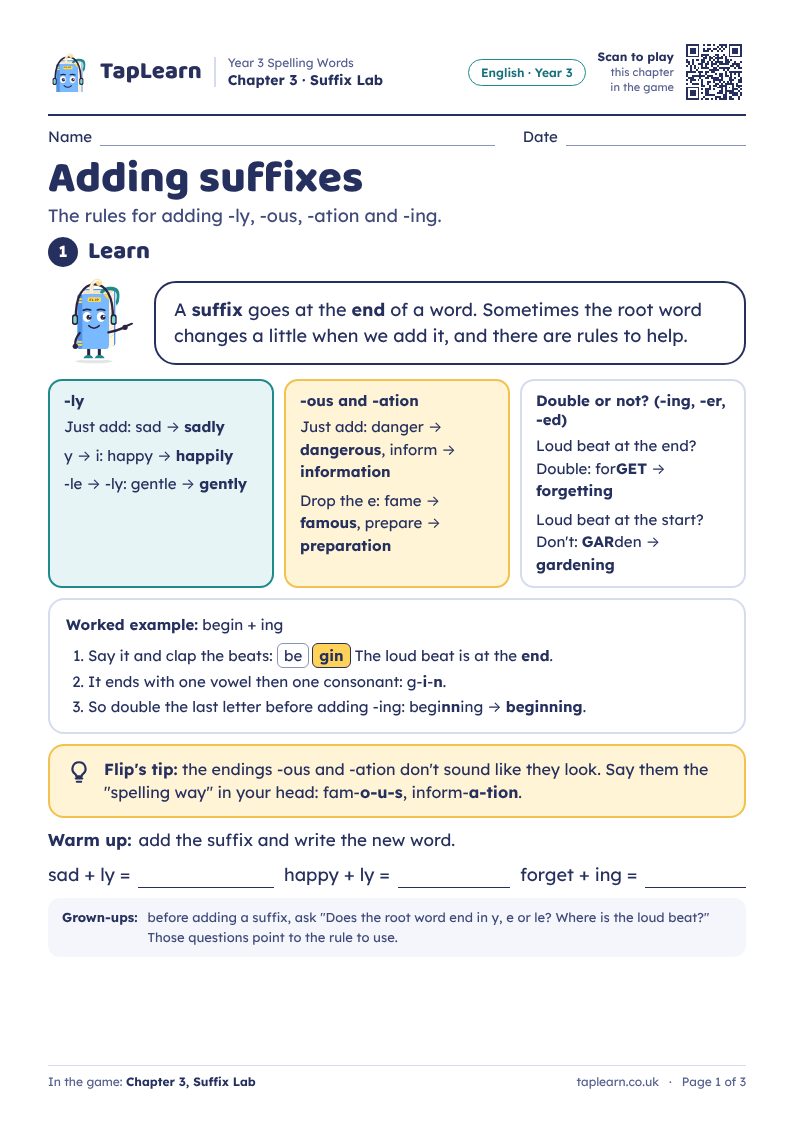
Adding Suffixes is a printable suffixes worksheet for Year 3 (ages 7 to 8) that teaches the rules for adding -ly, -ous, -ation and -ing, including changing y to i and doubling the last letter when the loud beat is at the end. On the sheet, children clap words, add suffixes and fix spellings like happyly and begining.
This worksheet is for members
Membership opens every chapter of every game and every worksheet, for all your children.
See the plansAlready a member? Log in to print it.
Start with the free one: Sneaky sound spellings (chapter 1).
Print it on A4, in colour or black and white. Do it after the chapter, or before it to see what your child already knows.
What's on the worksheet
Your child adds -ly, -ous, -ation and -ing using the rules: change y to i (happily), drop the e (famous) and double the last letter when the loud beat is at the end (beginning). Includes a clap-and-double game and an answers sheet.
- Page 1 · Learn
- The rules for -ly, -ous and -ation and for doubling, a worked example adding ing to begin by clapping the beats, Flip's tip to say endings the spelling way, and a warm-up.
- Page 2 · Try it together
- Clap and double: the grown-up says words like forget, garden and visit, you clap each beat with a big clap on the loud one, and double the last letter only if it's at the end.
- Page 3 · Practise
- Add -ly, decide whether to double, add -ous or -ation, fix six mistakes, add suffixes to finish sentences, and a challenge about gardenning.
- Answers sheet
- Every answer, mix-ups like famus and informashun, and clap-off and -ly-actions ideas.
3 A4 pages and an answers sheet · about 25 minutes
In the classroom
- Play clap-off as a starter: say forget, garden, begin, limit and pupils call "double" or "no double".
- Use Practise D as an editing task in pairs.
Questions from the worksheet
- Add -ly to make a new word: quick, angry, simple, busy, final, humble.
- Double the last letter or not? Write the new word: begin + er, garden + er, forget + ing, limit + ed, prefer + ed, visit + ing.
- Add -ous or -ation. Write the new word: poison + ous, fame + ous, inform + ation, prepare + ation.
- Each word has a mistake. Write it correctly: happyly, begining, famus, gardenning, informashun.
- Sam wrote gardenning. He says, "It's like beginning, so it needs a double n." Is he right? Explain using the loud beat.
The answers are on the answers sheet, for grown-ups.
Using it at home
- Before adding a suffix, ask, "Does the root word end in y, e or le? Where is the loud beat?" Those questions point to the rule.
- In clap and double, exaggerate the loud beat (GAR-den, be-GIN). Saying it with the beat in the wrong place sounds silly and helps.
- Act out happily, angrily and gently, then spell each word aloud.
Watch out for
- Forgetting to change y to i, like happyly or angryly.
- If the word ends in a consonant then y, the y becomes i.
- Forgetting to double, like begining or forgeting.
- Clap it: loud beat at the end means double.
- Spelling endings by sound, like famus or informashun.
- The endings are always spelt -ous and -ation.
Questions and answers
When do you double the last letter before adding -ing?
Double it when the loud beat is at the end of the word and it ends in one vowel then one consonant: begin becomes beginning, but garden becomes gardening.
When does y change to i?
When a word ends in a consonant then y, change the y to i before adding -ly: happy becomes happily.
How do you spell words ending in -ous?
The ending is always spelt -ous, even though it sounds like "us": famous, dangerous, poisonous.
 TapLearn