Prefixes worksheet for Year 3: Prefix power
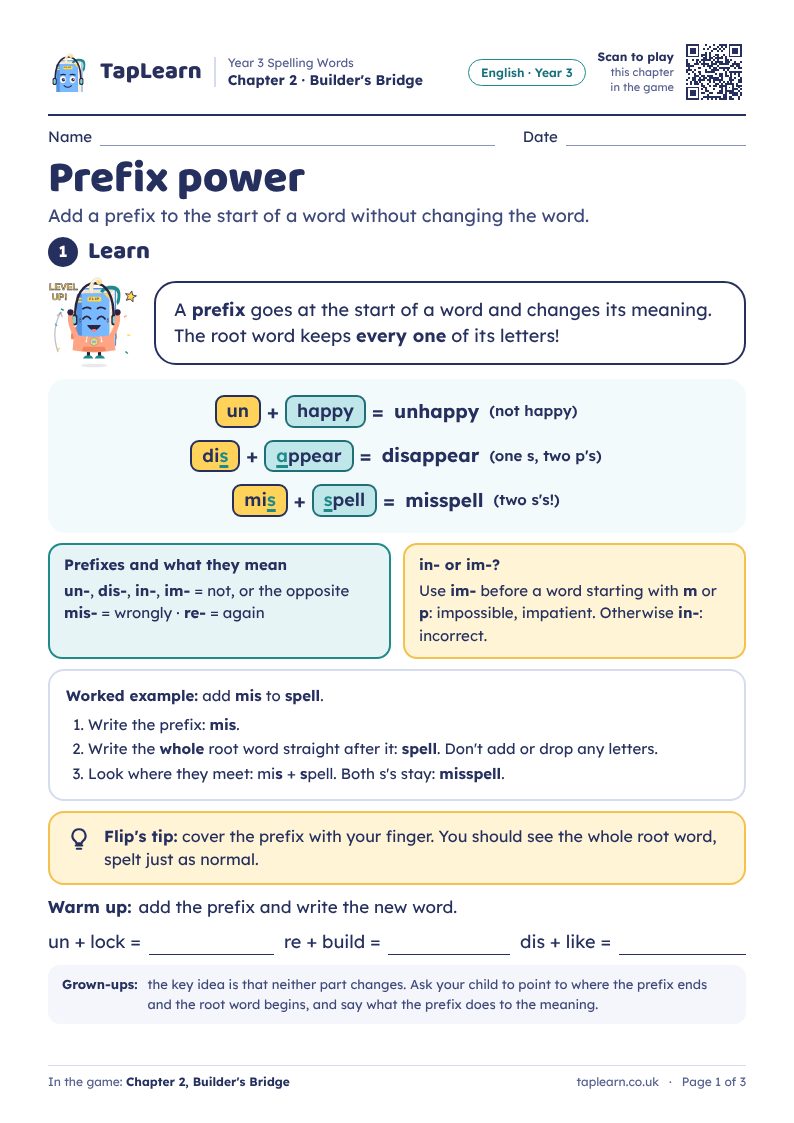
Prefix Power is a printable prefixes worksheet for Year 3 (ages 7 to 8) that teaches children that un-, dis-, mis-, re- and im- change a word's meaning while the root word keeps every letter. On the sheet, children join prefixes to root words, make opposites and fix spellings like dissappear and mispell.
This worksheet is for members
Membership opens every chapter of every game and every worksheet, for all your children.
See the plansAlready a member? Log in to print it.
Start with the free one: Sneaky sound spellings (chapter 1).
Print it on A4, in colour or black and white. Do it after the chapter, or before it to see what your child already knows.
What's on the worksheet
Your child adds prefixes like un-, dis-, mis-, re- and im- without changing the root word, so disappear keeps one s and misspell keeps two. Includes a flip-the-meaning card game and an answers sheet.
- Page 1 · Learn
- Unhappy, disappear and misspell built from parts, what each prefix means, when to use im- or in-, a worked example adding mis to spell, Flip's finger tip, and a warm-up.
- Page 2 · Try it together
- Flip the meaning: lay out prefix cards, turn over root words like happy, agree and possible, slide the right prefix in front, then say and write the new word and its meaning.
- Page 3 · Practise
- Match prefixes to root words, join prefixes keeping every letter, make opposites with un, dis or im, fix three mistakes, write a sentence, and a challenge about mispell.
- Answers sheet
- Every answer, mix-ups like unpossible, and opposite ping-pong and prefix-spotter ideas.
3 A4 pages and an answers sheet · about 20 minutes
In the classroom
- Play opposite ping-pong as a starter: say a word and pupils write its opposite with a prefix.
- Use Practise D as a mini-whiteboard spelling check.
Questions from the worksheet
- Join the prefix and the root word. Keep every letter! dis + appear, mis + spell, un + natural, im + patient, re + write.
- Make the opposite. Write un, dis or im in each box: tidy, honest, perfect, lucky, polite, connect.
- Each word has a mistake. Write it correctly: dissappear, mispell, unpossible.
- Mia wrote mispell. She says, "When you add mis, you drop one s." Is she right? Explain.
The answers are on the answers sheet, for grown-ups.
Using it at home
- Ask your child to point to where the prefix ends and the root word begins, and say what the prefix does to the meaning.
- In flip the meaning, if your child tries "unpossible", say, "Close! It starts with p, so which prefix do we use?"
- Spot prefixes on packaging or in books (refill, unwrap, reuse) and say what they mean.
Watch out for
- Adding an extra letter where the prefix joins, like dissappear.
- Cover the prefix: is "appear" spelt correctly?
- Dropping a letter where the prefix joins, like mispell or unatural.
- Both parts keep every letter, so sometimes you get a double letter.
- Choosing the wrong prefix, like unpossible.
- Say both versions aloud; remember im- before m and p.
Questions and answers
What is a prefix?
A prefix is a group of letters added to the start of a word to change its meaning, like un in unhappy or re in rewrite.
Why does misspell have two s's?
The prefix never changes the root word. Mis ends in s and spell starts with s, so both stay: misspell.
When do you use im instead of un?
Use im- before words starting with m or p, as in impossible and impatient.
 TapLearn